HiPP UK Growing Up Milk HiPP Organic Growing Up Milk, 800 g tin

We earn a commission when you buy through links on this page, including from our partner retailer, which sells and ships the order. How this site is funded →
The answer
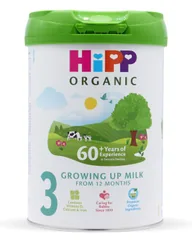
HiPP UK Growing Up Milk is HiPP's organic milk for toddlers from twelve months in the United Kingdom, sold in an 800 g tin printed in English. The tin's legal name calls it a follow on milk from the twelfth month, and HiPP UK says a toddler needs about 350 ml a day, from a beaker. It adds galacto-oligosaccharides but no lactic culture. The NHS says children aged one to five do not need formula milks, growing-up milks included.
Key takeaways
- Labelled from twelve months, organic, made up in a beaker rather than a bottle.
- The tin's legal name is follow on milk from the twelfth month onwards; HiPP UK sells it as Growing Up Milk.
- HiPP UK says about 350 ml a day, made with water boiled and left for no more than 30 minutes.
- The NHS says children from one to five do not need formula milks, and pasteurised whole cow's milk can be the main drink from one.
What is in HiPP UK Growing Up Milk?
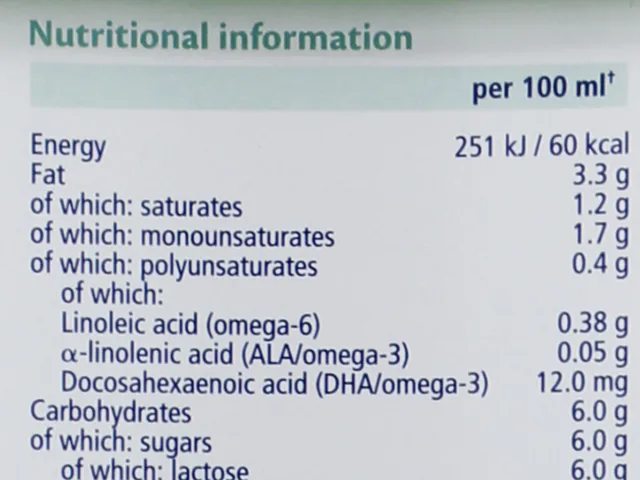
The first ingredients are organic skimmed milk, organic lactose and organic palm, rapeseed and sunflower oil, with no whey; fish oil adds DHA at 12 mg per 100 ml, and HiPP adds galacto-oligosaccharides made from organic lactose. No lactic culture is listed.1
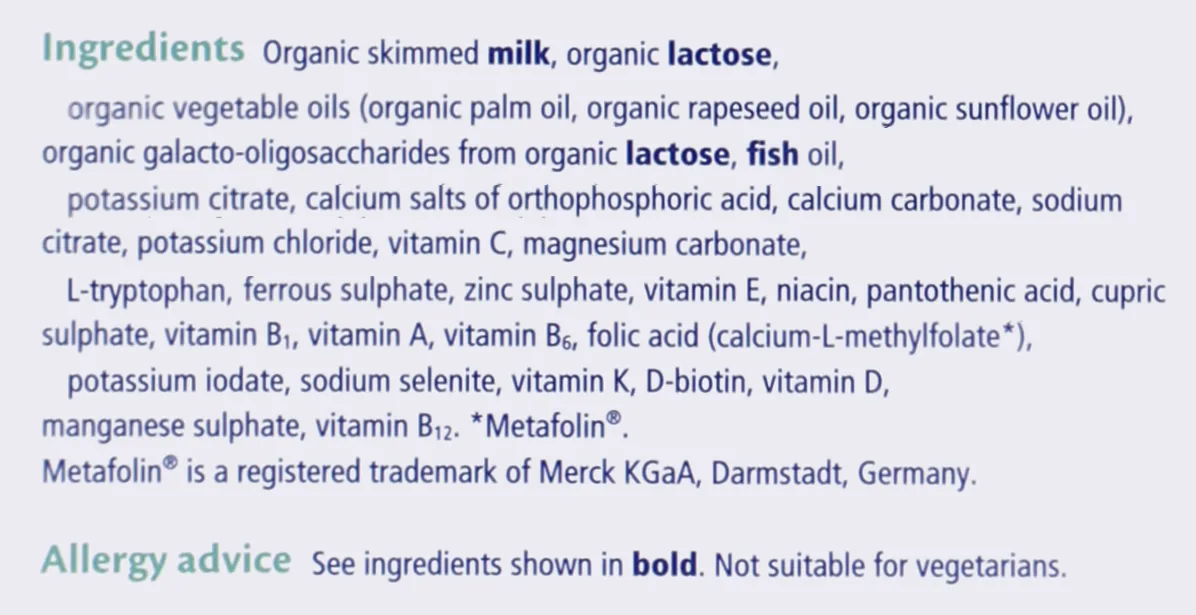
Nutrition per 100 ml, prepared
| Nutrient | Per 100 ml | Per 100 kcal | EU min to max |
|---|---|---|---|
| Energy, fat, carbohydrate and protein | |||
| Energy | 60 kcal | 100 kcal | 60 to 70 kcal per 100 ml |
| Fat | 3.3 g | 5.5 g | 4.4 to 6.0 g |
| of which saturates | 1.2 g | 2.0 g | |
| of which monounsaturates | 1.7 g | 2.8 g | |
| of which polyunsaturates | 0.4 g | 0.67 g | |
| Linoleic acid | 0.38 g | 0.63 g | |
| Alpha-linolenic acid | 0.05 g | 0.083 g | |
| DHA | 12.0 mg | 20 mg | 20 to 50 mg |
| Carbohydrate | 6.0 g | 10.0 g | 9 to 14 g |
| of which sugars | 6.0 g | 10 g | |
| of which lactose | 6.0 g | 10.0 g | min 4.5 g |
| Fibre | 0.4 g | 0.67 g | |
| GOS | 0.4 g | 0.67 g | max 0.8 g per 100 ml |
| Protein | 1.4 g | 2.3 g | 1.8 to 2.5 g |
| Minerals | |||
| Sodium | 20 mg | 33 mg | |
| Potassium | 80 mg | 133 mg | |
| Chloride | 45 mg | 75 mg | |
| Calcium | 73 mg | 122 mg | 50 to 140 mg |
| Phosphorus | 41 mg | 68 mg | |
| Magnesium | 7.5 mg | 12 mg | |
| Iron | 0.90 mg | 1.5 mg | 0.6 to 2 mg |
| Zinc | 0.50 mg | 0.83 mg | |
| Copper | 0.048 mg | 0.08 mg | |
| Manganese | 0.0040 mg | 0.0067 mg | |
| Fluoride | < 0.010 mg | < 0.017 mg | |
| Selenium | 3.5 µg | 5.8 µg | |
| Iodine | 14 µg | 23 µg | |
| Vitamins | |||
| Vitamin A | 49 µg | 82 µg | |
| Vitamin D | 1.6 µg | 2.7 µg | 2 to 3 µg |
| Vitamin E | 0.80 mg | 1.3 mg | |
| Vitamin K | 3.4 µg | 5.7 µg | |
| Vitamin C | 9.2 mg | 15 mg | |
| Vitamin B1 | 0.045 mg | 0.075 mg | |
| Vitamin B2 | 0.13 mg | 0.22 mg | |
| Niacin | 0.30 mg | 0.5 mg | |
| Vitamin B6 | 0.046 mg | 0.077 mg | |
| Folate | 19.2 µg | 32 µg | |
| Vitamin B12 | 0.17 µg | 0.28 µg | |
| Biotin | 2.5 µg | 4.2 µg | |
| Pantothenic acid | 0.31 mg | 0.52 mg | |
Values from HiPP's label for the United Kingdom, checked 15 October 2026. The last column is the range for follow-on formula in Regulation (EU) 2016/127, Annex II, per 100 kcal unless it says per 100 ml. The label prints values per 100 ml only, so the per 100 kcal column is calculated from them.
Every value is the one printed on the tin for 100 ml made from 11.9 g of powder and 90 ml of water.11 The tin photographed here differs from HiPP UK's page on four rows: a little less saturated fat, a little more monounsaturated fat and linoleic acid, and folate where the page gives folic acid. The table follows the tin.111
How do you prepare it?
Wash your hands and the equipment. Boil a litre of freshly run water and leave it to cool for no longer than 30 minutes, then measure the water into a beaker and add one level scoop, about 4 g, for each fluid ounce, about 30 ml.1
Put the cap on, shake it until the powder dissolves, cool it under the cold tap to around body temperature and test it before your toddler drinks it; HiPP UK says to make each feed fresh.1
| Water | Scoops | Powder | Feed size | Water temp. |
|---|---|---|---|---|
| 30 ml · 1 fl oz | 1 | 4.0 g | 33 ml · 1.1 fl oz | Boiled, then cooled for no more than 30 minutes |
| 90 ml · 3 fl oz | 3 | 12.0 g | 100 ml · 3.4 fl oz | Boiled, then cooled for no more than 30 minutes |
| 120 ml · 4 fl oz | 4 | 16.0 g | 133 ml · 4.5 fl oz | Boiled, then cooled for no more than 30 minutes |
| 150 ml · 5 fl oz | 5 | 20.0 g | 167 ml · 5.6 fl oz | Boiled, then cooled for no more than 30 minutes |
| 180 ml · 6 fl oz | 6 | 24.0 g | 200 ml · 6.8 fl oz | Boiled, then cooled for no more than 30 minutes |
| 210 ml · 7 fl oz | 7 | 28.0 g | 233 ml · 7.9 fl oz | Boiled, then cooled for no more than 30 minutes |
One scoop is 4 g, level, not packed. The feed size column is the volume in the bottle after the powder dissolves.
How much should a baby drink?
| Boiled water | Scoops |
|---|---|
| 120 ml | 4 |
| 150 ml | 5 |
The pack gives bottle sizes rather than ages, so this is what it prints and all it prints. How much a child takes varies, and a hungry or sleepy child is a better guide than the table.
HiPP UK puts a toddler's day at about 350 ml, as a drink, on cereal or in other food, and its guide gives two beakers and no ages.1
Who is it for, and who is it not for?
It is for children from twelve months.1
The NHS says children aged one to five do not need formula milks, growing-up and toddler milks included, and that pasteurised whole or semi-skimmed cow's milk can be the main drink from one. The American Academy of Pediatrics also advises whole cow's milk from twelve months, and the European Food Safety Authority found young-child formula no more necessary than a normal diet.456
It is made from cow's milk and contains fish oil, so it is not for a child with a diagnosed cow's milk protein allergy.1
The same stage in other markets
| Market | Product | Size | Starch | Ships to the United States | Sold by Organic Life Start |
|---|---|---|---|---|---|
| United Kingdom | HiPP Organic Growing Up Milk (this page) | 800 g tin | No | Yes | Yes, US and CA |
| Germany | HiPP Kindermilch Combiotik 1+ | 600 g box | No | Yes | Yes, US and CA |
| Netherlands | HiPP 3 Bio Combiotik | 800 g tin | No | Yes | Yes, US and CA |
| Germany | HiPP 3 Bio Combiotik | 600 g box | Yes | Yes | Yes, US and CA |
What buyers say
386 reviews of this product, gathered from the sellers' own review pages, all of them counted in the rating. The newest are below as their buyers wrote them, each showing where it was written and linking to it; a review is one buyer's experience, not evidence. The rating is this product's alone, never pooled with other products or with a seller's store rating, and milkatlas edits none of them.
- Organic Life Start5.0 · 295
- Organic Formula Shop4.9 · 61
- Formuland4.9 · 30
- Organic's Best0.0 · 0
★★★★★ Van U. Verified buyer on Organic Life Start
The formula dissolves so easily into cool or warm water without leaving any stubborn clumps at the bottom of the sippy cup.
★★★★★ Lucca M. Verified buyer on Organic Life Start
My 13-month-old grandson is officially walking and loves to explore the local park. This toddler milk mixes up incredibly fast in his sippy cup and keeps him happily energized for our afternoon outings.
★★★★★ Sindy A. Verified buyer on Formuland
I highly recommend HiPP formula! My baby has done really well with it. It’s very nutritious, gentle on my baby’s stomach, and easy to digest. We’ve had a great experience with this formula, and I feel very comfortable giving it to my baby. I would definitely recommend it to other parents! 🍼💕
★★★★★ Isiah B. Verified buyer on Organic Life Start
Hipp UK is okay as a meal replacement. It keeps the pickiest babies (I have one!) full and nourished.
Questions parents ask
Does my toddler need HiPP UK Growing Up Milk?
Most do not. The NHS says children aged one to five do not need formula milks, growing-up milks included, and that pasteurised whole or semi-skimmed cow's milk can be the main drink from one. The American Academy of Pediatrics advises whole cow's milk from twelve months for most children.
Why does the tin call it a follow on milk?
Its legal name, printed at the foot of the tin, is organic follow on milk from the twelfth month onwards; HiPP UK sells it under the name Growing Up Milk. EU law does not define a separate category for young-child formula.
How much HiPP UK Growing Up Milk should a toddler drink?
About 350 ml a day, HiPP UK says, as a drink, on cereal or in other food, and it calls that a guide only.
What is the difference between HiPP UK Growing Up Milk and Follow On Milk?
Growing Up Milk is labelled from twelve months and Follow On Milk from six. Per 100 ml, Growing Up Milk has less energy and fat, a little more protein, and less iron and calcium; it has no whey in its ingredients and takes a smaller scoop, about 4 g to each fluid ounce of water.
How do you make up HiPP UK Growing Up Milk?
In a beaker: boil a litre of fresh water and leave it to cool for no more than 30 minutes, add one level scoop to each fluid ounce, shake it until the powder dissolves, cool it to around body temperature, test it and give it straight away.
Is it organic?
Yes. The tin says it is certified organic in line with UK and EU rules, and HiPP UK lists the milk, the lactose and the oils as organic.
Does it contain probiotics?
No lactic culture is listed in the ingredients HiPP UK gives, unlike HiPP's German and Dutch Combiotik packs. It adds galacto-oligosaccharides made from organic lactose.
Is HiPP UK Growing Up Milk sold in the United States?
Not by HiPP. It is made in Germany for the UK market, and the sellers that offer it in the US import it.
Sources
- HiPP UK, product page for HiPP Organic Growing Up Milk from 12 months, article number GB2079-04, ingredients, the full nutrition table per 100 ml, standard dilution, scoop of about 4 g, preparation in a beaker, storage after opening, Product of Germany, about 350 ml a day fetched 22 September 2026
- The partner retailer's listing for HiPP UK Growing Up Milk, which carries the current pack 800 g, article number and organic certification, and the legal name printed on the tin: organic follow on milk from the 12th month onwards; and the photograph of an earlier print of its nutrition panel, read on 25 September 2026 fetched 18 September 2026
- NHS, Making up baby formula boil the water, then leave it to cool for no more than 30 minutes, so that it stays at 70 °C or more fetched 18 September 2026
- NHS, Types of formula first infant formula through the first year; no benefit in switching to follow-on formula at six months; never under six months; no evidence that babies settle better on formula with more casein; goat, comfort, anti-reflux, hypoallergenic and growing-up milks fetched 18 September 2026
- American Academy of Pediatrics, Most toddlers don't need toddler formula toddler formulas are unnecessary for most children; whole cow's milk from 12 months; 20 October 2023 fetched 18 September 2026
- European Food Safety Authority, press release on young-child formula young-child formula has no unique role and does not bring additional value to a balanced diet; 25 October 2013 fetched 18 September 2026
- European Commission, Report on young-child formulae, COM(2016) 169, 31 March 2016 young-child formulae are not defined in EU legislation; EFSA: no unique role, cannot be considered a necessity; general food law sufficient to regulate them fetched 18 September 2026
- HiPP UK, product page for HiPP Comfort Milk, questions and answers how to make a bottle with HiPP formula: water boiled and left for no longer than 30 minutes, which needs to stay at around 70 °C fetched 18 September 2026
- Regulation (EU) 2016/127 compositional requirements for infant formula (Annex I) and follow-on formula (Annex II) fetched 18 September 2026
- HiPP Germany, product page for Kindermilch Combiotik 1+ a milk drink for children from one year; not organic fetched 18 September 2026
- The partner retailer's photographs of the Growing Up Milk tin the pack photo, and its ingredients list, nutrition table, preparation and feeding guide, read on 15 October 2026; the source of the nutrition table, where this tin prints less saturated and more monounsaturated fat and more linoleic acid than HiPP UK's page gives, and folate where the page gives folic acid; the article number GB2079-04 and the barcode 4062300460522 on its back fetched 15 October 2026
Corrections (1)
- The nutrition table had followed HiPP UK's product page, which an earlier photograph of the tin matched. The current tin, in the photographs added to this page on 15 October 2026, prints 1.2 g of saturated and 1.7 g of monounsaturated fat per 100 ml where the page gives 1.4 g and 1.5 g, and 0.38 g of linoleic acid where it gives 0.36 g. It also calls its folate row folate, at 19.2 µg, where the page gives folic acid at 11.3 µg; both give it as 15 % of the reference value. Every other row is the same. The table now follows the tin, as the page says it will when the two disagree.