HiPP German Stage 3 HiPP 3 Bio Combiotik, 600 g box

We earn a commission when you buy through links on this page, including from our partner retailer, which sells and ships the order. How this site is funded →
The answer
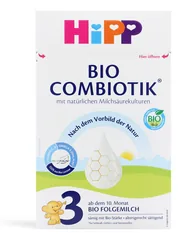
HiPP German Stage 3 is the last follow-on formula in HiPP's German organic range, labelled from the tenth month of life, which begins when a baby is nine months old. It has more starch than Stage 2, 1.4 g per 100 ml, which HiPP says makes it creamier and more filling for the age. It comes in a 600 g box, one 4.5 g scoop per 30 ml of water. HiPP suggests it after Stage 2; nothing on the box says a baby needs it.
Key takeaways
- Labelled from the tenth month of life, which begins at nine months, as part of a mixed diet.
- It has 1.4 g of organic starch per 100 ml, where Stage 2 has 1.2 g; the rest of the panel is close to Stage 2's.
- HiPP says moving on through the stages is possible but not required, so a baby can stay on Stage 2.
- From twelve months the American Academy of Pediatrics advises whole cow's milk for most children, not a formula.
What is in HiPP German Stage 3?
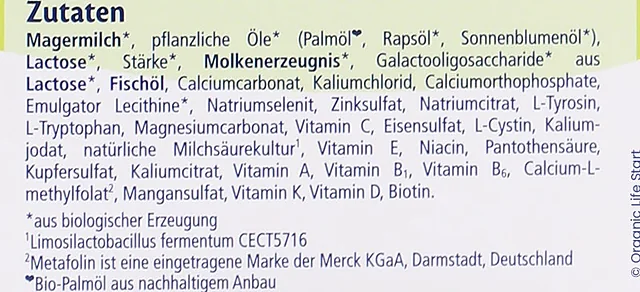
The base is organic skimmed milk and an organic whey product, and the carbohydrate is lactose with more organic starch than Stage 2, 1.4 g per 100 ml. HiPP says the higher share of starch makes it creamier and suitably filling for the age.210
The fat is organic palm, rapeseed and sunflower oil, with fish oil for DHA at 13.6 mg per 100 ml, and HiPP adds galacto-oligosaccharides, a prebiotic, and the lactic culture Limosilactobacillus fermentum CECT5716.2
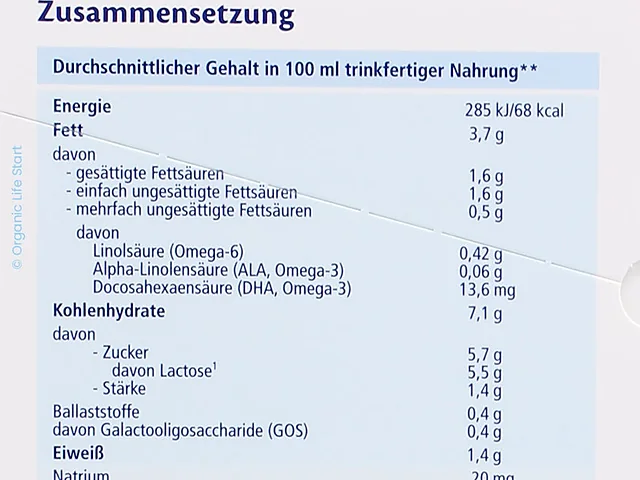
Nutrition per 100 ml, prepared
| Nutrient | Per 100 ml | Per 100 kcal | EU min to max |
|---|---|---|---|
| Energy, fat, carbohydrate and protein | |||
| Energy | 68 kcal | 100 kcal | 60 to 70 kcal per 100 ml |
| Fat | 3.7 g | 5.4 g | 4.4 to 6.0 g |
| of which saturates | 1.6 g | 2.4 g | |
| of which monounsaturates | 1.6 g | 2.4 g | |
| of which polyunsaturates | 0.5 g | 0.74 g | |
| Linoleic acid | 0.42 g | 0.62 g | |
| Alpha-linolenic acid | 0.06 g | 0.088 g | |
| DHA | 13.6 mg | 20 mg | 20 to 50 mg |
| Carbohydrate | 7.1 g | 10.4 g | 9 to 14 g |
| of which sugars | 5.7 g | 8.4 g | |
| of which lactose | 5.5 g | 8.1 g | min 4.5 g |
| of which starch | 1.4 g | 2.1 g | no limit set |
| Fibre | 0.4 g | 0.59 g | |
| GOS | 0.4 g | 0.59 g | max 0.8 g per 100 ml |
| Protein | 1.4 g | 2.1 g | 1.8 to 2.5 g |
| Minerals | |||
| Sodium | 20 mg | 29 mg | |
| Potassium | 88 mg | 129 mg | |
| Chloride | 52 mg | 76 mg | |
| Calcium | 77 mg | 113 mg | 50 to 140 mg |
| Phosphorus | 44 mg | 65 mg | |
| Magnesium | 6.3 mg | 9.3 mg | |
| Iron | 1.0 mg | 1.5 mg | 0.6 to 2 mg |
| Zinc | 0.50 mg | 0.74 mg | |
| Copper | 0.054 mg | 0.079 mg | |
| Manganese | 0.0070 mg | 0.01 mg | |
| Fluoride | < 0.010 mg | < 0.015 mg | |
| Selenium | 3.9 µg | 5.7 µg | |
| Iodine | 15 µg | 22 µg | |
| Vitamins | |||
| Vitamin A | 56 µg | 82 µg | |
| Vitamin D | 1.6 µg | 2.4 µg | 2 to 3 µg |
| Vitamin E | 0.80 mg | 1.2 mg | |
| Vitamin K | 3.9 µg | 5.7 µg | |
| Vitamin C | 10 mg | 15 mg | |
| Vitamin B1 | 0.051 mg | 0.075 mg | |
| Vitamin B2 | 0.15 mg | 0.22 mg | |
| Niacin | 0.53 mg | 0.78 mg | |
| Vitamin B6 | 0.042 mg | 0.062 mg | |
| Folic acid | 11.3 µg | 17 µg | |
| Vitamin B12 | 0.10 µg | 0.15 µg | |
| Biotin | 1.6 µg | 2.4 µg | |
| Pantothenic acid | 0.35 mg | 0.51 mg | |
Values from HiPP's label for Germany, checked 18 September 2026. The last column is the range for follow-on formula in Regulation (EU) 2016/127, Annex II, per 100 kcal unless it says per 100 ml. The label prints values per 100 ml only, so the per 100 kcal column is calculated from them.
Every value is the one HiPP prints for 100 ml of made-up feed, which is 13.5 g of powder in 90 ml of water. Beside Stage 2 it has more starch, less lactose and a little more protein.210
How do you prepare it?
Boil fresh drinking water and let it cool to 40 to 50 °C, pour it into the bottle and add one level scoop (4.5 g) for every 30 ml. Shake it hard, cool it to about body temperature and check it before the feed; HiPP says to make each bottle fresh.2
| Water | Scoops | Powder | Feed size | Water temp. |
|---|---|---|---|---|
| 30 ml · 1 fl oz | 1 | 4.5 g | 33 ml · 1.1 fl oz | 40 to 50 °C · 104 to 122 °F |
| 90 ml · 3 fl oz | 3 | 13.5 g | 100 ml · 3.4 fl oz | 40 to 50 °C · 104 to 122 °F |
| 120 ml · 4 fl oz | 4 | 18.0 g | 133 ml · 4.5 fl oz | 40 to 50 °C · 104 to 122 °F |
| 150 ml · 5 fl oz | 5 | 22.5 g | 167 ml · 5.6 fl oz | 40 to 50 °C · 104 to 122 °F |
| 180 ml · 6 fl oz | 6 | 27.0 g | 200 ml · 6.8 fl oz | 40 to 50 °C · 104 to 122 °F |
| 210 ml · 7 fl oz | 7 | 31.5 g | 233 ml · 7.9 fl oz | 40 to 50 °C · 104 to 122 °F |
One scoop is 4.5 g, level, not packed. The feed size column is the volume in the bottle after the powder dissolves.
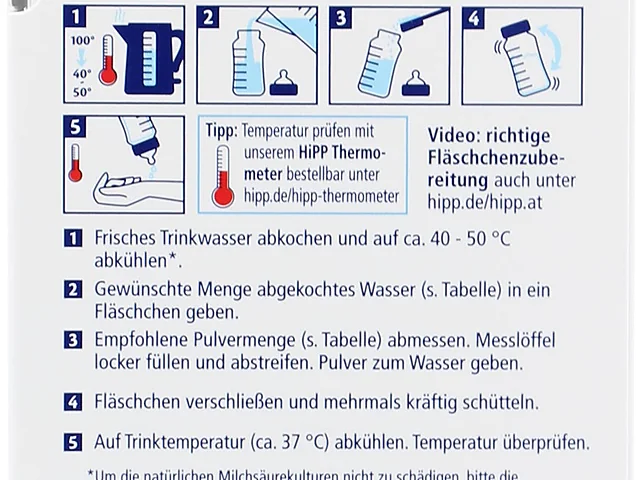
- Frisches Trinkwasser abkochen und auf ca. 40 - 50 °C abkühlen*.
- Boil fresh drinking water and let it cool to about 40 to 50 °C.
- Gewünschte Menge abgekochtes Wasser (s. Tabelle) in ein Fläschchen geben.
- Pour the amount of boiled water you need (see the table) into a bottle.
- Empfohlene Pulvermenge (s. Tabelle) abmessen. Messlöffel locker füllen und abstreifen. Pulver zum Wasser geben.
- Measure the powder the table gives. Fill the scoop loosely and level it off. Add the powder to the water.
- Fläschchen verschließen und mehrmals kräftig schütteln.
- Close the bottle and shake it hard several times.
- Auf Trinktemperatur (ca. 37 °C) abkühlen. Temperatur überprüfen.
- Let it cool to drinking temperature, about 37 °C, and check it.
How much should a baby drink?
| Made-up bottle | Boiled water | Scoops |
|---|---|---|
| 170 ml | 150 ml | 5 |
| 200 ml | 180 ml | 6 |
| 235 ml | 210 ml | 7 |
The pack gives bottle sizes rather than ages, so this is what it prints and all it prints. How much a child takes varies, and a hungry or sleepy child is a better guide than the table. The pack says a child needs about 5 of these a day.
The box gives the same three bottles as Stage 2, with no ages against them, and the same guide: each fully introduced solid meal replaces one.2
Who is it for, and who is it not for?
It is for babies from the tenth month of life who eat solid food, after Stage 2 or another follow-on formula, the box says, and HiPP suggests it for a baby who no longer seems full.2
HiPP says moving on through its stages is possible but not required, and the NHS says a first formula can stay the main drink through the first year. From twelve months, the American Academy of Pediatrics advises whole cow's milk for most children and calls toddler formulas unnecessary.7611
It is made from cow's milk and contains fish oil, so it is not for a baby with a diagnosed cow's milk protein allergy, and it is not lactose-free.26
The same stage in other markets
| Market | Product | Size | Starch | Ships to the United States | Sold by Organic Life Start |
|---|---|---|---|---|---|
| Germany | HiPP 3 Bio Combiotik (this page) | 600 g box | Yes | Yes | Yes, US and CA |
| Netherlands | HiPP 3 Bio Combiotik | 800 g tin | No | Yes | Yes, US and CA |
| United Kingdom | HiPP Organic Growing Up Milk | 800 g tin | No | Yes | Yes, US and CA |
HiPP makes a separate range for each market. The Dutch Stage 3 is also a follow-on formula, labelled from ten months, with no starch and less energy per 100 ml; the UK Growing Up Milk, from twelve months, is close to the Dutch tin, with slightly different fats and vitamin C, and folate where the Dutch tin prints folic acid.1213
What buyers say
742 reviews of this product, gathered from the sellers' own review pages, all of them counted in the rating. The newest are below as their buyers wrote them, each showing where it was written and linking to it; a review is one buyer's experience, not evidence. The rating is this product's alone, never pooled with other products or with a seller's store rating, and milkatlas edits none of them.
- 5 ★99 %
- 4 ★1 %
- 3 ★0 %
- 2 ★0 %
- 1 ★0 %
- Organic Life Start5.0 · 555
- Organic Formula Shop4.9 · 127
- Organic's Best5.0 · 41
- Formuland5.0 · 19
★★★★★ Gregg S. Verified buyer on Organic Life Start
I wanted something straightforward for the next stage, and this has worked out great for us. The little one seems happy with every bottle, so I’m calling that a win.
★★★★★ Lewis S. Verified buyer on Organic Life Start
Our son Cyrus digests this so well, and the subscription portal makes reordering incredibly easy.
★★★★★ Mallory S. Verified buyer on Organic Life Start
Little Tavian sleeps better now that his gas has improved, and the delivery always arrives quickly.
★★★★★ Rosie L. Verified buyer on Organic Life Start
Stage 3 helped Bastien's delicate stomach, and shipments were always on time.
Questions parents ask
When can a baby start HiPP German Stage 3?
From the tenth month of life, the box says, which begins when a baby is nine months old. HiPP suggests it after Stage 2, or after another follow-on formula when a baby no longer seems full.
What is the difference between HiPP German Stage 2 and Stage 3?
Mostly the starch. Stage 3 has 1.4 g per 100 ml against Stage 2's 1.2 g, a little more protein and a little less lactose. Energy, fat, DHA, iron, vitamin D and calcium are the same per 100 ml, and so are the scoop and the three bottle sizes.
Does my baby need Stage 3?
Nothing says so. HiPP says moving on through the stages is possible but not required, and the NHS says a first formula can stay the main drink through the first year.
What comes after HiPP Stage 3?
In Germany HiPP sells Kindermilch 1+ from one year. The American Academy of Pediatrics says most toddlers do not need a toddler formula and advises whole cow's milk from twelve months, and the European Food Safety Authority found young-child formula no more necessary than a normal diet. Ask your pediatrician if your child eats very little.
How many scoops of HiPP German Stage 3 for a bottle?
One level scoop of 4.5 g for every 30 ml of water: the box gives five scoops in 150 ml, six in 180 ml and seven in 210 ml.
How long does an opened box last?
HiPP says to close the bag well, keep it dry at room temperature, and use it within 3 weeks of opening.
Is HiPP German Stage 3 approved by the FDA?
No. The FDA does not approve infant formulas, and this box is made for the German market. No HiPP formula is on the FDA's list of formulas marketed in the United States, and the box has no US nutrition facts panel.
Why does the box say 40 to 50 °C?
So as not to damage the lactic cultures, the box says. The CDC's advice to use water of around 70 °C is for babies under two months, born early or with a weakened immune system; ask your pediatrician if either of the last two applies.
Sources
- HiPP Germany, product page for 3 Bio Combiotik (600 g) the product, its age, and the link to its pack artwork fetched 18 September 2026
- HiPP pack artwork for HiPP 3 Bio Combiotik 600 g, version 6 (May 2025) legal name (Bio-Folgemilch), age, composition per 100 ml, ingredients and allergens, scoop, standard dilution, preparation and water temperature, feeding chart, use within 3 weeks of opening, article number 2033-02, 600 g, Hergestellt in Deutschland (made in Germany), the barcode on the bottom flap; the full nutrition panel as printed, every row fetched 25 September 2026
- The partner retailer's listing for HiPP German Stage 3 the pack photo, and the photographs of its ingredients, nutrition and preparation panels (the panels read on 25 September 2026) fetched 18 September 2026
- Regulation (EU) 2016/127 compositional requirements for infant formula (Annex I) and follow-on formula (Annex II) fetched 18 September 2026
- CDC, Infant formula preparation and storage water around 70 °C for babies younger than two months, born early or with a weakened immune system fetched 18 September 2026
- NHS, Types of formula first infant formula through the first year; no benefit in switching to follow-on formula at six months; never under six months; no evidence that babies settle better on formula with more casein; goat, comfort, anti-reflux, hypoallergenic and growing-up milks fetched 18 September 2026
- HiPP Germany, Was muss ich beim Umstellen von Milchnahrungen beachten? moving on from PRE to 1, 2 or 3 is possible but not required; PRE can be fed for the whole bottle-feeding period fetched 18 September 2026
- HiPP for health professionals, Milk formula during the first year follow-on formulae: more iron and calcium than infant formulae and an adapted casein-whey ratio, which HiPP says promotes satiety; casein to whey about 40 : 60 in infant formula and 60 : 40 in follow-on formula, given as an example with no claim to completeness fetched 18 September 2026
- Maldonado J. et al., 2012, Journal of Pediatric Gastroenterology and Nutrition 54(1):55-61 randomised trial of a follow-on formula with L. fermentum CECT5716 in infants aged 6 to 12 months; 188 analysed; fewer gastrointestinal infections fetched 18 September 2026
- HiPP pack artwork for HiPP 2 Bio Combiotik 600 g, version 6 (April 2025) legal name (Bio-Folgemilch), age, composition per 100 ml, ingredients and allergens, scoop, standard dilution, preparation and water temperature, feeding chart, use within 3 weeks of opening, article number 2032-02, 600 g, Hergestellt in Deutschland (made in Germany), the barcode on the bottom flap fetched 18 September 2026
- American Academy of Pediatrics, Most toddlers don't need toddler formula toddler formulas are unnecessary for most children; whole cow's milk from 12 months; 20 October 2023 fetched 18 September 2026
- European Food Safety Authority, press release on young-child formula young-child formula has no unique role and does not bring additional value to a balanced diet; 25 October 2013 fetched 18 September 2026
- The partner retailer's photographs of the UK Growing Up Milk tin the UK Growing Up Milk, for comparison: its nutrition table as printed on the tin, read on 15 October 2026 fetched 15 October 2026
Corrections (1)
- The page had said the UK Growing Up Milk has the same values as the Dutch Stage 3. The UK tin in the photographs added on 15 October 2026 differs from the Dutch tin slightly in its fats and its vitamin C, and prints folate where the Dutch tin prints folic acid. The page now says the two are close.