HiPP Dutch Stage 1 HiPP 1 Bio Combiotik, 800 g tin

We earn a commission when you buy through links on this page, including from our partner retailer, which sells and ships the order. How this site is funded →
The answer
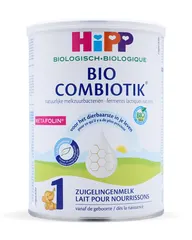
HiPP Dutch Stage 1 is the organic infant formula HiPP makes for the Netherlands, labelled for use from birth. Its only carbohydrate is lactose, with no starch or maltodextrin, and it adds galacto-oligosaccharides and the culture L. fermentum, the two parts of what HiPP calls Combiotik. It comes in an 800 g tin, made up with one 4.3 g scoop per 30 ml of water. It meets the EU rules for infant formula; it is not sold under US rules, and the sellers here import it.
Key takeaways
- Labelled for use from birth, with lactose as the only carbohydrate and no starch.
- An 800 g tin with a 4.3 g scoop per 30 ml of water; HiPP says to use an opened tin within 3 weeks.
- HiPP says to make it with water at 40 to 50 °C; the CDC says about 70 °C for babies under two months.
- On every value this page records, its panel per 100 ml matches the German PRE, which comes in a 600 g box.
- It is not sold under US rules: the sellers listed import it from Europe.
What is in HiPP Dutch Stage 1?
The base is organic skimmed milk and an organic whey product, the first two ingredients on HiPP's label. HiPP does not say how the protein divides between whey and casein.2
The only carbohydrate is lactose, with no starch and no maltodextrin, which is the main difference from the German Stage 1.110
The fat is organic palm, rapeseed and sunflower oil, with fish oil for DHA at 13.2 mg per 100 ml. Combiotik is HiPP's name for the pairing of galacto-oligosaccharides (GOS), a prebiotic, with the lactic culture Limosilactobacillus fermentum CECT5716, and folate is added as Metafolin, a calcium salt of the active form.2
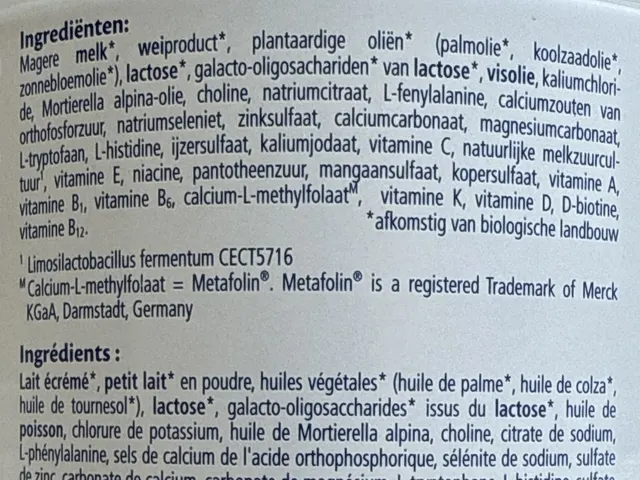
Nutrition per 100 ml, prepared
| Nutrient | Per 100 ml | Per 100 kcal | EU min to max |
|---|---|---|---|
| Energy, fat, carbohydrate and protein | |||
| Energy | 66 kcal | 100 kcal | 60 to 70 kcal per 100 ml |
| Fat | 3.6 g | 5.5 g | 4.4 to 6.0 g |
| of which saturates | 1.5 g | 2.3 g | |
| of which monounsaturates | 1.6 g | 2.4 g | |
| of which polyunsaturates | 0.5 g | 0.76 g | |
| Linoleic acid | 0.4 g | 0.61 g | |
| Alpha-linolenic acid | 0.06 g | 0.091 g | |
| ARA | 13.2 mg | 20 mg | |
| DHA | 13.2 mg | 20 mg | 20 to 50 mg |
| Carbohydrate | 7.0 g | 10.6 g | 9 to 14 g |
| of which sugars | 7.0 g | 11 g | |
| of which lactose | 6.9 g | 10.5 g | min 4.5 g |
| Fibre | 0.3 g | 0.45 g | |
| GOS | 0.3 g | 0.45 g | max 0.8 g per 100 ml |
| Protein | 1.28 g | 1.9 g | 1.8 to 2.5 g |
| L-carnitine | 1.8 mg | 2.7 mg | |
| Minerals | |||
| Sodium | 20 mg | 30 mg | |
| Potassium | 76 mg | 115 mg | |
| Chloride | 51 mg | 77 mg | |
| Calcium | 51 mg | 77 mg | 50 to 140 mg |
| Phosphorus | 30 mg | 45 mg | |
| Magnesium | 4.5 mg | 6.8 mg | |
| Iron | 0.50 mg | 0.76 mg | 0.3 to 1.3 mg |
| Zinc | 0.50 mg | 0.76 mg | |
| Copper | 0.053 mg | 0.08 mg | |
| Manganese | 0.0050 mg | 0.0076 mg | |
| Fluoride | < 0.0050 mg | < 0.0076 mg | |
| Selenium | 3.8 µg | 5.8 µg | |
| Iodine | 15 µg | 23 µg | |
| Vitamins | |||
| Vitamin A | 54 µg | 82 µg | |
| Vitamin D | 1.5 µg | 2.3 µg | 2 to 3 µg |
| Vitamin E | 0.70 mg | 1.1 mg | |
| Vitamin K | 5.1 µg | 7.7 µg | |
| Vitamin C | 8.9 mg | 13 mg | |
| Vitamin B1 | 0.050 mg | 0.076 mg | |
| Vitamin B2 | 0.14 mg | 0.21 mg | |
| Niacin | 0.34 mg | 0.52 mg | |
| Vitamin B6 | 0.029 mg | 0.044 mg | |
| Folic acid | 10 µg | 15 µg | |
| Vitamin B12 | 0.12 µg | 0.18 µg | |
| Biotin | 1.5 µg | 2.3 µg | |
| Pantothenic acid | 0.34 mg | 0.52 mg | |
| Other nutrients | |||
| Choline | 25 mg | 38 mg | |
| Inositol | 4.2 mg | 6.4 mg | |
Values from HiPP's label for the Netherlands, checked 18 September 2026. The last column is the range for infant formula in Regulation (EU) 2016/127, Annex I, per 100 kcal unless it says per 100 ml. The label prints values per 100 ml only, so the per 100 kcal column is calculated from them.
Every value in the table is the one HiPP prints for 100 ml of made-up feed, which is 12.9 g of powder in 90 ml of water.2
How do you prepare it?
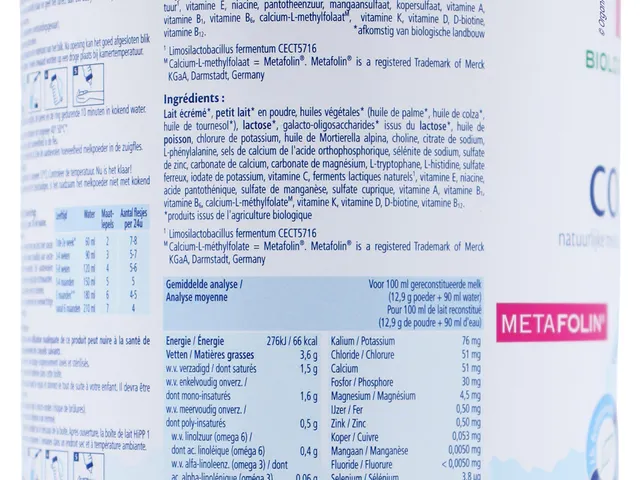
Boil fresh drinking water and let it cool to 40 to 50 °C. Pour the water into the bottle first, then add one level scoop (4.3 g) for every 30 ml. Close the bottle, shake it hard, let it cool to about body temperature and check it on your wrist; HiPP says to give it within half an hour and to throw away what is left.2
| Water | Scoops | Powder | Feed size | Water temp. |
|---|---|---|---|---|
| 30 ml · 1 fl oz | 1 | 4.3 g | 33 ml · 1.1 fl oz | 40 to 50 °C · 104 to 122 °F |
| 90 ml · 3 fl oz | 3 | 12.9 g | 100 ml · 3.4 fl oz | 40 to 50 °C · 104 to 122 °F |
| 120 ml · 4 fl oz | 4 | 17.2 g | 133 ml · 4.5 fl oz | 40 to 50 °C · 104 to 122 °F |
| 150 ml · 5 fl oz | 5 | 21.5 g | 167 ml · 5.6 fl oz | 40 to 50 °C · 104 to 122 °F |
| 180 ml · 6 fl oz | 6 | 25.8 g | 200 ml · 6.8 fl oz | 40 to 50 °C · 104 to 122 °F |
| 210 ml · 7 fl oz | 7 | 30.1 g | 233 ml · 7.9 fl oz | 40 to 50 °C · 104 to 122 °F |
One scoop is 4.3 g, level, not packed. The feed size column is the volume in the bottle after the powder dissolves.
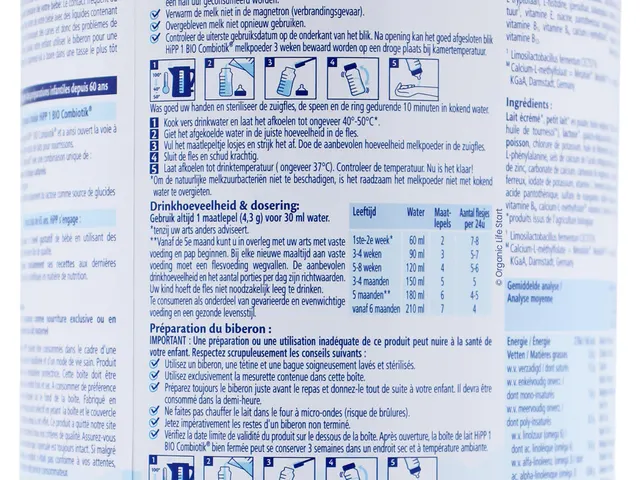
- Kook vers drinkwater en laat afkoelen tot ongeveer 40°-50°C
- Boil fresh drinking water and let it cool to about 40 to 50 °C
- Giet het afgekoelde water in de juiste hoeveelheid in de fles
- Pour the right amount of the cooled water into the bottle
- Vul het maatlepeltje losjes en strijk het af
- Fill the scoop loosely and level it off
- Gebruik altijd 1 maatlepel (4,3 g) voor 30 ml water
- Always use 1 scoop (4.3 g) for 30 ml of water
- Sluit de fles en schud krachtig
- Close the bottle and shake it hard
- Il doit être consommé dans la demi-heure
- Give it within half an hour (the French text on the same tin)
How much should a baby drink?
| Age | Feeds a day | Water per feed | Scoops | Water a day |
|---|---|---|---|---|
| Weeks 1 to 2 | 7 to 8 | 60 ml | 2 | 420 to 480 ml |
| Weeks 3 to 4 | 5 to 7 | 90 ml | 3 | 450 to 630 ml |
| Weeks 5 to 8 | 5 to 6 | 120 ml | 4 | 600 to 720 ml |
| Months 3 to 4 | 5 | 150 ml | 5 | 750 ml |
| Month 5 | 4 to 5 | 180 ml | 6 | 720 to 900 ml |
| From month 6 | 4 | 210 ml | 7 | 840 ml |
HiPP's own chart from the pack; water a day is feeds times water per feed. Babies vary, and a hungry or sleepy baby is a better guide than the table.
Who is it for, and who is it not for?
It is for healthy babies born at term who are not breastfed, or not only breastfed, and whose parents want an organic formula without starch.1
It is made from cow's milk and contains fish oil, so it is not for a baby with a diagnosed cow's milk protein allergy, and it is not lactose-free.2 A baby born early is fed to a plan from the neonatal team and the pediatrician.11
The same stage in other markets
| Market | Product | Size | Starch | Ships to the United States | Sold by Organic Life Start |
|---|---|---|---|---|---|
| Netherlands | HiPP 1 Bio Combiotik (this page) | 800 g tin | No | Yes | Yes, US and CA |
| Germany | HiPP PRE Bio Combiotik | 600 g box | No | Yes | Yes, US and CA |
| Germany | HiPP 1 Bio Combiotik | 600 g box | Yes | Yes | Yes, US and CA |
| United Kingdom | HiPP Organic First Infant Milk | 800 g tin | No | Yes | Yes, US and CA |
| International | HiPP 1 Organic Combiotic | 800 g box | No | Yes | No |
What buyers say
1,962 reviews of this product, gathered from the sellers' own review pages, all of them counted in the rating. The newest are below as their buyers wrote them, each showing where it was written and linking to it; a review is one buyer's experience, not evidence. The rating is this product's alone, never pooled with other products or with a seller's store rating, and milkatlas edits none of them.
- 5 ★98 %
- 4 ★1 %
- 3 ★0 %
- 2 ★0 %
- 1 ★0 %
- Organic Life Start5.0 · 862
- Organic Formula Shop5.0 · 637
- Formuland4.9 · 284
- Organic's Best5.0 · 179
★★★★★ Greg G. Verified buyer on Formuland
Hard to find product. Kids love it. Healthiest option. These guys deliver quick.
★★★★★ Jarrett W. Verified buyer on Formuland
My baby absolutely loves this milk. He pretty much rejects everything else except for this formula. It also helps with significantly reducing gas and bloated mess. Therefore, he sleeps better at night.
★★★★★ Samantha B. Verified buyer on Formuland
good
★★★★★ Junior D. Verified buyer on Organic Life Start
Once we started using this formula, our little boy finally started sleeping five-hour stretches.
Questions parents ask
Is HiPP Dutch Stage 1 the same as HiPP German Stage 1?
No. The German Stage 1 adds a little starch and the Dutch tin has none; both are infant formula under the same EU rules, and both are labelled for use from birth.
Is HiPP Dutch Stage 1 the same as HiPP PRE?
On the panel values this page records, yes: per 100 ml the two match in energy, protein, fat, lactose, DHA, GOS, iron, vitamin D and calcium, and both take a 4.3 g scoop per 30 ml. They differ in pack and market: an 800 g tin made for the Netherlands, or a 600 g box made for Germany.
Can I use it past six months?
Yes. HiPP's chart on the tin runs on past six months, and the NHS says first infant formula is the only formula a baby needs in the first year.
Does it contain palm oil?
Yes. Organic palm oil is the first of the three vegetable oils HiPP lists in the fat blend, before rapeseed and sunflower oil.
Where is the best-before date on the tin?
On the bottom of the tin, where HiPP's label says to check it before use. Once the tin is open, HiPP says to keep it closed, dry and at room temperature, and to use it within 3 weeks.
Is HiPP Dutch Stage 1 approved by the FDA?
No. The FDA does not approve infant formulas: a maker notifies it before selling a new formula in the United States. HiPP makes this tin for the Netherlands, and no HiPP formula is on the FDA's list of formulas marketed in the United States. The tin you receive has a Dutch and French label, with no US nutrition facts panel.
How many scoops for 150 ml of water?
5. HiPP's rule is one level 4.3 g scoop for every 30 ml of water, and the water goes into the bottle before the powder.
Why does HiPP say 40 to 50 °C when the CDC says 70 °C?
HiPP's label says not to pour boiling water on the powder, to protect the lactic culture. The CDC advises water at about 70 °C for babies under two months, born early or with a weakened immune system, to kill germs in the powder. Both are on this page; ask your pediatrician which to follow.
How long does an 800 g tin last?
It holds about 186 level scoops. On HiPP's chart for months three and four, 5 bottles of 150 ml of water a day, that is a little over a week of feeds; the cost calculator works it out for your own baby's day.
How long can a made-up bottle wait?
HiPP's label says to give it within half an hour and never to reuse what is left. The CDC's limit is longer: use it within two hours of making it, and within an hour of starting the feed.
Sources
- HiPP Netherlands, product page for HiPP 1 Bio Combiotik (NL2472-03) name, stage, from birth, 800 g, lactose as the only carbohydrate fetched 18 September 2026
- HiPP Netherlands, label of HiPP 1 Bio Combiotik (NL2472-03), linked from that page ingredients, nutrition per 100 ml, scoop, standard dilution, preparation, the half an hour the label gives to drink a made-up bottle, feeding chart, storage after opening, made in Germany; the full nutrition panel as printed, every row, read from the label image because the file carries no text layer fetched 22 September 2026
- The partner retailer's listing and photographs of the current tin barcode, and the label panels as printed on the tin sold now fetched 18 September 2026
- Regulation (EU) 2016/127, Annex I compositional requirements for infant formula, per 100 kcal
- CDC, Infant formula preparation and storage water at about 70 °C for babies under two months, born early or with a weakened immune system; use within two hours of preparing fetched 18 September 2026
- Maldonado J. et al., 2012, Journal of Pediatric Gastroenterology and Nutrition 54(1):55-61 randomised trial of a follow-on formula with L. fermentum CECT5716 in infants aged 6 to 12 months; 188 analysed (registry NCT01215656) fetched 18 September 2026
- Piloquet H. et al., 2024, American Journal of Clinical Nutrition 119(5):1259-1269 randomised trial sponsored by HiPP: formula with GOS and L. fermentum CECT5716 from one month, 460 infants; no difference in infectious diarrhoea, the main outcome fetched 18 September 2026
- NHS, Types of formula first infant formula is the only formula a baby needs in the first year; no benefit in switching to follow-on formula at six months fetched 18 September 2026
- HiPP Germany, product page for PRE Bio Combiotik from birth, lactose as the only carbohydrate fetched 18 September 2026
- HiPP Germany, product page for 1 Bio Combiotik from birth, with a little starch fetched 18 September 2026
- American Academy of Pediatrics, Your premature baby's nutrition needs the neonatal team and the pediatrician set a premature baby's feeding plan; updated 13 April 2026 fetched 18 September 2026
Corrections (4)
- Delivery in the buy box corrected from 'ships from Germany, 5 to 9 days' to the partner retailer's own terms: from its warehouses in Europe, 1 to 6 business days. (before publication)
- Nutrition per 100 ml corrected to HiPP's Dutch label: protein 1.28 g (was 1.25 g), fat 3.6 g (3.5 g), carbohydrate 7.0 g (7.3 g), lactose 6.9 g (7.3 g), vitamin D 1.5 µg (1.3 µg), calcium 51 mg (52 mg). The per 100 kcal column is now marked as calculated, because the label prints per 100 ml only. (before publication)
- Removed the claim that the protein is 60 % whey and 40 % casein, which HiPP does not state; the age range is now 'from birth', as printed; the preparation panel is transcribed from the tin, which says to give a bottle within half an hour, not within an hour; and the probiotic trial is cited correctly (Journal of Pediatric Gastroenterology and Nutrition, 2012, a follow-on formula from six months), beside HiPP's own 2024 trial. (before publication)
- The EU limits for energy and galacto-oligosaccharides are now shown per 100 ml, as the regulation sets them; they had sat in the per 100 kcal column without their unit. (before publication)