HiPP Dutch vs German vs UK

We earn a commission when you buy through links on this page, including from our partner retailer, which sells and ships the order. How this site is funded →
The answer
The first-stage milk is the same in all three ranges. HiPP's German PRE, Dutch Stage 1 and UK First Infant Milk agree on all 44 rows of the panel, all are made in Germany, and all take the same scoop to the same water. What differs is the name, the pack, one ingredient that never reaches a panel, and the temperature the label asks for. The German range also sells a Stage 1 that is not this milk, which is where most of the confusion starts.
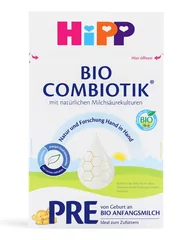 HiPP German PRE2060-02 · 600 g boxThe German equivalent is PRE, not Stage 1: Germany sells both, and only PRE matches.
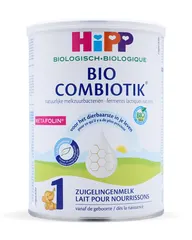 HiPP Dutch Stage 1NL2472-03 · 800 g tinThe Dutch tin holds more and carries the same culture as the German box.
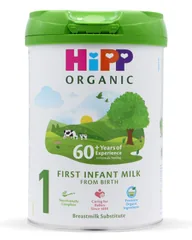 HiPP UK First Infant MilkGB2029-02 · 800 g tinThe same numbers, no lactic culture in the ingredients, and a hotter-water method.
Key takeaways
- All 44 rows of the three panels agree, and all three are made in Germany from the same scoop to the same water.
- The German equivalent is PRE. Germany's Stage 1 adds starch and is a different milk.
- The UK tin lists no lactic culture, which no panel row would ever show.
- The German and Dutch labels ask for water at 40 to 50 °C; HiPP UK's asks for water left no longer than 30 minutes, which is the NHS method.
- Pack sizes decide the price per 100 g: a 600 g box against two 800 g tins.
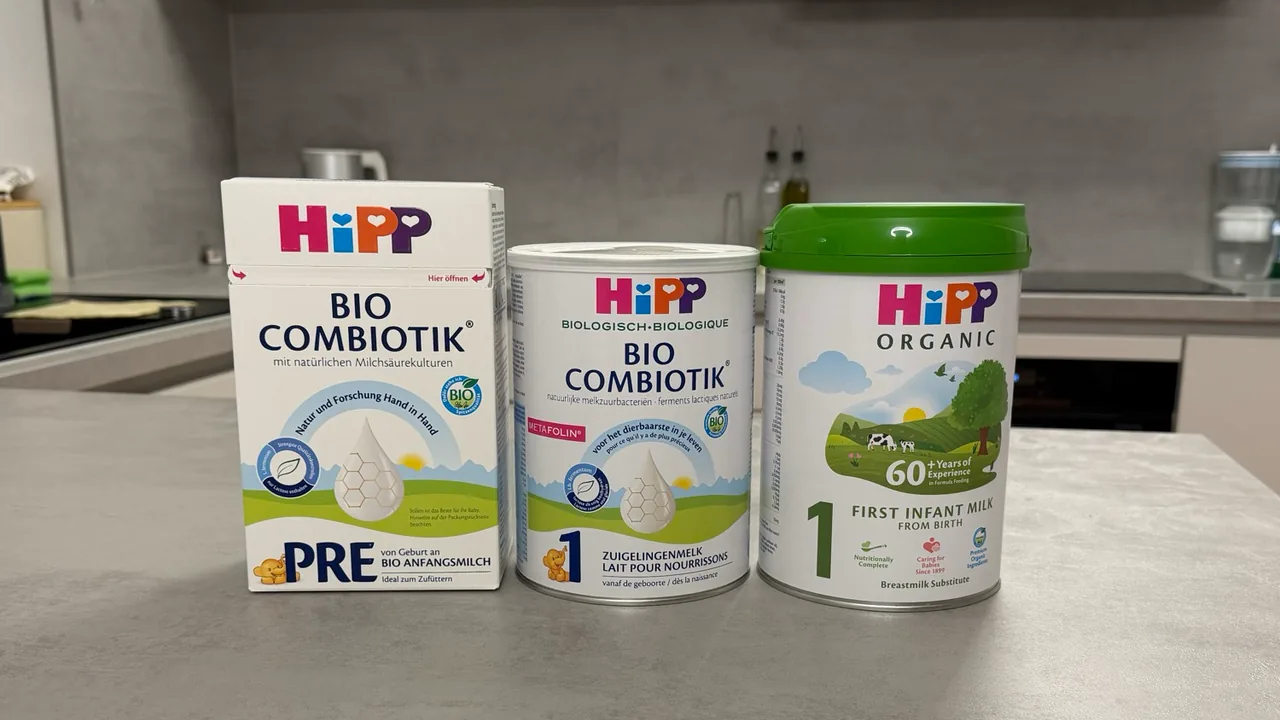
How do the three first-stage milks compare?
| HiPP German PRE | HiPP Dutch Stage 1 | HiPP UK First Infant Milk | |
|---|---|---|---|
| Age | From birth | From birth | From birth |
| Size | 600 g box | 800 g tin | 800 g tin |
| Article code | 2060-02 | NL2472-03 | GB2029-02 |
| Base | Cow's milk: skimmed milk and whey | Cow's milk: skimmed milk and whey | Cow's milk: skimmed milk and whey |
| Protein | 1.28 g | 1.28 g | 1.28 g |
| Carbohydrate | 7.0 g · Lactose only | 7.0 g · Lactose only | 7.0 g · Lactose only |
| Starch | No | No | No |
| Fat | 3.6 g | 3.6 g | 3.6 g |
| DHA | 13.2 mg | 13.2 mg | 13.2 mg |
| GOS | 0.3 g | 0.3 g | 0.3 g |
| Combiotik | GOS + L. fermentum | GOS + L. fermentum | GOS only |
| Scoop | 4.3 g per 30 ml | 4.3 g per 30 ml | 4.3 g per 30 ml |
| Price at Organic Life Start, United States | $40.79 · $6.80 per 100 g | $49.79 · $6.22 per 100 g | $49.79 · $6.22 per 100 g |
Nutrition from each product's panel, fetched 18 September 2026. Prices seen 15 October 2026.
Is it the same milk?
On the panel, yes, and completely: the three agree on all 44 rows, with nothing printed on one that is missing from another. All three are made in Germany, and all three take a 4.3 g scoop to 30 ml of water.123
In the ingredients there is one difference, and it is one no panel would ever show. The German and Dutch packs list the lactic culture Limosilactobacillus fermentum; the British tin does not.123 A culture is not a nutrient, so its absence costs the panel nothing, which is exactly why comparing tables alone will mislead you here.
Why do the names not line up?
Because Germany sells two first-stage milks and the others sell one. The German equivalent of the Dutch Stage 1 and the British First Infant Milk is PRE, not Stage 1: the German Stage 1 adds a little starch and is a different recipe.4
That single fact is behind most of the confusion in this comparison. A buyer told the Dutch Stage 1 is the good one, who then buys a German Stage 1 because the number matches, has bought something else.
The article numbers do not help either. These three share no code between them, unlike HiPP's HA range, where the Dutch and German packs carry the same number under a market prefix.123
What differs in the instructions?
The water, and the gap is wide. The German and Dutch labels ask you to cool boiled water to 40 to 50 °C before the powder goes in, and the Dutch tin says why: do not pour boiling water on the powder, so as not to damage the lactic acid cultures.2 HiPP UK tells you to boil the water and leave it no longer than 30 minutes, which is the NHS method and keeps it at 70 °C or more.37
Both instructions are for the same milk, and the reason they differ is the culture the British tin does not contain.
Which stages does each market sell?
Germany goes furthest: PRE, Stage 1, two different Stage 2 boxes, one with starch and one without, and a Stage 3, each in a 600 g box.4
The Netherlands sells Stage 1, 2 and 3 in 800 g tins.5 Britain sells a First Infant Milk and a Follow On Milk in this range, then a Growing Up Milk from twelve months, and adds ready-to-feed bottles no other market has in English.6
There is a fourth option most buyers never hear about: HiPP's English-language export range, sold as Stage 1 and Stage 2 in 800 g boxes, whose Stage 1 matches these three on every row as well.
Questions parents ask
Is Dutch HiPP the same as German HiPP?
For the first stage, yes. The Dutch Stage 1 and the German PRE agree on all 44 rows of the panel, share the same scoop and the same water temperature, and are both made in Germany. The Dutch tin holds 800 g and the German box 600 g.
Which German stage matches the Dutch Stage 1?
PRE, not Stage 1. Germany sells both, and its Stage 1 adds a little starch, which makes it a different recipe rather than a different pack of the same one.
Is the UK version the same milk?
On the panel, yes: all 44 rows match the other two. In the ingredients it differs by one thing, the lactic culture, which HiPP UK does not list. A culture is not a nutrient, so no row of a nutrition table would ever show its absence, which is why reading panels alone will not tell you.
Why do the labels give different water temperatures?
Because of that culture. HiPP asks for cooler water where there is a live culture to protect, and the British tin has none to protect.
Which temperature should I follow?
The one on the pack in your hand, and ask your pediatrician if your baby is under two months, was born early or has a weakened immune system. The WHO and the CDC ask for water at 70 °C or more because powder is not sterile; HiPP's German and Dutch labels ask for cooler water to keep the culture alive. The water temperature guide sets out both positions.
Are they all organic?
Yes, all three of them. The British tin carries a UK organic mark alongside the EU one, which the organic certification guide explains.
Which is the best value?
Per 100 g of powder, which is the only fair way to compare a 600 g box with an 800 g tin. The table above gives the price each way for the packs our partner retailer sells, and the answer moves with the exchange rate.
Do the stage numbers mean the same ages?
Not quite. PRE and 1 are both from birth, and every market's Stage 2 is a follow-on formula from six months, but only Germany sells both a PRE and a Stage 1.
Which ranges go furthest?
Germany's, which runs PRE, Stage 1, two different Stage 2 boxes and a Stage 3. The Netherlands runs Stage 1, 2 and 3. Britain sells a First Infant Milk and a Follow On Milk in this range, then a Growing Up Milk from twelve months. There is also an English-language export range, sold as Stage 1 and Stage 2 in 800 g boxes.
Which should I buy from outside Europe?
Whichever your seller has in stock and can ship. The milk is the same; the label, the pack size and the instructions are what you are choosing between.
Sources
- HiPP pack artwork for HiPP PRE Bio Combiotik 600 g, version 7 (May 2025) the German box: article 2060-02, the composition per 100 ml, the ingredient list with the lactic culture, the scoop and the 40 to 50 °C instruction fetched 23 September 2026
- HiPP Netherlands, label of HiPP 1 Bio Combiotik (NL2472-03) the Dutch tin: the composition per 100 ml, the ingredient list, the scoop, and the instruction not to pour boiling water on the powder so as not to damage the lactic acid cultures fetched 23 September 2026
- HiPP UK, product page for HiPP Organic First Infant Milk the British tin: article GB2029-02, the organic ingredient list with no lactic culture, the composition per 100 ml, and the instruction to boil water and leave it no more than 30 minutes fetched 23 September 2026
- HiPP Germany, Milchnahrung the German range: PRE, Stage 1, two Stage 2 boxes and Stage 3, each in a 600 g box fetched 23 September 2026
- HiPP Netherlands, melk producten the Dutch range: Stage 1, 2 and 3, each in an 800 g tin fetched 23 September 2026
- HiPP UK, formula milks the British range: First Infant Milk, Follow On Milk and Growing Up Milk, with the ready-to-feed bottles and the two special medical tins fetched 23 September 2026
- NHS, Making up baby formula boil the water and leave it to cool for no more than 30 minutes so it stays at 70 °C or above, which is the method HiPP UK prints fetched 23 September 2026
- Commission Delegated Regulation (EU) 2016/127 one composition for infant formula across the union, which is why three markets can print the same panel; preparation temperature is not among the harmonised requirements, which is why they can print different instructions fetched 23 September 2026