HiPP Stage 1 vs Stage 2

We earn a commission when you buy through links on this page, including from our partner retailer, which sells and ships the order. How this site is funded →
The answer
HiPP Stage 1 vs Stage 2 is a change of legal category rather than a step up in quality. Stage 2 is follow-on formula, for a baby over six months who is also eating solids, and its panel drops four ingredients Stage 1 carries while raising calcium, phosphorus, magnesium and iron. The switch is optional: the NHS says research shows moving to follow-on formula at six months has no benefits, and a first formula can stay a baby's main drink to one year.
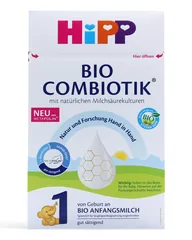 HiPP German Stage 12031-02 · 600 g boxInfant formula, from birth, and a baby may stay on it for the whole first year.
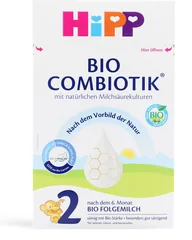 HiPP German Stage 22032-02 · 600 g boxFollow-on formula, after six months, with more minerals and four ingredients fewer.
Key takeaways
- Stage 2 drops ARA, L-carnitine, choline and inositol, which is why its panel is four rows shorter.
- Calcium rises from 52 mg to 77 mg per 100 ml and iron from 0.60 mg to 1.0 mg.
- That iron is above what EU law allows a from-birth formula, which is the clearest sign the step is a category rather than a better milk.
- The NHS says switching at six months has no benefits and that a first formula can be the main drink to one year.
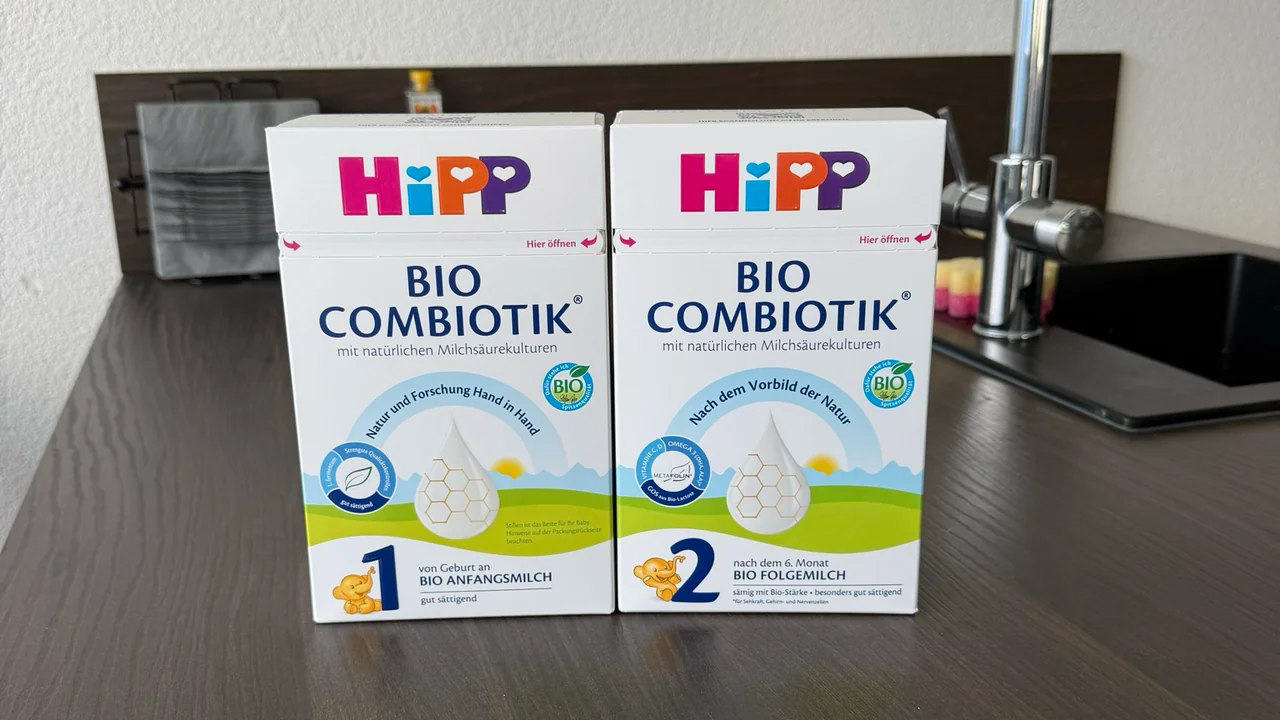
- The labels look alike, and the NHS warns about exactly that; the article number on the pack is the reliable tell.
How do HiPP Stage 1 and Stage 2 compare?
| HiPP German Stage 1 | HiPP German Stage 2 | |
|---|---|---|
| Age | From birth | After 6 months |
| Size | 600 g box | 600 g box |
| Article code | 2031-02 | 2032-02 |
| Base | Cow's milk: skimmed milk and whey | Cow's milk: skimmed milk and whey |
| Protein | 1.3 g | 1.3 g |
| Carbohydrate | 7.1 g · Lactose and starch | 7.2 g · Lactose and starch |
| Starch | Yes | Yes |
| Fat | 3.6 g | 3.7 g |
| DHA | 13.4 mg | 13.6 mg |
| GOS | 0.3 g | 0.4 g |
| Combiotik | GOS + L. fermentum | GOS + L. fermentum |
| Scoop | 4.4 g per 30 ml | 4.5 g per 30 ml |
| Price at Organic Life Start, United States | $40.79 · $6.80 per 100 g | $40.79 · $6.80 per 100 g |
Nutrition from each product's panel, fetched 18 September 2026. Prices seen 15 October 2026.
What actually changes?
Four ingredients leave. Stage 1 lists choline, inositol, L-carnitine and Mortierella alpina oil, the oil that carries ARA; Stage 2 lists none of them, which is why its panel has four rows fewer.12
The rules are what changed, not HiPP's mind. Article 7 of Regulation (EU) 2016/127 requires the nutrition declaration of infant formula, and only of infant formula, to include choline, inositol and carnitine, and Annex I sets a minimum for L-carnitine that Annex II does not repeat for follow-on formula.4
Most minerals go the other way. Calcium rises from 52 mg per 100 ml to 77 mg, phosphorus from 30 mg to 44 mg, and magnesium from 4.5 mg to 6.3 mg.12 Vitamin K falls.
Iron is the row that settles what kind of change this is. Stage 2 prints 1.0 mg per 100 ml, which converts to 1.5 mg per 100 kcal, the basis the regulation uses. Annex I allows infant formula 0.3 to 1.3 mg and Annex II allows follow-on formula 0.6 to 2 mg.4 Stage 2 is above the first band and inside the second, so it could not be sold for a newborn at all.
Does a baby have to move at six months?
No, and the NHS says so in terms. Research shows that switching to follow-on formula at six months has no benefits for your baby, it writes, and a baby can continue to have first infant formula as their main drink until they are one year old.3
It adds two warnings worth carrying. Follow-on formula should never be fed to a baby under six months. And the labels on follow-on formula can look very similar to those on first infant formula, so read the label carefully to avoid a mistake.3 On the German boxes the reliable tell is the article number, 2031-02 against 2032-02.
HiPP does not argue with any of that. It sells Stage 2 as a follow-on milk to complement a mixed diet after the sixth month, and makes no claim that a baby has to move.5
Is the Dutch pair the same?
The same shape, with one difference at the start. The Dutch Stage 1 to Stage 2 step drops the same four ingredients and raises the same minerals, including iron from 0.50 mg to 1.0 mg per 100 ml.7
The difference is that the Dutch Stage 1 has lactose as its only carbohydrate where the German Stage 1 adds a little starch, which is its own comparison rather than this one.1
If you do switch, how?
One bottle at a time. HiPP's advice for changing between its own milks is to replace one feed a day and never to mix two powders in the same bottle.6
The scoops are not interchangeable either: 4.4 g in the Stage 1 box and 4.5 g in the Stage 2 box, both to 30 ml of water, so measure each powder with the scoop that came with it.12
Questions parents ask
What is the difference between HiPP Stage 1 and Stage 2?
Category first. Stage 1 is infant formula and Stage 2 is follow-on formula, which EU law treats as a different product for a baby over six months. On the panel, Stage 2 drops four ingredients and carries more calcium, phosphorus, magnesium and iron.
Does my baby have to move to Stage 2 at six months?
No. The NHS says research shows switching at six months has no benefits, and that a first infant formula can stay a baby's main drink until they are one.
Why does the Stage 2 panel have fewer rows?
Because the rules change with the category. ARA, L-carnitine, choline and inositol are gone from the ingredients, and EU law requires infant formula, and only infant formula, to declare choline, inositol and carnitine. A follow-on formula is not asked for them, so HiPP does not add them.
Is the extra iron a reason to switch?
It is the reason the category exists, not a reason on its own. A baby over six months needs more iron than a newborn, and solid food is the usual answer to that.
Can a baby under six months have Stage 2?
No. The NHS says follow-on formula should never be fed to babies under six months old, and the pack is labelled accordingly.
What does HiPP say?
HiPP sells Stage 2 as a follow-on milk to complement a mixed diet after the sixth month, and its advice on changing between its own milks is to replace one feed a day and never to mix two powders in the same bottle. What it does not do is claim a baby has to move, which is worth noticing on a page written to sell the next tin.
Do the two look different on the shelf?
Barely, and the NHS warns about it: the labels on follow-on formula can look very similar to those on first infant formula, and it tells parents to read the label carefully to avoid a mistake. The article number is the reliable tell, 2031-02 against 2032-02 on the German boxes.
Is the Dutch pair the same as the German pair?
The same shape. The Dutch Stage 1 to Stage 2 step drops the same four ingredients and raises the same minerals, and the Dutch Stage 1 has no starch where the German one does.
Does the scoop change?
Slightly: 4.4 g in the Stage 1 box and 4.5 g in the Stage 2 box, both to 30 ml of water. Use the scoop that came with the powder.
If I do switch, how?
One bottle at a time, HiPP says, adding a bottle of the new milk each day and never mixing two powders together. The guide on switching stages has the schedule.
Sources
- HiPP pack artwork for HiPP 1 Bio Combiotik 600 g, version 8 (May 2025) the ingredient list including choline, inositol, L-carnitine and Mortierella alpina oil; the composition per 100 ml; the scoop and the feeding chart fetched 23 September 2026
- HiPP pack artwork for HiPP 2 Bio Combiotik 600 g, version 6 (April 2025) the ingredient list without those four; the composition per 100 ml; the follow-on statement and the dosing table fetched 23 September 2026
- NHS, Types of formula follow-on formula is suitable from 6 months but ask a health visitor first; it should never be fed under 6 months; research shows switching at 6 months has no benefits and first infant formula can be the main drink to 1 year; the labels look very similar fetched 23 September 2026
- Commission Delegated Regulation (EU) 2016/127 Annex I and Annex II, the iron ranges for infant and follow-on formula; Article 7(1), the declaration of choline, inositol and carnitine required of infant formula only fetched 23 September 2026
- HiPP Germany, product page for 2 Bio Combiotik (600 g) HiPP's own description of Stage 2 as a follow-on milk to complement a mixed diet after the sixth month fetched 23 September 2026
- HiPP Germany, Was muss ich beim Umstellen von Milchnahrungen beachten? HiPP's advice on changing between its milks: one bottle at a time, and never two powders in the same bottle fetched 23 September 2026
- HiPP Netherlands, product page for HiPP 2 Bio Combiotik (NL2476-03) the Dutch follow-on tin, for the second pair fetched 23 September 2026