HiPP Dutch Goat Stage 2 HiPP 2 Biologische Opvolgmelk op basis van Geitenmelk, 400 g tin

We earn a commission when you buy through links on this page, including from our partner retailer, which sells and ships the order. How this site is funded →
The answer
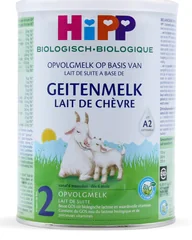
HiPP Dutch Goat Stage 2 is HiPP's organic follow-on formula made from goat's milk in the Netherlands, labelled from six months as part of a varied diet. Its protein comes from goat's milk and goat's milk powder, with no added whey; lactose is its only carbohydrate, and it adds galacto-oligosaccharides but no lactic culture. Beside goat Stage 1 it has more iron and a heavier 4.5 g scoop, in the same 400 g tin. Like Stage 1, it is not for a cow's milk protein allergy.
Key takeaways
- A follow-on formula from six months, part of a varied diet, never in place of breast milk before then.
- Per 100 ml it has 1.0 mg of iron, where goat Stage 1 has 0.50 mg.
- Not for a baby with a cow's milk protein allergy or a suspected one, the tin says in bold.
- The NHS says there is no benefit in switching to a follow-on formula at six months.
What is in HiPP Dutch Goat Stage 2?
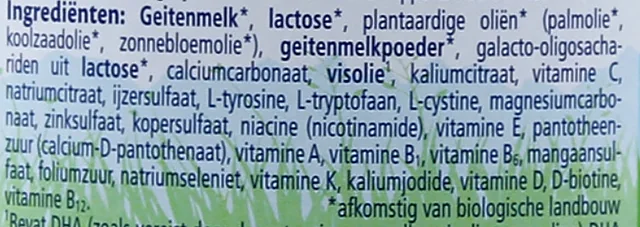
The Dutch ingredient list starts with goat's milk and lactose, then organic palm, rapeseed and sunflower oil and goat's milk powder, with no whey; the French list on the same tin, like HiPP's German goat's milk box, calls both milks skimmed.210
Fish oil adds DHA at 13.6 mg per 100 ml, and HiPP adds galacto-oligosaccharides from organic lactose, with no lactic culture. Unlike goat Stage 1, it adds no Mortierella alpina oil, the source of arachidonic acid.29
Nutrition per 100 ml, prepared
| Nutrient | Per 100 ml | Per 100 kcal | EU min to max |
|---|---|---|---|
| Energy, fat, carbohydrate and protein | |||
| Energy | 68 kcal | 100 kcal | 60 to 70 kcal per 100 ml |
| Fat | 3.7 g | 5.4 g | 4.4 to 6.0 g |
| of which saturates | 1.6 g | 2.4 g | |
| of which monounsaturates | 1.6 g | 2.4 g | |
| of which polyunsaturates | 0.5 g | 0.74 g | |
| Alpha-linolenic acid | 0.06 g | 0.088 g | |
| DHA | 13.6 mg | 20 mg | 20 to 50 mg |
| Carbohydrate | 7.1 g | 10.4 g | 9 to 14 g |
| of which lactose | 7.0 g | 10.3 g | min 4.5 g |
| Fibre | 0.5 g | 0.74 g | |
| GOS | 0.5 g | 0.74 g | max 0.8 g per 100 ml |
| Protein | 1.4 g | 2.1 g | 1.8 to 2.5 g |
| Minerals | |||
| Sodium | 20 mg | 29 mg | |
| Potassium | 84 mg | 124 mg | |
| Chloride | 63 mg | 93 mg | |
| Calcium | 77 mg | 113 mg | 50 to 140 mg |
| Phosphorus | 43 mg | 63 mg | |
| Magnesium | 6.3 mg | 9.3 mg | |
| Iron | 1.0 mg | 1.5 mg | 0.6 to 2 mg |
| Zinc | 0.5 mg | 0.74 mg | |
| Copper | 0.054 mg | 0.079 mg | |
| Manganese | 0.007 mg | 0.01 mg | |
| Fluoride | < 0.010 mg | < 0.015 mg | |
| Selenium | 3.1 µg | 4.6 µg | |
| Iodine | 14 µg | 21 µg | |
| Vitamins | |||
| Vitamin A | 56 µg | 82 µg | |
| Vitamin D | 1.6 µg | 2.4 µg | 2 to 3 µg |
| Vitamin E | 0.80 mg | 1.2 mg | |
| Vitamin K | 3.9 µg | 5.7 µg | |
| Vitamin C | 10.0 mg | 15 mg | |
| Vitamin B1 | 0.051 mg | 0.075 mg | |
| Vitamin B2 | 0.14 mg | 0.21 mg | |
| Niacin | 0.53 mg | 0.78 mg | |
| Vitamin B6 | 0.042 mg | 0.062 mg | |
| Folic acid | 10.0 µg | 15 µg | |
| Vitamin B12 | 0.10 µg | 0.15 µg | |
| Biotin | 1.6 µg | 2.4 µg | |
| Pantothenic acid | 0.35 mg | 0.51 mg | |
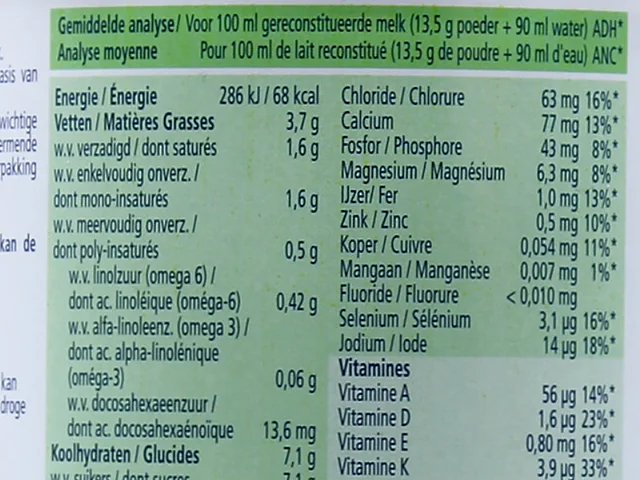
Values from HiPP's label for the Netherlands, checked 18 September 2026. The last column is the range for follow-on formula in Regulation (EU) 2016/127, Annex II, per 100 kcal unless it says per 100 ml. The label prints values per 100 ml only, so the per 100 kcal column is calculated from them.
Every value is the one printed on HiPP's label for 100 ml of made-up feed, which is 13.5 g of powder in 90 ml of water. Beside goat Stage 1 it has twice the iron and more calcium and galacto-oligosaccharides.29
How do you prepare it?
Boil fresh drinking water and let it cool to 40 to 50 °C, pour it into the bottle and add one level scoop (4.5 g) for every 30 ml. Shake it, cool it to about body temperature and check it; an opened tin, closed well, keeps for 3 weeks in a cool, dry place.2
| Water | Scoops | Powder | Feed size | Water temp. |
|---|---|---|---|---|
| 30 ml · 1 fl oz | 1 | 4.5 g | 33 ml · 1.1 fl oz | 40 to 50 °C · 104 to 122 °F |
| 90 ml · 3 fl oz | 3 | 13.5 g | 100 ml · 3.4 fl oz | 40 to 50 °C · 104 to 122 °F |
| 120 ml · 4 fl oz | 4 | 18.0 g | 133 ml · 4.5 fl oz | 40 to 50 °C · 104 to 122 °F |
| 150 ml · 5 fl oz | 5 | 22.5 g | 167 ml · 5.6 fl oz | 40 to 50 °C · 104 to 122 °F |
| 180 ml · 6 fl oz | 6 | 27.0 g | 200 ml · 6.8 fl oz | 40 to 50 °C · 104 to 122 °F |
| 210 ml · 7 fl oz | 7 | 31.5 g | 233 ml · 7.9 fl oz | 40 to 50 °C · 104 to 122 °F |
One scoop is 4.5 g, level, not packed. The feed size column is the volume in the bottle after the powder dissolves.
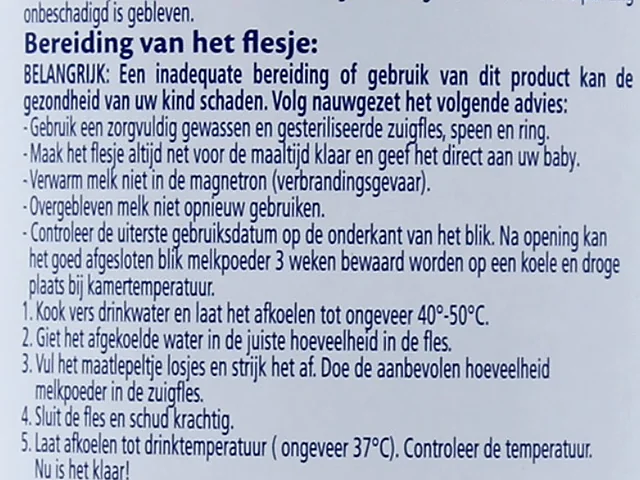
- Kook vers drinkwater en laat het afkoelen tot ongeveer 40°-50°C.
- Boil fresh drinking water and let it cool to about 40 to 50 °C.
- Gebruik altijd 1 maatlepel (4,5 g) voor 30 ml water.
- Always use one scoop (4.5 g) for every 30 ml of water.
- Gebruik uitsluitend de meegeleverde maatlepel!
- Use only the scoop in the tin.
How much should a baby drink?
| Made-up bottle | Boiled water | Scoops |
|---|---|---|
| 170 ml | 150 ml | 5 |
| 200 ml | 180 ml | 6 |
| 235 ml | 210 ml | 7 |
The pack gives bottle sizes rather than ages, so this is what it prints and all it prints. How much a child takes varies, and a hungry or sleepy child is a better guide than the table. The pack says a child needs about 5 of these a day.
The tin gives bottle sizes rather than ages, and says each new solid meal replaces one bottle.2
Who is it for, and who is it not for?
The tin says it is only for babies at least six months old, as one part of a varied diet, and must not replace breast milk in the first six months. It warns in bold that its proteins are similar to cow's milk proteins, so it must not be used when a cow's milk protein allergy exists or is suspected.2
The NHS says there is no benefit in switching to a follow-on formula at six months, and that goat's milk formula is not less likely to cause allergies than cow's milk formula.6
The same stage in other markets
| Market | Product | Size | Starch | Ships to the United States | Sold by Organic Life Start |
|---|---|---|---|---|---|
| Netherlands | HiPP 2 Biologische Opvolgmelk op basis van Geitenmelk (this page) | 400 g tin | No | Yes | Yes, US and CA |
| Germany | HiPP 2 Folgemilch aus Bio Ziegenmilch | 400 g box | No | Yes | No |
In Germany HiPP sells a goat's milk Stage 2 with the same values per 100 ml and the same scoop, in a 400 g box labelled after six months.10
What buyers say
580 reviews of this product, gathered from the sellers' own review pages, all of them counted in the rating. The newest are below as their buyers wrote them, each showing where it was written and linking to it; a review is one buyer's experience, not evidence. The rating is this product's alone, never pooled with other products or with a seller's store rating, and milkatlas edits none of them.
- 5 ★98 %
- 4 ★1 %
- 3 ★0 %
- 2 ★0 %
- 1 ★0 %
- Organic Life Start5.0 · 365
- Organic Formula Shop4.9 · 117
- Formuland4.9 · 97
- Organic's Best5.0 · 1
★★★★★ Anon Verified buyer Rewarded with a discount on Formuland
Love it
★★★★★ Deniz K. Verified buyer Rewarded with a discount on Formuland
HiPP has been a game changer for our little boy! We tried both Kendamil and Kabrita, but HiPP is the only formula that seemed to agree with his tummy. Finding a formula that works well for your baby can be such a challenge, and I’m so grateful we found one that Corrado tolerates well. I love that we finally have a formula we feel comfortable with and that works for our little one. If you’re a parent struggling to find the right formula for your baby, HiPP may be worth trying! We’re so happy we gave it a chance. 💙
★★★★★ Monika Verified buyer on Formuland
Great website! Super fast delivery.
★★★★★ M B. Verified buyer on Formuland
MY BABY LOVES IT
Questions parents ask
When can a baby start HiPP Dutch Goat Stage 2?
From six months, as one part of a varied diet, the tin says; ask your doctor whether your baby is ready.
Does a baby on goat Stage 1 need to move to Stage 2?
Nothing on the tin says so. The NHS says there is no benefit in switching to a follow-on formula at six months and that a first formula can stay the main drink through the first year.
Can a baby move to it from a cow's milk formula?
The tin says it can follow breastfeeding or any other infant formula, and that a baby can switch to it from any follow-on formula. It is still not for a baby with a cow's milk protein allergy.
Can HiPP goat's milk formula be used for a cow's milk allergy?
No. The tin says in bold that it contains proteins similar to those of cow's milk and must not be used when a cow's milk protein allergy exists or is suspected.
What is the difference between goat Stage 1 and Stage 2?
Stage 2 is a follow-on formula with more iron and more galacto-oligosaccharides per 100 ml and a 4.5 g scoop against 4.3 g. It leaves out some of what Stage 1 adds, such as the oil that supplies arachidonic acid, and gives bottle sizes instead of an age chart. Both are organic, in the same tin size, with the same warning on cow's milk allergy.
How many scoops of HiPP Dutch Goat Stage 2 for a bottle?
One level scoop of 4.5 g for every 30 ml of water. The tin gives three bottles, 5 scoops in 150 ml, 6 in 180 ml and 7 in 210 ml, and says babies need about 5 meals a day.
Is HiPP Dutch Goat Stage 2 organic?
Yes. The tin carries the EU organic logo, the Dutch EKO mark and the HiPP Bio seal, like goat Stage 1.
Is HiPP Dutch Goat Stage 2 approved by the FDA?
No. The FDA does not approve infant formulas, and this tin is made in Germany for the Dutch market, printed in Dutch and French. No HiPP formula is on the FDA's list of formulas marketed in the United States.
Sources
- HiPP Netherlands, product page for HiPP 2 Biologische Opvolgmelk op basis van Geitenmelk (NL20004) name, 'Vanaf 6 maanden', 400 g, 'Artikel nummer: NL20004', 'Uit A2 geitenmelk', 'Met GOS', 'Uit biologische ingrediënten', 'Omega-3 (ALA)– belangrijk voor hersen- en zenuwcellen'; links the label PDF fetched 18 September 2026
- HiPP Netherlands, label of HiPP 2 Biologische Opvolgmelk op basis van Geitenmelk (NL20004), linked from that page artwork NL20004_9980517_V1_1-21 (version 1, January 2021; file dated February 2022): legal name, age, ingredients and allergens, composition per 100 ml, scoop, standard dilution, preparation and water temperature, feeding chart, storage after opening, Geproduceerd in Duitsland (made in Germany), organic logos, label block, article number and barcode; the full nutrition panel as printed, every row, read from the label image because the file carries no text layer fetched 22 September 2026
- The partner retailer's listing for HiPP Dutch Goat Stage 2 barcode of the single pack, the pack photo, and the photographs of its ingredients, nutrition and preparation panels (the panels read on 25 September 2026) fetched 18 September 2026
- Regulation (EU) 2016/127 compositional requirements for infant formula (Annex I) and follow-on formula (Annex II) fetched 18 September 2026
- CDC, Infant formula preparation and storage water around 70 °C for babies younger than two months, born early or with a weakened immune system fetched 18 September 2026
- NHS, Types of formula first infant formula through the first year; no benefit in switching to follow-on formula at six months; never under six months; no evidence that babies settle better on formula with more casein; goat, comfort, anti-reflux, hypoallergenic and growing-up milks fetched 18 September 2026
- EFSA Panel on Dietetic Products, Nutrition and Allergies, 2012, EFSA Journal 10(3):2603 goat milk protein can be suitable as a protein source for infant and follow-on formula; a trial of 200 infants found no significant differences in growth against cow's milk formula fetched 18 September 2026
- HiPP for health professionals, HiPP formula from organic goat's milk HiPP's claims for its goat's milk formulas (A2 beta-casein, tolerability, colic) and its statement that they are not for known or suspected cow's milk protein allergy fetched 18 September 2026
- HiPP Netherlands, label of HiPP 1 Biologische Zuigelingenmelk op basis van Geitenmelk (NL20003) the goat Stage 1, for comparison; the full nutrition panel as printed, every row, read from the label image because the file carries no text layer fetched 22 September 2026
- HiPP pack artwork for HiPP 2 Folgemilch aus BIO Ziegenmilch 400 g, version 6 (June 2026), linked from that page HiPP's German goat's milk Stage 2, for comparison: skimmed goat's milk and skimmed goat's milk powder, the same values per 100 ml fetched 6 October 2026
Corrections (0)
None since this page was published. How we correct mistakes