HiPP Dutch Goat Stage 3 HiPP 3 Biologische Groeimelk op basis van Geitenmelk, 400 g tin

We earn a commission when you buy through links on this page, including from our partner retailer, which sells and ships the order. How this site is funded →
The answer
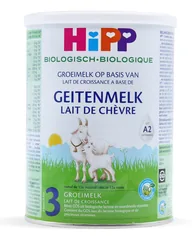
HiPP Dutch Goat Stage 3 is an organic milk from goat's milk for children from the twelfth month, drunk from a cup. Its front calls it a growing-up milk, while its legal name calls it an organic follow-on formula. It has less energy per 100 ml than goat Stage 2, a 4 g scoop, and galacto-oligosaccharides but no culture, in a 400 g tin. HiPP's Dutch site now lists only goat Stages 1 and 2, and the NHS says children from one to five do not need formula milks.
Key takeaways
- Labelled from the twelfth month on the front, which begins at eleven months, for a child drinking from a cup.
- Per 100 ml it has 60 kcal, where goat Stage 2 has 68 kcal.
- HiPP's Dutch site lists only goat Stages 1 and 2; this tin's label is still on HiPP's file server.
- The NHS says pasteurised whole cow's or goat's milk can be a child's main drink from one year.
Buy from Organic Life Start
Out of stock- DeliveryShips when restocked, then 1 to 6 business days
- Sold and shipped byOrganic Life Start, our partner retailer
- Price per oz$2.96 for one 400 g tin (14.1 oz)
- Prices seenLast checked
Waitlist
What is in HiPP Dutch Goat Stage 3?
The Dutch ingredient list starts with goat's milk and lactose, then organic palm, rapeseed and sunflower oil and goat's milk powder, with no whey; the French list on the same tin calls both milks skimmed.2
Fish oil adds DHA at 12 mg per 100 ml, and HiPP adds galacto-oligosaccharides from organic lactose, with no lactic culture.2
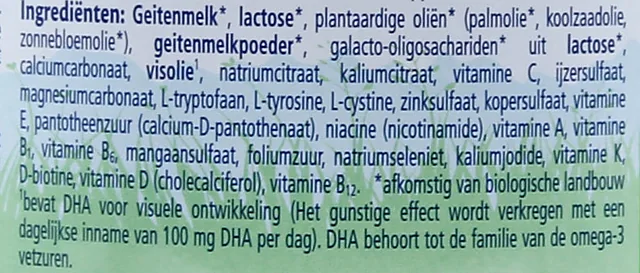
Nutrition per 100 ml, prepared
| Nutrient | Per 100 ml | Per 100 kcal | EU min to max |
|---|---|---|---|
| Energy, fat, carbohydrate and protein | |||
| Energy | 60 kcal | 100 kcal | 60 to 70 kcal per 100 ml |
| Fat | 3.2 g | 5.3 g | 4.4 to 6.0 g |
| of which saturates | 1.3 g | 2.2 g | |
| of which monounsaturates | 1.5 g | 2.5 g | |
| of which polyunsaturates | 0.4 g | 0.67 g | |
| Linoleic acid | 0.36 g | 0.6 g | |
| DHA | 12.0 mg | 20 mg | 20 to 50 mg |
| Carbohydrate | 6.2 g | 10.3 g | 9 to 14 g |
| of which sugars | 6.2 g | 10 g | |
| of which lactose | 6.1 g | 10.2 g | min 4.5 g |
| GOS | 0.5 g | 0.83 g | max 0.8 g per 100 ml |
| Protein | 1.4 g | 2.3 g | 1.8 to 2.5 g |
| Minerals | |||
| Sodium | 20 mg | 33 mg | |
| Potassium | 80 mg | 133 mg | |
| Chloride | 60 mg | 100 mg | |
| Calcium | 73 mg | 122 mg | 50 to 140 mg |
| Phosphorus | 40 mg | 67 mg | |
| Magnesium | 7.5 mg | 12 mg | |
| Iron | 0.90 mg | 1.5 mg | 0.6 to 2 mg |
| Zinc | 0.50 mg | 0.83 mg | |
| Copper | 0.048 mg | 0.08 mg | |
| Manganese | 0.0060 mg | 0.01 mg | |
| Fluoride | < 0.010 mg | < 0.017 mg | |
| Selenium | 2.7 µg | 4.5 µg | |
| Vitamins | |||
| Vitamin A | 49 µg | 82 µg | |
| Vitamin D | 1.6 µg | 2.7 µg | 2 to 3 µg |
| Vitamin E | 0.73 mg | 1.2 mg | |
| Vitamin K | 3.4 µg | 5.7 µg | |
| Vitamin C | 9.0 mg | 15 mg | |
| Vitamin B1 | 0.045 mg | 0.075 mg | |
| Vitamin B2 | 0.13 mg | 0.22 mg | |
| Niacin | 0.300 mg | 0.5 mg | |
| Vitamin B6 | 0.046 mg | 0.077 mg | |
| Folic acid | 7.70 µg | 13 µg | |
| Vitamin B12 | 0.20 µg | 0.33 µg | |
| Biotin | 2.5 µg | 4.2 µg | |
| Pantothenic acid | 0.31 mg | 0.52 mg | |
Values from HiPP's label for the Netherlands, checked 18 September 2026. The last column is the range for follow-on formula in Regulation (EU) 2016/127, Annex II, per 100 kcal unless it says per 100 ml. The label prints values per 100 ml only, so the per 100 kcal column is calculated from them.
Every value is the one printed on HiPP's label for 100 ml, made from 12 g of powder in 90 ml of water. Beside goat Stage 2 it has less energy, fat and DHA, the same protein and a little less iron.29
How do you prepare it?
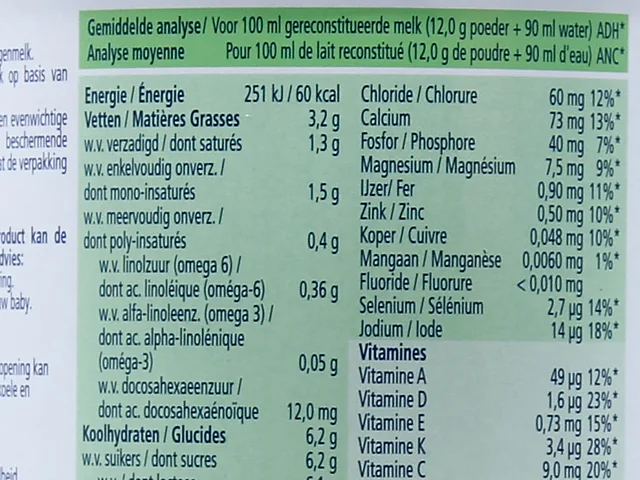
Boil fresh drinking water and let it cool to 40 to 50 °C, then add one level scoop (4 g) for every 30 ml. Shake it, cool it to about body temperature and check it; an opened tin, closed well, keeps for 3 weeks.2
| Water | Scoops | Powder | Feed size | Water temp. |
|---|---|---|---|---|
| 30 ml · 1 fl oz | 1 | 4.0 g | 33 ml · 1.1 fl oz | 40 to 50 °C · 104 to 122 °F |
| 90 ml · 3 fl oz | 3 | 12.0 g | 100 ml · 3.4 fl oz | 40 to 50 °C · 104 to 122 °F |
| 120 ml · 4 fl oz | 4 | 16.0 g | 133 ml · 4.5 fl oz | 40 to 50 °C · 104 to 122 °F |
| 150 ml · 5 fl oz | 5 | 20.0 g | 167 ml · 5.6 fl oz | 40 to 50 °C · 104 to 122 °F |
| 180 ml · 6 fl oz | 6 | 24.0 g | 200 ml · 6.8 fl oz | 40 to 50 °C · 104 to 122 °F |
| 210 ml · 7 fl oz | 7 | 28.0 g | 233 ml · 7.9 fl oz | 40 to 50 °C · 104 to 122 °F |
One scoop is 4 g, level, not packed. The feed size column is the volume in the bottle after the powder dissolves.
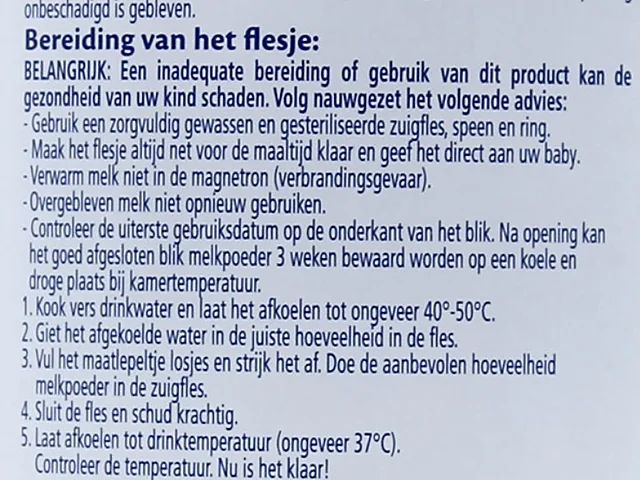
- Kook vers drinkwater en laat het afkoelen tot ongeveer 40°-50°C.
- Boil fresh drinking water and let it cool to about 40 to 50 °C.
- Gebruik altijd 1 maatlepel (4,0 g) voor 30 ml water.
- Always use one scoop (4.0 g) for every 30 ml of water.
- is bedoeld voor kinderen vanaf het einde van de 11e maand en wordt uit een beker gedronken.
- It is meant for children from the end of the eleventh month and is drunk from a cup.
How much should a baby drink?
| Made-up bottle | Boiled water | Scoops |
|---|---|---|
| 100 ml | 90 ml | 3 |
| 200 ml | 180 ml | 6 |
The pack gives bottle sizes rather than ages, so this is what it prints and all it prints. How much a child takes varies, and a hungry or sleepy child is a better guide than the table.
The tin gives two cup sizes rather than a daily total, and offers the milk with meals, such as with muesli, or as a snack.2
Who is it for, and who is it not for?
The notices say it can be part of a varied diet from the end of the eleventh month, drunk from a cup, and must not replace breast milk in the first six months; the front says from the twelfth month.2
It warns in bold that its proteins are similar to cow's milk proteins, so it must not be used when a cow's milk protein allergy exists or is suspected.2
What buyers say
256 reviews of this product, gathered from the sellers' own review pages, all of them counted in the rating. The newest are below as their buyers wrote them, each showing where it was written and linking to it; a review is one buyer's experience, not evidence. The rating is this product's alone, never pooled with other products or with a seller's store rating, and milkatlas edits none of them.
- 5 ★100 %
- 4 ★0 %
- 3 ★0 %
- 2 ★0 %
- 1 ★0 %
- Organic Life Start5.0 · 254
- Formuland5.0 · 2
★★★★★ Madison B. Verified buyer on Organic Life Start
This has been a great choice for our next stage, and we’ve had a really positive experience with it. The little one enjoys every bottle, and watching them grow makes it feel like such a good choice.
★★★★★ Asa B. Verified buyer on Organic Life Start
Coralie has had great success using HiPP Dutch Goat Stage 3 when she has had trouble with constipation.
★★★★★ Infant L. Verified buyer on Organic Life Start
The formula has worked well for our baby and hasn’t caused any digestive problems. Shipping was also quicker than expected. No complaints so far.
★★★★★ Gianna P. Verified buyer on Organic Life Start
We moved to this stage when the time was right, and it has been a really easy transition. My little one enjoys the bottles and seems perfectly happy with the change.
Questions parents ask
Does a toddler need HiPP Dutch Goat Stage 3?
Most do not. The NHS says children aged one to five do not need formula milks, growing-up milks included, and that pasteurised whole cow's or goat's milk can be the main drink from one year. The American Academy of Pediatrics calls toddler formulas unnecessary for most children and advises whole cow's milk from twelve months. Ask your pediatrician if your child eats very little.
Is HiPP Dutch Goat Stage 3 still sold?
HiPP's Dutch site now lists only goat Stages 1 and 2, though this tin's label file is still on HiPP's server. Check the best-before date on the bottom of the tin before you buy.
Is it a growing-up milk or a follow-on formula?
The label says both. The front calls it a growing-up milk from the twelfth month; the legal name beside HiPP's address is organic follow-on formula, and the notices say it can join a varied diet from the end of the eleventh month. This site follows the legal name.
Can HiPP goat's milk formula be used for a cow's milk allergy?
No. The tin says in bold that it contains proteins similar to those of cow's milk and must not be used when a cow's milk protein allergy exists or is suspected.
How much HiPP Dutch Goat Stage 3 should a child drink?
The tin gives two amounts rather than a daily total: 100 ml of milk from 90 ml of water and 3 scoops, or 200 ml from 180 ml and 6, and says the amounts are a guide and need not be finished.
How is Stage 3 different from goat Stage 2?
Less energy, fat and DHA per 100 ml, a little less iron, and a smaller 4 g scoop, to drink from a cup.
Is HiPP Dutch Goat Stage 3 organic?
Yes. It carries the EU organic logo and the Dutch EKO mark, like HiPP's two other Dutch goat's milk tins.
Is HiPP Dutch Goat Stage 3 sold in the United States?
Not by HiPP. It is made in Germany for the Dutch market and printed in Dutch and French, and the sellers that offer it in the US import it.
Sources
- HiPP Netherlands, HiPP BIO Geitenmelk HiPP's Dutch goat's milk range: Stage 1 and Stage 2 only, a list the page renders with script: read in a browser, 21 September 2026 fetched 18 September 2026
- HiPP Netherlands, label of HiPP 3 Biologische Groeimelk op basis van Geitenmelk (NL20005), on hipp.nl's file server but not linked from any page artwork NL20005_9980518_V1_1-21 (version 1, January 2021; file dated February 2022): names on the front and the legal-name line, age, ingredients and allergens, composition per 100 ml, scoop, standard dilution, preparation and water temperature, feeding chart, storage after opening, Geproduceerd in Duitsland (made in Germany), organic logos, label block, article number and barcode; the full nutrition panel as printed, every row, read from the label image because the file carries no text layer fetched 22 September 2026
- The partner retailer's listing for HiPP Dutch Goat Stage 3 barcode of the single pack, the pack photo, and the photographs of its ingredients, nutrition and preparation panels (the panels read on 25 September 2026) fetched 18 September 2026
- Regulation (EU) 2016/127 compositional requirements for infant formula (Annex I) and follow-on formula (Annex II) fetched 18 September 2026
- CDC, Infant formula preparation and storage water around 70 °C for babies younger than two months, born early or with a weakened immune system fetched 18 September 2026
- NHS, Types of formula first infant formula through the first year; no benefit in switching to follow-on formula at six months; never under six months; no evidence that babies settle better on formula with more casein; goat, comfort, anti-reflux, hypoallergenic and growing-up milks fetched 18 September 2026
- EFSA Panel on Dietetic Products, Nutrition and Allergies, 2012, EFSA Journal 10(3):2603 goat milk protein can be suitable as a protein source for infant and follow-on formula; a trial of 200 infants found no significant differences in growth against cow's milk formula fetched 18 September 2026
- American Academy of Pediatrics, Most toddlers don't need toddler formula toddler formulas are unnecessary for most children; whole cow's milk from 12 months; 20 October 2023 fetched 18 September 2026
- HiPP Netherlands, label of HiPP 2 Biologische Opvolgmelk op basis van Geitenmelk (NL20004) the goat Stage 2, for comparison; the full nutrition panel as printed, every row, read from the label image because the file carries no text layer fetched 22 September 2026
Corrections (1)
- The page had said the tin is labelled from twelve months. Its front says from the twelfth month, which begins at eleven months, and its notices say from the end of the eleventh month; the page and the age in its data now say so. (before publication)