HiPP German Stage 2 ready to feed HiPP BIO COMBIOTIK® 2, 200 ml bottle

We earn a commission when you buy through links on this page, including from our partner retailer, which sells and ships the order. How this site is funded →
The answer
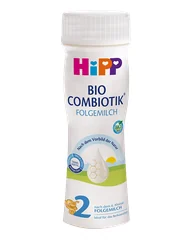
You cannot order this through milkatlas in the United States. The sellers below ship it there.
HiPP German Stage 2 ready to feed is HiPP's organic follow-on milk, already mixed and sealed in a 200 ml bottle, labelled after the sixth month for a baby who has started solids. Like the liquid Stage 1 it has no starch, where the powder does, and more lactose in its place. Its panel also leaves out the galacto-oligosaccharide figure the powder prints, and its calcium is lower.
Key takeaways
- The organic follow-on milk, ready to drink, labelled after the sixth month and alongside solids.
- No starch, where the Stage 2 powder has it, and more lactose in its place.
- The panel prints fibre but no galacto-oligosaccharide figure, though the ingredient list names them.
- Calcium is lower than in the powder, and the panel names omega-6 and omega-3 where the other bottles name arachidonic acid.
- One feeding row only: about five feeds a day of 170 to 200 ml.
Where to buy
Not sold by milkatlas in the United StatesWe do not sell this product in the United States. These sellers do; prices are what we saw on the date shown, in the currency each seller quotes.
| Seller | Price | Observed | Notes |
|---|---|---|---|
| Formuland | $5.49 | 12 Oct 2026 | Pack of 96, per unit |
| Organic's Best | $6.49 | 12 Oct 2026 | Pack of 60, per unit |
Last checked . Prices change; the seller's page is the price you pay.
We earn a commission when you buy through links on this page, including from our partner retailer, which sells and ships the order. How this site is funded →
What is in HiPP German Stage 2 ready to feed?
Organic whey product and skimmed milk come first, then water, cream, lactose, organic sunflower and rapeseed oils, galacto-oligosaccharides from lactose and a lecithin emulsifier.2
No starch appears, though the Stage 2 powder lists it. As on the liquid Stage 1, taking the starch out leaves more room for lactose, and this bottle carries more of it per 100 ml than the powder does.23
There is no lactic culture in the list, so the COMBIOTIK on the front stands for the galacto-oligosaccharides alone here too.2
Nutrition per 100 ml, prepared
| Nutrient | Per 100 ml | Per 100 kcal | EU min to max |
|---|---|---|---|
| Energy, fat, carbohydrate and protein | |||
| Energy | 68 kcal | 100 kcal | 60 to 70 kcal per 100 ml |
| Fat | 3.7 g | 5.4 g | 4.4 to 6.0 g |
| of which saturates | 1.4 g | 2.1 g | |
| of which monounsaturates | 1.8 g | 2.6 g | |
| of which polyunsaturates | 0.5 g | 0.74 g | |
| Linoleic acid | 0.42 g | 0.62 g | |
| DHA | 13.6 mg | 20 mg | 20 to 50 mg |
| Carbohydrate | 7.2 g | 10.6 g | 9 to 14 g |
| of which sugars | 7.2 g | 11 g | |
| of which lactose | 7.0 g | 10.3 g | min 4.5 g |
| Fibre | 0.5 g | 0.74 g | |
| Protein | 1.3 g | 1.9 g | 1.8 to 2.5 g |
| Minerals | |||
| Sodium | 20 mg | 29 mg | |
| Potassium | 84 mg | 124 mg | |
| Chloride | 52 mg | 76 mg | |
| Calcium | 70 mg | 103 mg | 50 to 140 mg |
| Phosphorus | 40 mg | 59 mg | |
| Magnesium | 6.3 mg | 9.3 mg | |
| Iron | 1.0 mg | 1.5 mg | 0.6 to 2 mg |
| Zinc | 0.50 mg | 0.74 mg | |
| Copper | 0.054 mg | 0.079 mg | |
| Manganese | 0.0070 mg | 0.01 mg | |
| Fluoride | < 0.0050 mg | < 0.0074 mg | |
| Selenium | 3.9 µg | 5.7 µg | |
| Iodine | 15 µg | 22 µg | |
| Vitamins | |||
| Vitamin A | 56 µg | 82 µg | |
| Vitamin D | 1.6 µg | 2.4 µg | 2 to 3 µg |
| Vitamin E | 0.80 mg | 1.2 mg | |
| Vitamin K | 3.1 µg | 4.6 µg | |
| Vitamin C | 10 mg | 15 mg | |
| Vitamin B1 | 0.040 mg | 0.059 mg | |
| Vitamin B2 | 0.14 mg | 0.21 mg | |
| Niacin | 0.53 mg | 0.78 mg | |
| Vitamin B6 | 0.040 mg | 0.059 mg | |
| Vitamin B12 | 0.10 µg | 0.15 µg | |
| Biotin | 1.6 µg | 2.4 µg | |
| Pantothenic acid | 0.35 mg | 0.51 mg | |
Values from HiPP's label for Germany, checked 21 September 2026. The last column is the range for follow-on formula in Regulation (EU) 2016/127, Annex II, per 100 kcal unless it says per 100 ml. The label prints values per 100 ml only, so the per 100 kcal column is calculated from them.
The values are for the milk as poured. Energy, protein, fat, carbohydrate, DHA, iron and vitamin D match the Stage 2 powder; lactose is higher, calcium is lower, and the galacto-oligosaccharide row the powder prints is missing from this panel.23
This is also the one bottle of the four whose panel names linoleic and alpha-linolenic acid instead of arachidonic acid.2
How do you prepare it?
Shake the sealed bottle, open it, pour what you need into a feeding bottle and warm it to about 40 °C. Let it cool to about 37 °C, check it, feed it at once and throw away what is left.2
Nothing is added: the bottle is already at drinking strength. Pour out what you need, warm it to about 40 °C, check it at about 37 °C, and keep an opened bottle in the fridge for no longer than 24 hours.
- Die noch versiegelte Flasche vor dem ersten Öffnen kräftig schütteln.
- Shake the still-sealed bottle hard before opening it for the first time.
- Benötigte Trinkmenge in ein Fläschchen füllen und auf ca. 40 °C erwärmen.
- Pour the amount you need into a feeding bottle and warm it to about 40 °C.
- Nahrung nicht in der Mikrowelle erhitzen (Verbrühungsgefahr).
- Do not heat the feed in a microwave: it can scald.
- Geöffnetes, unerwärmtes Fläschchen verschlossen im Kühlschrank (max. 6 °C) aufbewahren und innerhalb von 24h aufbrauchen.
- Keep an opened, unwarmed bottle closed in the fridge at no more than 6 °C and use it within 24 hours.
How much should a baby drink?
| Age | Feeds a day | Ready to drink | Milk a day |
|---|---|---|---|
| From month 6 | 5 | 170 to 200 ml | 850 to 1000 ml |
HiPP's own chart from the pack; milk a day is feeds times the bottle. Babies vary, and a hungry or sleepy baby is a better guide than the table.
Where the PRE and Stage 1 bottles print a chart by age, this one prints a single row and a sentence beside it: babies need about five meals a day. By the age this milk is for, most of what a baby eats is solid food.2
Who is it for, and who is it not for?
The bottle carries the follow-on notice: breastfeeding for the first six months is ideal, and a follow-on milk is not a breast milk substitute before then, but part of a mixed diet afterwards.2
It is cow's milk formula, not lactose-free, and not for a baby with a diagnosed cow's milk protein allergy.26
What buyers say
23 reviews of this product, gathered from the sellers' own review pages, all of them counted in the rating. The newest are below as their buyers wrote them, each showing where it was written and linking to it; a review is one buyer's experience, not evidence. The rating is this product's alone, never pooled with other products or with a seller's store rating, and milkatlas edits none of them.
- 5 ★91 %
- 4 ★0 %
- 3 ★4 %
- 2 ★0 %
- 1 ★4 %
- Formuland4.7 · 18
- Organic's Best5.0 · 5
★★★★★ Amber M. Verified buyer on Formuland
My daughter loves the milk and as a mother it’s so easy for on the go! Super convenient
★★★★★ Samina R. Verified buyer on Organic's Best
Great and highly recommend!
★★★★★ Catherine S. Verified buyer on Formuland
We've been using HiPP Stage 2 Ready to Feed for our baby, and it's been excellent. It's very convenient for travel, outings, and late-night feedings since there's no mixing required. Our baby enjoys it, digests it well, and we've had no issues transitioning from Stage 1.
★★★★★ Xueyi W. Verified buyer on Organic's Best
My baby love it
Questions parents ask
When can a baby have HiPP Stage 2 ready to feed?
After the sixth month, the bottle says, alongside solids. It is a follow-on milk, not a breast milk substitute for the first six months.
Is it the same as the Stage 2 powder?
No. This liquid has no starch, where the powder does, and carries more lactose instead. Its calcium is lower than the powder's, and its panel prints no galacto-oligosaccharide figure at all, although the ingredient list names them.
Is it the same as the German Stage 2 without starch?
They are two different packs that share one idea. HiPP sells a powder Stage 2 without starch as its own box, for parents who want a follow-on milk that has not been thickened, and this bottle has no starch either. They are not the same recipe, and their panels do not match value for value. Compare the two tables rather than the names.
Why is there no GOS figure on the panel?
HiPP prints a fibre figure and stops there. The ingredient list names galacto-oligosaccharides made from lactose, so they are in it, but the pack does not say how much, and this site does not calculate a figure HiPP has not printed.
How much should a baby drink?
The pack gives one row rather than an age chart: about five feeds a day, each of 170 to 200 ml, marked as a guide that can vary.
Does a baby need a follow-on milk at all?
No. HiPP's own German advice says moving on from a first formula is possible but not required, and the NHS says there is no benefit in switching to a follow-on formula at six months: a first milk can stay the milk through the whole first year. Follow-on milks exist because the law makes room for them, not because a baby reaches an age that needs one.
How long does an opened bottle keep?
Closed in the fridge at no more than 6 °C, and used within 24 hours, so long as it has not been warmed. Warm only what the baby will drink.
Is it organic?
Yes. Its legal name is organic follow-on milk and its milk, cream, lactose, oils and galacto-oligosaccharides all carry the organic mark.
Does it have fish oil or palm oil?
Neither. Its oils are sunflower and rapeseed, its DHA comes from algal oil rather than fish oil, and its allergen line names milk alone, where the powder Stage 2 declares milk and fish.
What does the DHA claim on the front mean?
It is the wording EU law sets for that claim: DHA contributes to the normal development of vision, and the effect follows a daily intake of 100 mg of DHA. HiPP prints the condition as well as the claim.
Sources
- HiPP Germany, product page for HiPP 2 Bio Combiotik trinkfertig 200 ml the product, its size and the link to its pack artwork fetched 21 September 2026
- HiPP pack artwork (sleeve label) for HiPP 2 Bio Combiotik trinkfertig 200 ml, article 2225-01, version V1 08/24 (print file 24_0903EM 46504), linked from that page legal name, composition per 100 ml, ingredients, preparation and storage panel, feeding chart, EAN, article number, Hergestellt in Deutschland, front-of-pack claims; the full nutrition panel as printed, every row fetched 22 September 2026
- HiPP pack artwork for HiPP 2 Bio Combiotik 600 g, version 6 (April 2025) the powder Stage 2, for comparison: starch in the ingredients and the panel, a galacto-oligosaccharide figure, calcium per 100 ml fetched 18 September 2026
- Regulation (EU) 2016/127 compositional requirements for infant formula (Annex I) and follow-on formula (Annex II) fetched 18 September 2026
- CDC, Infant formula preparation and storage the extra preparation steps for a baby under two months, born early or with a weakened immune system are written for powdered formula; ready-to-feed formula where water cannot be made safe by boiling fetched 21 September 2026
- NHS, Types of formula formula comes as a dry powder or a ready-to-feed liquid; ready-to-feed tends to be more expensive and, once opened, needs to be used more quickly; no benefit in switching to a follow-on formula at six months fetched 21 September 2026
- HiPP Germany, Was muss ich beim Umstellen von Milchnahrungen beachten? moving on from a first formula is possible but not required fetched 18 September 2026
Corrections (0)
None since this page was published. How we correct mistakes