HiPP ready to feed vs powder

We earn a commission when you buy through links on this page, including from our partner retailer, which sells and ships the order. How this site is funded →
The answer
HiPP ready to feed is not the powder of the same name with water added. Reading all six German labels against their boxes: not one liquid carries the lactic culture the powders carry, the liquid Stage 1 and Stage 2 have no starch where both powders do, and the liquids take their long-chain fats from algal oil rather than fish oil. The nutrition panels are close, and most rows are identical. The ingredient lists are not.
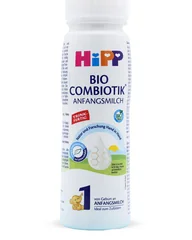 HiPP German Stage 1 ready to feed2224-02 · 200 ml bottleNo culture, no starch, no fish oil; sterile until you open it, and dearer per feed.
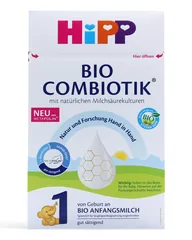 HiPP German Stage 12031-02 · 600 g boxThe culture, the starch and the fish oil; cheaper per feed, and not sterile until you make it up.
Key takeaways
- Every HiPP ready-to-feed label we have read lists galacto-oligosaccharides and no lactic culture, though the front says COMBIOTIK.
- The liquid Stage 1 and Stage 2 have no starch, where both powders do, and carry more lactose instead.
- The liquids use algal oil rather than fish oil, so most of them declare milk alone where the boxes declare milk and fish.
- Milk sealed in the bottle is sterile; powder is not, which is what the water temperature rules are about.
- Ready to feed costs several times more per feed, which is the NHS's own summary of the trade.
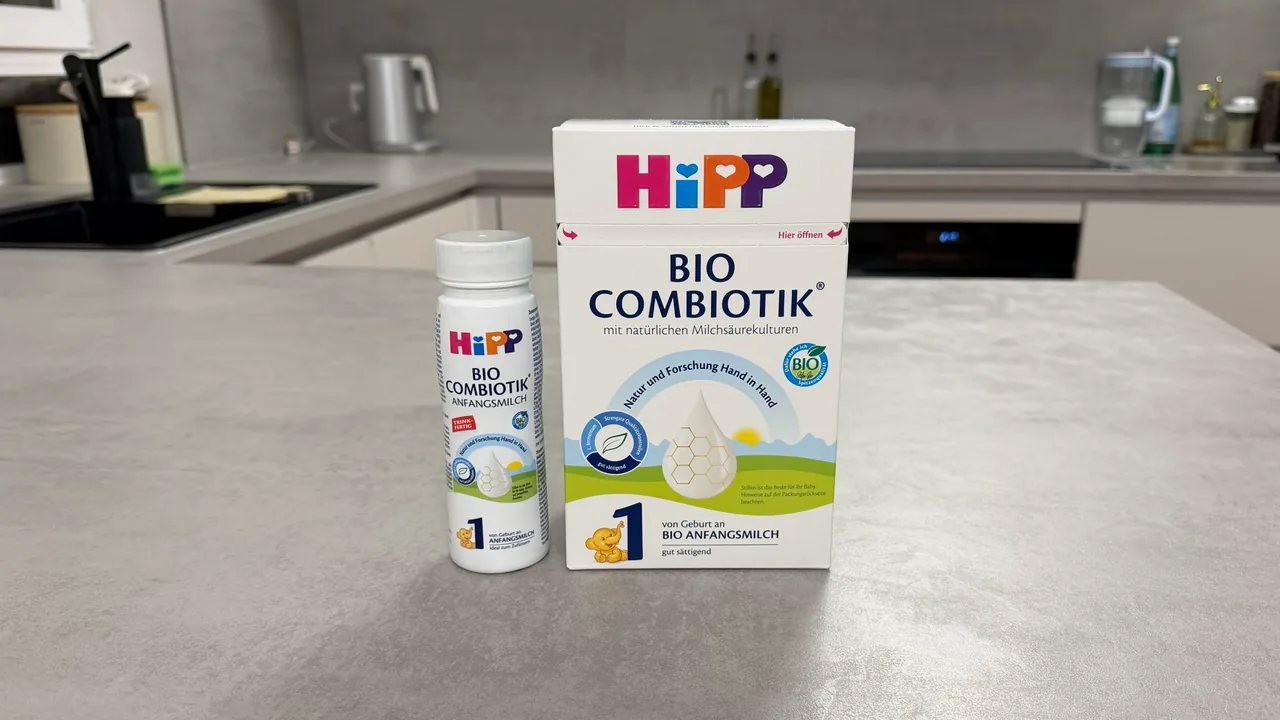
How do the liquid and the powder compare?
| HiPP German Stage 1 ready to feed | HiPP German Stage 1 | |
|---|---|---|
| Age | From birth | From birth |
| Size | 200 ml bottle | 600 g box |
| Article code | 2224-02 | 2031-02 |
| Base | Cow's milk: whey product, skimmed milk and cream | Cow's milk: skimmed milk and whey |
| Protein | 1.3 g | 1.3 g |
| Carbohydrate | 7.1 g · Lactose only | 7.1 g · Lactose and starch |
| Starch | No | Yes |
| Fat | 3.6 g | 3.6 g |
| DHA | 13.4 mg | 13.4 mg |
| GOS | 0.3 g | 0.3 g |
| Combiotik | GOS only | GOS + L. fermentum |
| Scoop | None: ready to drink | 4.4 g per 30 ml |
| Price at Organic Life Start, United States | Not sold by Organic Life Start | $40.79 · $6.80 per 100 g |
Nutrition from each product's panel, fetched 21 September 2026. Prices seen 15 October 2026.
Energy, protein, fat and total carbohydrate are identical, and so are most of the other rows both panels print. Lactose moves, for a reason you can read in the ingredient list rather than the table: 7.1 g in the bottle against 5.9 g in the box, which adds 1.0 g of starch.12
L-carnitine, potassium, vitamin B2 and inositol differ as well, and so does the split between saturated and monounsaturated fat. Neither label says why.12
Why is there no lactic culture in the bottles?
Because HiPP does not put one in them. Every ready-to-feed label we have read lists galacto-oligosaccharides and stops there, while the boxes of the same name list a natural lactic culture as well.1235
The fronts still say COMBIOTIK, which is HiPP's name for pairing the prebiotic with the culture. On a bottle it covers the prebiotic alone.3
What else is in one and not the other?
Starch. The powder Stage 1 lists organic starch fourth and prints a starch row in its panel; the liquid has neither, and carries more lactose in its place. The same is true of Stage 2.1256
The fats differ too. The boxes use palm, rapeseed and sunflower oil with fish oil; the bottles use sunflower and rapeseed with algal oil and Mortierella alpina oil. That is why most bottles declare milk alone and the boxes declare milk and fish.12
Is the liquid safer than the powder?
Sealed, yes, in one specific way: the milk in an unopened bottle is sterile and powdered formula is not. That is the whole reason the preparation rules argue about water temperature.8
The CDC writes its extra steps for powder, and names ready-to-feed formula for emergencies where water cannot be made safe by boiling. Once a bottle is open, it is food like any other: a poured feed within two hours, the rest in the fridge for a day.83
Which should you buy?
Powder is several times cheaper per feed, and the NHS says as much: ready-to-feed costs more and has to be used more quickly once opened.7
Against that, a bottle needs no water, no kettle and no scoop, which is worth most at three in the morning, in a car, or in the week you come home from hospital.37
Questions parents ask
Is HiPP ready to feed the same formula as the powder?
Close on the numbers, different on the label. Take the German Stage 1: most rows of the two panels match, lactose moves because the liquid has no starch, and a handful of vitamins and minerals differ besides. The ingredient lists differ in three ways, and one of them is the lactic culture that gives the range its name.
Why is there no probiotic in the liquid?
HiPP does not say. Every ready-to-feed label we have read lists galacto-oligosaccharides and no culture, so on these bottles Combiotik covers the prebiotic alone.
Which has more lactose?
The liquid, on the pairs where the powder has starch. Taking the starch out leaves the carbohydrate to lactose, so the liquid Stage 1 and Stage 2 both carry about a gram more per 100 ml than their boxes do.
Is ready to feed safer than powder?
Sealed, it is sterile, and powdered formula is not: that is why the CDC writes extra preparation steps for powder and for babies under two months, born early or with a weakened immune system, and why it names ready-to-feed formula when water cannot be made safe. Once you open a bottle, the usual hygiene rules apply to it too.
Does ready to feed contain fish oil?
No. The liquids take DHA from the microalga Schizochytrium and arachidonic acid from Mortierella alpina oil. Most of them declare milk as their only allergen, where the boxes declare milk and fish.
Is powder cheaper?
Several times cheaper per feed, which the NHS says plainly: ready-to-feed is more expensive and has to be used more quickly once opened. The sellers table on each product page gives the price of one bottle.
Can I mix the two, powder at home and bottles out?
Nothing on either pack forbids it, and the milks are close enough that most babies will not notice. If your baby has a medical condition or is very young, ask your pediatrician before changing anything about the feeds.
Does ready to feed taste different?
It may, because the recipes are not identical and heat treatment differs, but neither HiPP nor this site has tested that, so we will not claim a difference we cannot show.
How long does each keep once opened?
An opened ready-to-feed bottle keeps a day in the fridge, unwarmed, and a poured feed is used within two hours. An opened box of powder keeps for weeks: HiPP prints three on the German boxes.
Which should I choose?
Powder for everyday feeds, bottles for the night, the car and the first days at home. That is the answer for most families, and cost is the reason.
Sources
- HiPP pack artwork for HiPP 1 Bio Combiotik trinkfertig 200 ml (2224-02), version V2 06/25 the liquid Stage 1: no starch in the ingredients or the panel, no lactic culture, sunflower and rapeseed oil with algal and Mortierella alpina oil, milk as the only allergen fetched 21 September 2026
- HiPP pack artwork for HiPP 1 Bio Combiotik 600 g, version 8 (May 2025) the powder Stage 1: organic starch fourth in the list and a starch row in the panel, a natural lactic culture, palm, rapeseed and sunflower oil with fish oil, milk and fish as allergens fetched 18 September 2026
- HiPP pack artwork for HiPP PRE Bio Combiotik trinkfertig 200 ml (2227-05), version V1 05/26 the liquid PRE, as printed from 2026: no lactic culture, taurine marked new, room temperature or a water bath to about 37 °C, opened bottle 24 hours at no more than 6 °C fetched 25 September 2026
- HiPP pack artwork for HiPP PRE Bio Combiotik 600 g, version 7 (May 2025) the powder PRE: the natural lactic culture and fish oil in the ingredient list, the scoop, the dilution and three weeks of use after opening fetched 18 September 2026
- HiPP pack artwork for HiPP 2 Bio Combiotik trinkfertig 200 ml (2225-01), version V1 08/24 the liquid Stage 2: no starch and no lactic culture, a fibre figure with no galacto-oligosaccharide breakdown, one feeding row fetched 21 September 2026
- HiPP pack artwork for HiPP 2 Bio Combiotik 600 g, version 6 (April 2025) the powder Stage 2: starch in the ingredients and the panel, the culture, and the galacto-oligosaccharide figure fetched 18 September 2026
- NHS, Types of formula formula comes as a dry powder or a ready-to-feed liquid; ready-to-feed tends to be more expensive and, once opened, needs to be used more quickly fetched 21 September 2026
- CDC, Infant formula preparation and storage the extra preparation steps for a baby under two months, born early or with a weakened immune system are written for powdered formula; ready-to-feed formula where water cannot be made safe by boiling fetched 21 September 2026
Corrections (1)
- The page had said nine of the ten values this site records match between the German Stage 1 bottle and box, with lactose the only one that moves. With the full panels recorded, 34 of the 42 rows both labels print match: lactose moves with the starch, and L-carnitine, potassium, vitamin B2, inositol and the split of the fats differ as well. The page now says so.