HiPP Kindermilch 2+ HiPP Kindermilch Combiotik 2+, 600 g box

We earn a commission when you buy through links on this page, including from our partner retailer, which sells and ships the order. How this site is funded →
The answer
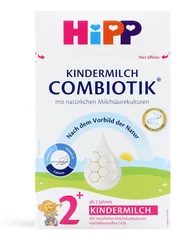
HiPP Kindermilch 2+ is HiPP's German milk drink for children from two years, made to be drunk from a cup. It is the Kindermilch 1+ recipe adjusted for an older child: less energy, fat and protein per 100 ml and more vitamin D, with the same skimmed milk base, galacto-oligosaccharides and culture L. fermentum. It is not organic. HiPP recommends 300 ml a day. The NHS says children from one to five do not need formula milks, and most two-year-olds drink cow's milk.
Key takeaways
- A milk drink for young children from two years, by the name on the box; not a formula.
- Per 100 ml it has 51 kcal, where the 1+ has 54 kcal, and more vitamin D; calcium and iron are the same.
- Not organic, unlike HiPP's German Stage 1 to 3.
- The NHS says children aged one to five do not need formula milks, growing-up milks included.
What is in HiPP Kindermilch 2+?
The ingredient list is word for word the Kindermilch 1+'s: skimmed milk, lactose and vegetable oils, palm, rapeseed and sunflower, with fish oil for DHA at 7.7 mg per 100 ml, galacto-oligosaccharides and the culture Limosilactobacillus fermentum CECT5716.29
It is not organic, and the box prints glutenfrei, gluten-free, under the ingredients.2
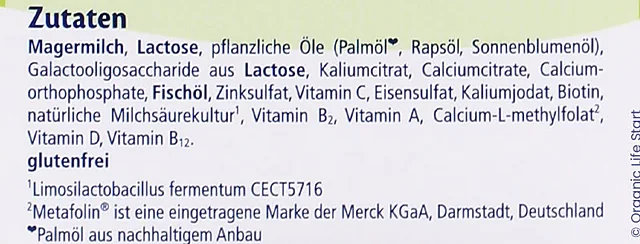
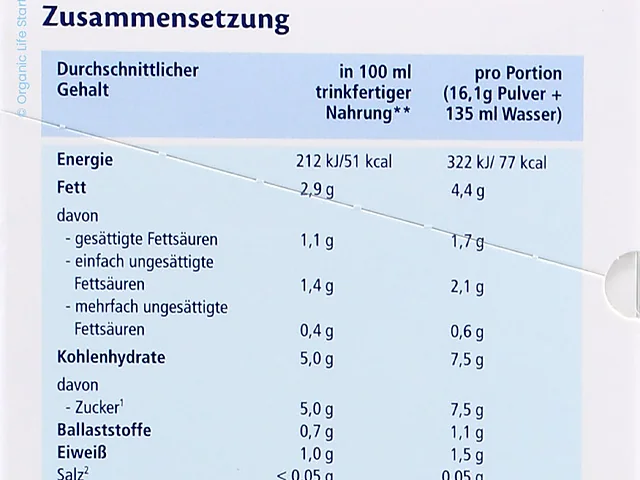
Nutrition per 100 ml, prepared
| Nutrient | Per 100 ml | Per 100 kcal |
|---|---|---|
| Energy, fat, carbohydrate and protein | ||
| Energy | 51 kcal | 100 kcal |
| Fat | 2.9 g | 5.7 g |
| of which saturates | 1.1 g | 2.2 g |
| Linoleic acid | 0.31 g | 0.61 g |
| DHA | 7.7 mg | 15 mg |
| Carbohydrate | 5.0 g | 9.8 g |
| of which sugars | 5.0 g | 9.8 g |
| Fibre | 0.7 g | 1.4 g |
| GOS | 0.7 g | 1.4 g |
| Protein | 1.0 g | 2.0 g |
| Minerals | ||
| Potassium | 155 mg | 304 mg |
| Calcium | 120 mg | 235 mg |
| Phosphorus | 61 mg | 120 mg |
| Iron | 1.2 mg | 2.4 mg |
| Zinc | 0.75 mg | 1.5 mg |
| Iodine | 14 µg | 27 µg |
| Vitamins | ||
| Vitamin A | 60 µg | 118 µg |
| Vitamin D | 2.9 µg | 5.7 µg |
| Vitamin C | 7.7 mg | 15 mg |
| Folic acid | 15.0 µg | 29 µg |
| Vitamin B12 | 0.38 µg | 0.75 µg |
| Biotin | 3.8 µg | 7.5 µg |
Values from HiPP's label for Germany, checked 18 September 2026. EU law sets no composition for formula for young children, so there is no range to set it beside. The label prints values per 100 ml only, so the per 100 kcal column is calculated from them.
Every value is the one HiPP prints for 100 ml, made from 10.7 g of powder in 90 ml of water. Beside the 1+ it has less energy, fat and protein, and more vitamin D.29
How do you prepare it?
For a warm drink, boil fresh drinking water and let it cool to 40 to 50 °C, pour it into a cup and add one level scoop of 5.4 g for every 45 ml. Stir and check the temperature; HiPP says the drink can also be made cold.2
| Water | Scoops | Powder | Feed size | Water temp. |
|---|---|---|---|---|
| 45 ml · 2 fl oz | 1 | 5.4 g | 50 ml · 1.7 fl oz | 40 to 50 °C · 104 to 122 °F |
| 90 ml · 3 fl oz | 2 | 10.8 g | 100 ml · 3.4 fl oz | 40 to 50 °C · 104 to 122 °F |
| 135 ml · 5 fl oz | 3 | 16.2 g | 150 ml · 5.1 fl oz | 40 to 50 °C · 104 to 122 °F |
| 180 ml · 6 fl oz | 4 | 21.6 g | 200 ml · 6.8 fl oz | 40 to 50 °C · 104 to 122 °F |
| 225 ml · 8 fl oz | 5 | 27.0 g | 250 ml · 8.5 fl oz | 40 to 50 °C · 104 to 122 °F |
One scoop is 5.4 g, level, not packed. The feed size column is the volume in the bottle after the powder dissolves.
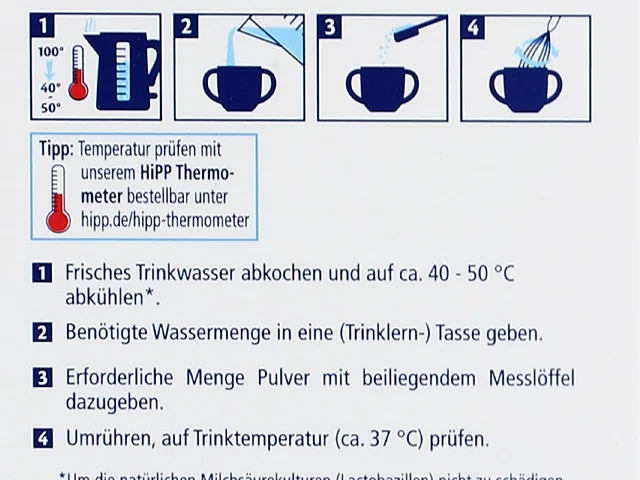
- Frisches Trinkwasser abkochen und auf ca. 40 - 50 °C abkühlen*.
- Boil fresh drinking water and let it cool to about 40 to 50 °C.
- Benötigte Wassermenge in eine (Trinklern-)Tasse geben.
- Pour the water you need into a (training) cup.
- Erforderliche Menge Pulver mit beiliegendem Messlöffel dazugeben.
- Add the powder with the scoop in the box.
- Umrühren, auf Trinktemperatur (ca. 37 °C) prüfen.
- Stir, and check it is at drinking temperature, about 37 °C.
How much should a baby drink?
| Made-up bottle | Boiled water | Scoops |
|---|---|---|
| 150 ml | 135 ml | 3 |
The pack gives bottle sizes rather than ages, so this is what it prints and all it prints. How much a child takes varies, and a hungry or sleepy child is a better guide than the table. The pack says a child needs about 2 of these a day.
HiPP recommends 300 ml a day, from a cup, as part of a meal.2
Who is it for, and who is it not for?
It is for children from two years.2
The NHS says children aged one to five do not need formula milks, growing-up milks included, and that whole or semi-skimmed cow's milk can be the main drink from one; the American Academy of Pediatrics calls toddler formulas unnecessary for most children, and the European Food Safety Authority found young-child formula no more necessary than a normal diet.654
It is made from cow's milk and contains fish oil, so it is not for a child with a diagnosed cow's milk protein allergy.2
The same stage in other markets
| Market | Product | Size | Starch | Ships to the United States | Sold by Organic Life Start |
|---|---|---|---|---|---|
| Germany | HiPP Kindermilch Combiotik 2+ (this page) | 600 g box | No | Yes | Yes, US and CA |
| Netherlands | HiPP Junior Combiotik | 800 g tin | No | Yes | Yes, US and CA |
What buyers say
278 reviews of this product, gathered from the sellers' own review pages, all of them counted in the rating. The newest are below as their buyers wrote them, each showing where it was written and linking to it; a review is one buyer's experience, not evidence. The rating is this product's alone, never pooled with other products or with a seller's store rating, and milkatlas edits none of them.
- 5 ★100 %
- 4 ★0 %
- 3 ★0 %
- 2 ★0 %
- 1 ★0 %
- Organic Life Start5.0 · 258
- Organic's Best5.0 · 15
- Formuland5.0 · 5
★★★★★ Donta V. Verified buyer on Organic Life Start
The order arrived in great condition with everything securely packaged. The boxes were protected well during shipping.
★★★★★ Pierce P. Verified buyer on Organic Life Start
My toddler seems to think every meal is a negotiation, but this is one thing that gets an easy yes. The cup is usually empty in record time, which is about as close to a parenting victory as I get.
★★★★★ Lukas D. Verified buyer on Organic Life Start
We usually mix this into my child’s morning routine and there’s no resistance or drama. It smells mild and blends quickly, which helps when things are rushed. It’s just been easy to use.
★★★★★ Abel N. Verified buyer on Organic Life Start
Our toddler adjusted nicely to HiPP Kindermilch 2+. It was easy to incorporate into meals and our everyday schedule.
Questions parents ask
Does a two-year-old need HiPP Kindermilch 2+?
Most do not. The NHS says children from one to five do not need formula milks, the European Food Safety Authority found young-child formula no more necessary than a normal diet, and the American Academy of Pediatrics calls toddler formulas unnecessary for most children. Ask your pediatrician if your child eats very little, or drinks no milk at all.
What is the difference between Kindermilch 1+ and 2+?
The age, and the recipe to match it. Per 100 ml the 2+ has less energy, fat and protein, and more vitamin D; the scoop is smaller, 5.4 g against 5.7 g, still to 45 ml of water. Calcium, iron and the ingredient list are the same on both boxes.
How much HiPP Kindermilch 2+ should a child drink?
HiPP recommends 300 ml a day, from a cup, as part of a meal, and calls that a recommendation for its own drink, not a need.
Is HiPP Kindermilch 2+ organic?
No. The box has no Bio in its name, no EU organic logo or control code, and no ingredient marked organic, unlike HiPP's German Stage 1 to 3.
Can it be made cold?
Yes. HiPP says it can be made warm or cold; for a cold drink made with tap water, it says to run the tap until the water comes out cold. For a warm drink, the box asks for boiled water cooled to 40 to 50 °C.
Is Kindermilch 2+ the same as the Dutch Junior?
They match per 100 ml on every row both packs print, though the Dutch tin prints four the German box leaves out, and both are made at 10.7 g of powder to 90 ml of water. The scoops differ, 5.4 g to 45 ml here and 3.6 g to 30 ml in the Dutch tin, so use the scoop from the pack in your hand.
What does the box claim for the milk?
It says vitamins C and D support the immune system and calcium the bones, and it describes a balanced gut flora as valuable. Those are HiPP's claims for its drink; this site does not repeat them as its own.
Is HiPP Kindermilch 2+ sold in the United States?
Not by HiPP. It is made for the German market with a German label, and the sellers that offer it in the US import it.
Sources
- HiPP Germany, product page for Kindermilch Combiotik 2+ the product, its age, and the link to its pack artwork fetched 18 September 2026
- HiPP pack artwork for HiPP Kindermilch Combiotik 2+ 600 g, version 8 (April 2025) legal name (Milchgetränk zur Ernährung von Kleinkindern), age, composition per 100 ml and per portion, ingredients and allergens, scoop, standard dilution, preparation in a cup and water temperature, daily amount and portions, use within 3 weeks of opening, article number 2035-03, 600 g, Hergestellt in Deutschland (made in Germany), the barcode on the bottom flap; the full nutrition panel as printed, every row fetched 25 September 2026
- The partner retailer's listing for HiPP Kindermilch 2+ the pack photo, and the photographs of its ingredients, nutrition and preparation panels (the panels read on 25 September 2026) fetched 18 September 2026
- European Food Safety Authority, press release on young-child formula young-child formula has no unique role and does not bring additional value to a balanced diet; 25 October 2013 fetched 18 September 2026
- American Academy of Pediatrics, Most toddlers don't need toddler formula toddler formulas are unnecessary for most children; whole cow's milk from 12 months; 20 October 2023 fetched 18 September 2026
- NHS, Types of formula first infant formula through the first year; no benefit in switching to follow-on formula at six months; never under six months; no evidence that babies settle better on formula with more casein; goat, comfort, anti-reflux, hypoallergenic and growing-up milks fetched 18 September 2026
- European Commission, Report on young-child formulae, COM(2016) 169, 31 March 2016 young-child formulae are not defined in EU legislation; EFSA: no unique role, cannot be considered a necessity; general food law sufficient to regulate them fetched 18 September 2026
- HiPP Netherlands, product page for HiPP Junior Combiotik (NL2483-04) HiPP's Dutch growing-up milk fetched 18 September 2026
- HiPP pack artwork for HiPP Kindermilch Combiotik 1+ 600 g, version 8 (April 2025) legal name (Milchgetränk zur Ernährung von Kleinkindern), age, composition per 100 ml and per portion, ingredients and allergens, scoop, standard dilution, preparation in a cup and water temperature, daily amount and portions, use within 3 weeks of opening, article number 2034-03, 600 g, Hergestellt in Deutschland (made in Germany), the barcode on the bottom flap fetched 18 September 2026
Corrections (0)
None since this page was published. How we correct mistakes