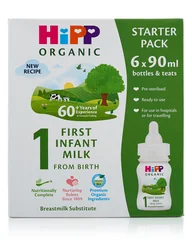
HiPP UK First Infant Milk ready to feed starter pack HiPP Organic First Infant Milk Ready to Feed Starter Pack, 6 × 90 ml starter pack

We earn a commission when you buy through links on this page, including from our partner retailer, which sells and ships the order. How this site is funded →
The answer
Catalogue entry. No seller we track ships it to the markets we cover.
HiPP UK's ready-to-feed starter pack holds six 90 ml bottles and six pre-sterilised single-use teats, article GB2371-04-KSP. It is not a different formula: every row of its panel matches HiPP UK's 200 ml bottle exactly, and it is the milk HiPP's German 90 ml bottle held until that bottle's 2026 print. What the pack buys you is the container. Each bottle takes a teat and is fed from directly, which is why HiPP UK sells it for a hospital bag.
Key takeaways
- six 90 ml bottles and six pre-sterilised single-use teats, made in Germany, labelled from birth.
- Every row of the panel matches HiPP UK's 200 ml bottle, so this is the same milk in a smaller container.
- You feed straight from the bottle with the teat supplied, which is the whole point of the pack.
- HiPP UK asks you to warm this one to 37 °C in warm water, where it allows the 200 ml bottle at room temperature.
- No seller this site tracks imports it, so the page is here for reference rather than to buy from.
Availability
Catalogue entry, not soldThis product is listed for reference. Neither milkatlas nor any seller we track ships it to the markets we cover. It is documented here because it appears in the HiPP range and parents ask about it.
Tell me if that changes
What is in HiPP UK First Infant Milk ready to feed starter pack?
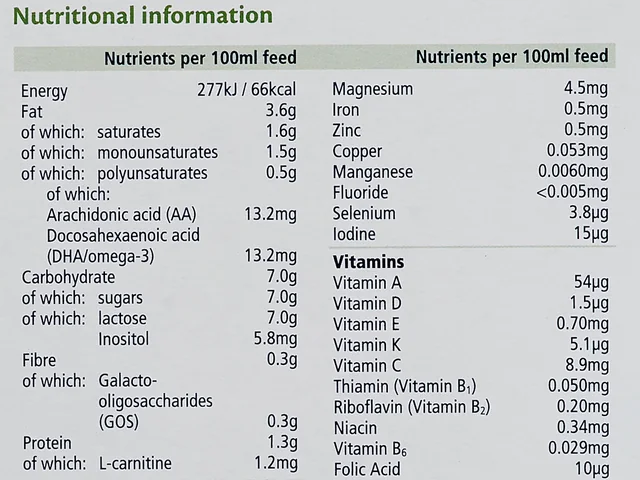
Organic whey product, organic skimmed milk and organic cream come first, then organic lactose, organic sunflower and rapeseed oils, galacto-oligosaccharides from organic lactose and a lecithin emulsifier.1
There is no lactic culture, and the long-chain fats come from algal oil and Mortierella alpina oil rather than fish oil, so the allergen line names milk alone.1
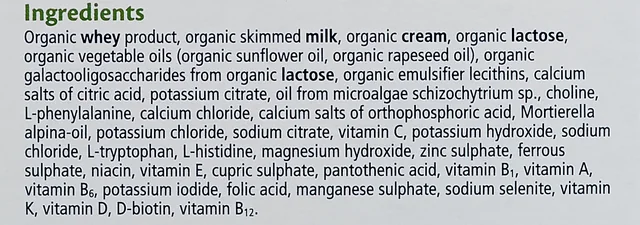
Nutrition per 100 ml, prepared
| Nutrient | Per 100 ml | Per 100 kcal |
|---|---|---|
| Energy, fat, carbohydrate and protein | ||
| Energy | 66 kcal | 100 kcal |
| Fat | 3.6 g | 5.5 g |
| of which saturates | 1.6 g | 2.4 g |
| of which monounsaturates | 1.5 g | 2.3 g |
| of which polyunsaturates | 0.5 g | 0.76 g |
| Linoleic acid | 0.36 g | 0.55 g |
| Alpha-linolenic acid | 0.06 g | 0.091 g |
| ARA | 13.2 mg | 20 mg |
| DHA | 13.2 mg | 20 mg |
| Carbohydrate | 7.0 g | 10.6 g |
| of which sugars | 7.0 g | 11 g |
| of which lactose | 7.0 g | 10.6 g |
| Fibre | 0.3 g | 0.45 g |
| GOS | 0.3 g | 0.45 g |
| Protein | 1.3 g | 2.0 g |
| L-carnitine | 1.2 mg | 1.8 mg |
| Minerals | ||
| Sodium | 20 mg | 30 mg |
| Potassium | 66 mg | 100 mg |
| Chloride | 51 mg | 77 mg |
| Calcium | 51 mg | 77 mg |
| Phosphorus | 30 mg | 45 mg |
| Magnesium | 4.5 mg | 6.8 mg |
| Iron | 0.5 mg | 0.76 mg |
| Zinc | 0.5 mg | 0.76 mg |
| Copper | 0.053 mg | 0.080 mg |
| Manganese | 0.0060 mg | 0.0091 mg |
| Fluoride | < 0.005 mg | < 0.0076 mg |
| Selenium | 3.8 µg | 5.8 µg |
| Iodine | 15 µg | 23 µg |
| Vitamins | ||
| Vitamin A | 54 µg | 82 µg |
| Vitamin D | 1.5 µg | 2.3 µg |
| Vitamin E | 0.7 mg | 1.1 mg |
| Vitamin K | 5.1 µg | 7.7 µg |
| Vitamin C | 8.9 mg | 13 mg |
| Vitamin B1 | 0.050 mg | 0.076 mg |
| Vitamin B2 | 0.20 mg | 0.30 mg |
| Niacin | 0.34 mg | 0.52 mg |
| Vitamin B6 | 0.029 mg | 0.044 mg |
| Folic acid | 10 µg | 15 µg |
| Vitamin B12 | 0.10 µg | 0.15 µg |
| Biotin | 1.5 µg | 2.3 µg |
| Pantothenic acid | 0.34 mg | 0.52 mg |
| Other nutrients | ||
| Inositol | 5.8 mg | 8.8 mg |
| Choline | 26 mg | 39 mg |
Values from HiPP's product page for the United Kingdom, checked 23 September 2026. The last column is the range for infant formula in Regulation (EU) 2016/127, Annex I, per 100 kcal unless it says per 100 ml. HiPP gives values per 100 ml only, so the per 100 kcal column is calculated from them.
HiPP UK prints these for 100 ml of the milk as poured, and every row matches its 200 ml bottle, which carries article GB2227-04.12 The panel is the reason this page is short: there is nothing to say about the recipe that the 200 ml page does not already say.
How do you prepare it?
Wash your hands, check that the bottle is not leaking and that the foil, cap and seal are intact, then shake it. Warm it to 37 °C by standing it in warm water, shake it again, attach a teat and feed straight away. Throw away what is left.1
Nothing is added: the bottle is already at drinking strength. Pour out what you need, warm it to about 37 °C, check it at about 37 °C, and keep an opened bottle in the fridge for no longer than 24 hours.
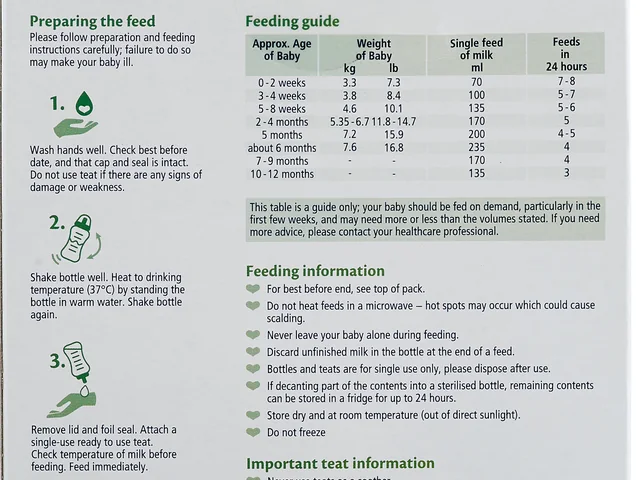
- Shake bottle well. Heat to drinking temperature (37°C) by standing the bottle in warm water. Shake bottle again.
- This bottle is warmed and fed from. The 200 ml bottle may be given at room temperature, because it is poured into a feeding bottle first.
- Remove lid and foil seal. Attach a single-use ready to use teat.
- The teat comes in the pack, already sterilised. Nothing here needs sterilising at home.
- Discard unfinished milk in the bottle at the end of a feed.
- Nothing keeps once a baby has fed from it. Only milk decanted into a sterilised bottle gets 24 hours in a fridge.
How much should a baby drink?
| Age | Feeds a day | Ready to drink | Milk a day |
|---|---|---|---|
| Weeks 0 to 2 | 7 to 8 | 70 ml | 490 to 560 ml |
| Weeks 3 to 4 | 5 to 7 | 100 ml | 500 to 700 ml |
| Weeks 5 to 8 | 5 to 6 | 135 ml | 675 to 810 ml |
| Months 2 to 4 | 5 | 170 ml | 850 ml |
| Month 5 | 4 to 5 | 200 ml | 800 to 1000 ml |
| Month 6 | 4 | 235 ml | 940 ml |
| Months 7 to 9 | 4 | 170 ml | 680 ml |
| Months 10 to 12 | 3 | 135 ml | 405 ml |
HiPP's own chart from the pack; milk a day is feeds times the bottle. Babies vary, and a hungry or sleepy baby is a better guide than the table.
The guide is HiPP UK's, the same one it prints on the bottles, running to twelve months with a typical weight beside each age.1 It is worth reading against the bottle in your hand: at 70 ml a feed in the first fortnight one bottle is a feed, and at 100 ml by the fourth week it is not.
Who is it for, and who is it not for?
It is a first infant milk, labelled from birth, and a first milk can stay a baby's milk for the whole first year.14 HiPP UK sells this pack for a hospital bag and for going out, which is a claim about the packaging rather than the milk.1
It is made from cow's milk and is not lactose free, so it is not for a baby with a diagnosed cow's milk protein allergy.1
The same stage in other markets
| Market | Product | Size | Starch | Ships to the United States | Sold by Organic Life Start |
|---|---|---|---|---|---|
| United Kingdom | HiPP Organic First Infant Milk Ready to Feed Starter Pack (this page) | 6 × 90 ml starter pack | No | No | No |
| United Kingdom | HiPP Organic First Infant Milk Ready to Feed | 200 ml bottle | No | No | No |
| United Kingdom | HiPP Organic First Infant Milk Ready to Feed | 470 ml bottle | No | No | No |
| Germany | HiPP PRE BIO COMBIOTIK® | 90 ml bottle | No | No | No |
Questions parents ask
What is in the starter pack?
six 90 ml bottles and six pre-sterilised single-use teats. HiPP UK sells it as one item at one price, and describes it as the pack for a hospital bag or for going out, because nothing has to be made up.
Is the milk different from the bottles?
No. Every row of the panel matches HiPP UK's 200 ml bottle exactly, and the ingredient lists read the same.
Why does this one have to be warmed?
Because you feed from the bottle itself. HiPP UK tells you to stand this bottle in warm water and bring it to 37 °C, where the 200 ml bottle, which you pour into a feeding bottle, may be given at room temperature. Both labels forbid a microwave, because hot spots can scald.
Do I need to sterilise anything?
Not for this pack. The bottles are sealed and the teats come pre-sterilised, which is the difference from pouring a 200 ml bottle into a feeding bottle you have sterilised yourself.
What size are the teats?
HiPP UK says they have a small perforation and a size 1 feed hole, which it calls suitable for babies from birth to six months. They are latex free and single use, and HiPP UK says never to use a feeding teat as a soother and to keep spare parts away from children. The bottles are single use too.
Can I keep an unfinished bottle?
Throw away what is left at the end of the feed. Only milk decanted into a sterilised bottle keeps, for up to 24 hours in a fridge.
Is 90 ml enough for a newborn?
For the first fortnight, about. HiPP UK's own guide puts a baby of that age at 70 ml a feed, which one bottle covers, and by three to four weeks at 100 ml, which it does not.
Is there some sediment in the bottle?
HiPP UK says it is normal to find some at the bottom before shaking, and the first instruction on the pack is to shake it well. The same note appears on its other ready-to-feed bottles.
Can I buy it outside the United Kingdom?
Not from any seller this site tracks. The importers that ship HiPP UK tins to North America list the powders and the anti-reflux tin but not this pack, and HiPP UK ships within the United Kingdom. The page is here so the range is complete and the article number is on record.
Is it the same as the German 90 ml bottle?
Not since HiPP changed the German bottle in 2026. Its new print, 2371-07, declares more magnesium and adds taurine, while this pack keeps the recipe the two shared before. The German bottle is also sold loose, by the tray, rather than with teats.
Sources
- HiPP UK, product page for HiPP Organic First Infant Milk Ready to Feed Starter Pack article number GB2371-04-KSP; six 90 ml bottles and six pre-sterilised teats; the organic ingredient list; the full nutrition table per 100 ml; warming to 37 °C in warm water; single-use bottles and teats; the size 1 teat hole for 0 to 6 months; 24 hours in a fridge once decanted; Product of Germany; the feeding guide to twelve months fetched 23 September 2026
- HiPP UK, product page for HiPP Organic First Infant Milk Ready to Feed 200ml article GB2227-04 and the same panel per 100 ml, for the comparison; its bottle is decanted into a sterilised bottle rather than fed from, and it names no warming temperature fetched 23 September 2026
- Regulation (EU) 2016/127 infant formula, and Annex I, the composition it must meet fetched 23 September 2026
- NHS, Types of formula first infant formula is the only formula a baby needs in the first year, and ready-to-feed liquid formula is sterile until it is opened fetched 23 September 2026
- HiPP pack artwork (tray lid) for HiPP PRE Bio Combiotik trinkfertig 24 x 90 ml, article 2371-07 (05/26), linked from HiPP Germany's product page the German 90 ml bottle as printed from 2026, for comparison: marked verbesserte Rezeptur, with more magnesium and added taurine per 100 ml, sold loose by the tray of 24 fetched 25 September 2026
- The partner retailer's photographs of the starter pack carton the pack photo, and its ingredients, nutrition and preparation panels, read on 3 October 2026 fetched 3 October 2026
Corrections (1)
- The page had said this is the same milk as HiPP's German 90 ml bottle. HiPP changed the German bottle in 2026, to article 2371-07, adding taurine and more magnesium, so the two now differ on those rows, and the page now says so. (before publication)