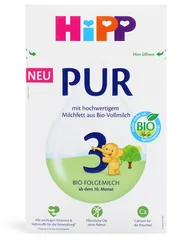
HiPP German PUR 3 HiPP 3 PUR, 500 g box

We earn a commission when you buy through links on this page, including from our partner retailer, which sells and ships the order. How this site is funded →
The answer
You cannot order this through milkatlas in the United States. The sellers below ship it there.
HiPP German PUR 3 is the last follow-on formula in HiPP Germany's newer organic PUR range, labelled from the tenth month of life, which begins at nine months. It prints PUR 2's ingredient list word for word, with organic whole milk powder at 19 %, no palm oil and no starch, but takes a smaller 4.3 g scoop and less powder per 100 ml. It has neither galacto-oligosaccharides nor a lactic culture. HiPP says moving on through its stages is not required.
Key takeaways
- Labelled from the tenth month of life, alongside solid food, as a follow-on formula.
- The same ingredient list as PUR 2, made up with less powder per 100 ml.
- No starch, where HiPP's Bio Combiotik 3 has it, and no palm oil.
- The American Academy of Pediatrics advises whole cow's milk from twelve months for most children.
Where to buy
Not sold by milkatlas in the United StatesWe do not sell this product in the United States. These sellers do; prices are what we saw on the date shown, in the currency each seller quotes.
| Seller | Price | Observed | Notes |
|---|---|---|---|
| Formuland | $27.89 | 12 Oct 2026 | Pack of 24 on subscription, per unit |
| Organic's Best | $29.99 | 12 Oct 2026 | Pack of 24, per unit |
Last checked . Prices change; the seller's page is the price you pay.
We earn a commission when you buy through links on this page, including from our partner retailer, which sells and ships the order. How this site is funded →
What is in HiPP German PUR 3?
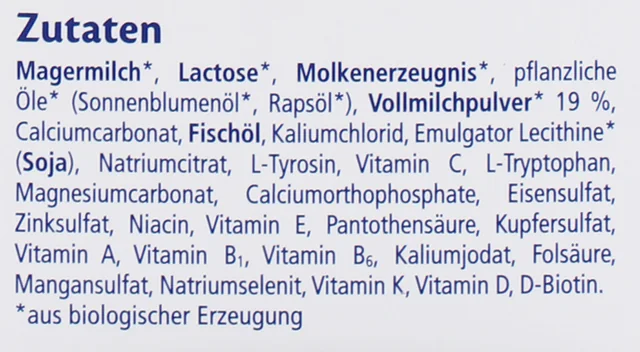
The ingredient list starts with skimmed milk, lactose and whey product, then organic sunflower and rapeseed oil and organic whole milk powder at 19 %, word for word the list on PUR 2; there is no palm oil and no starch.28
Fish oil adds DHA at 13.6 mg per 100 ml, and soy lecithin is the emulsifier. There are no galacto-oligosaccharides and no lactic culture.2
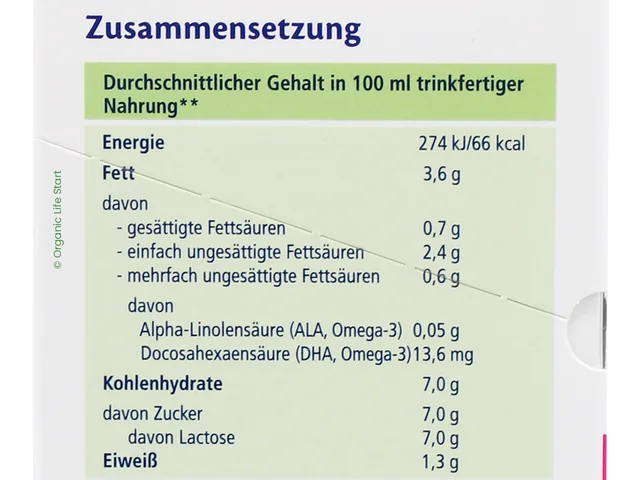
Nutrition per 100 ml, prepared
| Nutrient | Per 100 ml | Per 100 kcal | EU min to max |
|---|---|---|---|
| Energy, fat, carbohydrate and protein | |||
| Energy | 66 kcal | 100 kcal | 60 to 70 kcal per 100 ml |
| Fat | 3.6 g | 5.5 g | 4.4 to 6.0 g |
| of which saturates | 0.7 g | 1.1 g | |
| of which monounsaturates | 2.4 g | 3.6 g | |
| of which polyunsaturates | 0.6 g | 0.91 g | |
| Alpha-linolenic acid | 0.05 g | 0.076 g | |
| DHA | 13.6 mg | 21 mg | 20 to 50 mg |
| Carbohydrate | 7.0 g | 10.6 g | 9 to 14 g |
| of which sugars | 7.0 g | 11 g | |
| of which lactose | 7.0 g | 10.6 g | min 4.5 g |
| Protein | 1.3 g | 2.0 g | 1.8 to 2.5 g |
| Minerals | |||
| Sodium | 20 mg | 30 mg | |
| Potassium | 91 mg | 138 mg | |
| Chloride | 50 mg | 76 mg | |
| Calcium | 73 mg | 111 mg | 50 to 140 mg |
| Phosphorus | 40 mg | 61 mg | |
| Magnesium | 7.0 mg | 11 mg | |
| Iron | 1.0 mg | 1.5 mg | 0.6 to 2 mg |
| Zinc | 0.50 mg | 0.76 mg | |
| Copper | 0.054 mg | 0.082 mg | |
| Manganese | 0.0042 mg | 0.0064 mg | |
| Fluoride | < 0.010 mg | < 0.015 mg | |
| Selenium | 3.1 µg | 4.7 µg | |
| Iodine | 15 µg | 23 µg | |
| Vitamins | |||
| Vitamin A | 56 µg | 85 µg | |
| Vitamin D | 1.6 µg | 2.4 µg | 2 to 3 µg |
| Vitamin E | 1.4 mg | 2.1 mg | |
| Vitamin K | 3.7 µg | 5.6 µg | |
| Vitamin C | 10 mg | 15 mg | |
| Vitamin B1 | 0.049 mg | 0.074 mg | |
| Vitamin B2 | 0.16 mg | 0.24 mg | |
| Niacin | 0.52 mg | 0.79 mg | |
| Vitamin B6 | 0.042 mg | 0.064 mg | |
| Folic acid | 10.3 µg | 16 µg | |
| Vitamin B12 | 0.11 µg | 0.17 µg | |
| Biotin | 1.6 µg | 2.4 µg | |
| Pantothenic acid | 0.37 mg | 0.56 mg | |
Values from HiPP's label for Germany, checked 18 September 2026. The last column is the range for follow-on formula in Regulation (EU) 2016/127, Annex II, per 100 kcal unless it says per 100 ml. The label prints values per 100 ml only, so the per 100 kcal column is calculated from them.
Every value is the one printed on HiPP's artwork for 100 ml of made-up feed, which is 12.8 g of powder in 90 ml of water, against 13.2 g for PUR 2. Beside the Bio Combiotik 3 it has a little less energy, protein and calcium, more lactose and no starch.289
How do you prepare it?
Boil fresh drinking water and let it cool to 40 to 50 °C, pour it into the bottle and add one level scoop (4.3 g) for every 30 ml. Shake it, cool it to about body temperature and check it; an opened bag keeps for 3 weeks.2
| Water | Scoops | Powder | Feed size | Water temp. |
|---|---|---|---|---|
| 30 ml · 1 fl oz | 1 | 4.3 g | 33 ml · 1.1 fl oz | 40 to 50 °C · 104 to 122 °F |
| 90 ml · 3 fl oz | 3 | 12.9 g | 100 ml · 3.4 fl oz | 40 to 50 °C · 104 to 122 °F |
| 120 ml · 4 fl oz | 4 | 17.2 g | 133 ml · 4.5 fl oz | 40 to 50 °C · 104 to 122 °F |
| 150 ml · 5 fl oz | 5 | 21.5 g | 167 ml · 5.6 fl oz | 40 to 50 °C · 104 to 122 °F |
| 180 ml · 6 fl oz | 6 | 25.8 g | 200 ml · 6.8 fl oz | 40 to 50 °C · 104 to 122 °F |
| 210 ml · 7 fl oz | 7 | 30.1 g | 233 ml · 7.9 fl oz | 40 to 50 °C · 104 to 122 °F |
One scoop is 4.3 g, level, not packed. The feed size column is the volume in the bottle after the powder dissolves.
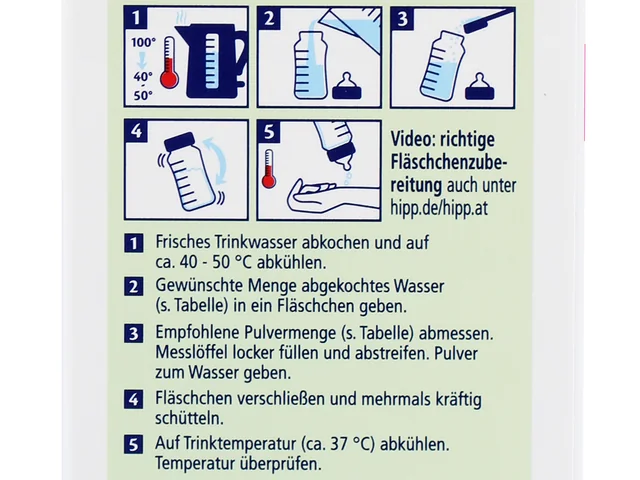
- Frisches Trinkwasser abkochen und auf ca. 40 - 50 °C abkühlen.
- Boil fresh drinking water and let it cool to about 40 to 50 °C.
- 1 gestrichener Messlöffel = ca. 4,3 g HiPP 3 PUR
- One level scoop is about 4.3 g of HiPP 3 PUR.
- Nahrung daher vor jeder Mahlzeit frisch zubereiten und sofort füttern. Nahrungsreste nicht wiederverwenden.
- Make each feed fresh and give it straight away. Do not reuse leftovers.
How much should a baby drink?
| Made-up bottle | Boiled water | Scoops |
|---|---|---|
| 170 ml | 150 ml | 5 |
| 200 ml | 180 ml | 6 |
| 235 ml | 210 ml | 7 |
The pack gives bottle sizes rather than ages, so this is what it prints and all it prints. How much a child takes varies, and a hungry or sleepy child is a better guide than the table. The pack says a child needs about 5 of these a day.
Who is it for, and who is it not for?
The box says it is made for babies from the tenth month alongside solid food, following breastfeeding or any follow-on formula, and that follow-on formula should not replace breast milk in the first six months.2
It is made from cow's milk and contains fish oil and soy, so it is not for a baby with a diagnosed cow's milk protein allergy, and it is not lactose-free.25
Questions parents ask
When can a baby start HiPP PUR 3?
From the tenth month of life, the box says, which begins when a baby turns nine months, alongside solid food. It follows breastfeeding or any follow-on formula.
What is the difference between PUR 2 and PUR 3?
The strength. The ingredient lists are the same word for word, but PUR 3 takes a 4.3 g scoop against 4.4 g and less powder per 100 ml, so it has a little less energy and fat per 100 ml. Protein, iron, vitamin D, calcium and DHA are the same, and so are the three bottle sizes.
Does my baby need PUR 3?
Nothing says so. HiPP's German advice says moving on through its stages is possible but not required, and from twelve months the American Academy of Pediatrics advises whole cow's milk for most children.
How is PUR 3 different from the Bio Combiotik 3?
PUR 3 has no starch, no palm oil and neither galacto-oligosaccharides nor the culture L. fermentum; it adds whole milk powder and soy lecithin. It also has a little less energy, protein and calcium per 100 ml, and takes a smaller scoop. Both are organic, made in Germany and labelled from the tenth month.
How many scoops of HiPP PUR 3 for a bottle?
One level scoop of 4.3 g for every 30 ml of water. The box prints the standard dilution as 12.8 g of powder in 90 ml, a touch less than three scoops, so the scoop weight is approximate.
Does HiPP PUR 3 contain soy?
Yes, as soy lecithin, the emulsifier. The box prints soy in bold among its allergens, with milk and fish oil, as PUR 2 does.
Is HiPP PUR 3 approved by the FDA?
No. The FDA does not approve infant formulas, and this box is made in Germany for the German market. No HiPP formula is on the FDA's list of formulas marketed in the United States.
What comes after HiPP PUR 3?
The box pictures HiPP's PUR Kindermilch as the next step from the twelfth month; the NHS says children from one to five do not need formula milks.
Sources
- HiPP Germany, product page for HiPP 3 PUR the product, its age, and the link to its pack artwork fetched 18 September 2026
- HiPP pack artwork for HiPP 3 PUR 500 g, version 1 (September 2025), linked from that page legal name (BIO Folgemilch), age, article number DA20015, 500 g, composition per 100 ml, ingredients and allergens, scoop, standard dilution, preparation and water temperature, feeding chart, use within 3 weeks of opening, Hergestellt in Deutschland (made in Germany), the barcode on the bottom flap; the full nutrition panel as printed, every row fetched 22 September 2026
- Regulation (EU) 2016/127 compositional requirements for infant formula (Annex I) and follow-on formula (Annex II) fetched 18 September 2026
- CDC, Infant formula preparation and storage water around 70 °C for babies younger than two months, born early or with a weakened immune system fetched 18 September 2026
- NHS, Types of formula first infant formula through the first year; no benefit in switching to follow-on formula at six months; never under six months; no evidence that babies settle better on formula with more casein; goat, comfort, anti-reflux, hypoallergenic and growing-up milks fetched 18 September 2026
- HiPP Germany, Was muss ich beim Umstellen von Milchnahrungen beachten? moving on from PRE to 1, 2 or 3 is possible but not required; PRE can be fed for the whole bottle-feeding period fetched 18 September 2026
- American Academy of Pediatrics, Most toddlers don't need toddler formula toddler formulas are unnecessary for most children; whole cow's milk from 12 months; 20 October 2023 fetched 18 September 2026
- HiPP pack artwork for HiPP 2 PUR 500 g, version 1 (September 2025), linked from that page HiPP 2 PUR, for comparison fetched 18 September 2026
- HiPP pack artwork for HiPP 3 Bio Combiotik 600 g, version 6 (May 2025) the German Stage 3, from the tenth month, with starch, for comparison fetched 18 September 2026
- The partner retailer's photographs of the HiPP 3 PUR box the pack photo, and its ingredients, composition and preparation panels, read on 2 October 2026 fetched 2 October 2026
Corrections (1)
- The page had said PUR 3 has a little less DHA per 100 ml than PUR 2. That followed HiPP's artwork for PUR 2, which prints 14.0 mg; the PUR 2 box photographed on 2 October 2026 prints 13.6 mg, the same as PUR 3. The answer now says the two have the same DHA, and that PUR 3 has a little less energy and fat. (before publication)