HiPP German HA PRE HiPP PRE HA Combiotik, 600 g box

We earn a commission when you buy through links on this page, including from our partner retailer, which sells and ships the order. How this site is funded →
The answer
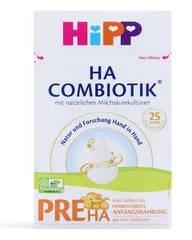
HiPP German HA PRE is HiPP's hydrolysed-protein formula from birth in Germany: its whey protein is broken down, and lactose is its only carbohydrate. It adds galacto-oligosaccharides and the culture L. fermentum, is not organic, and comes in a 600 g box, with one 4.3 g scoop per 30 ml of water. The box says it must not be used if a baby has, or is suspected of having, a cow's milk protein allergy, and the evidence does not show that hydrolysed formulas prevent allergy.
Key takeaways
- Labelled from birth, with hydrolysed whey protein and lactose as the only carbohydrate.
- The box says HA PRE must not be used if a baby has, or is suspected of having, a cow's milk protein allergy.
- Not organic, unlike the standard German PRE, and the two panels are close rather than identical: protein is printed as 1.3 g against 1.28 g, potassium as 83 mg against 76 mg, and five other rows differ a little.
- ESPGHAN found in 2024 that there is not enough evidence to recommend a hydrolysed formula for preventing cow’s milk allergy.
What is in HiPP German HA PRE?
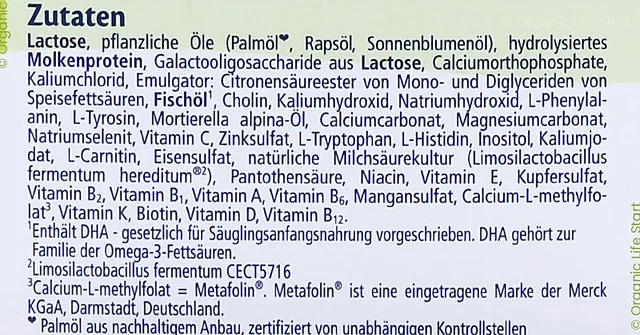
The first ingredients are lactose, then palm, rapeseed and sunflower oil, then hydrolysed whey protein, which the box calls strongly split. Lactose is the only carbohydrate, with no starch.2
Fish oil adds DHA at 13.2 mg per 100 ml, and HiPP adds galacto-oligosaccharides and the lactic culture Limosilactobacillus fermentum CECT5716. Nothing on the box is marked organic.2
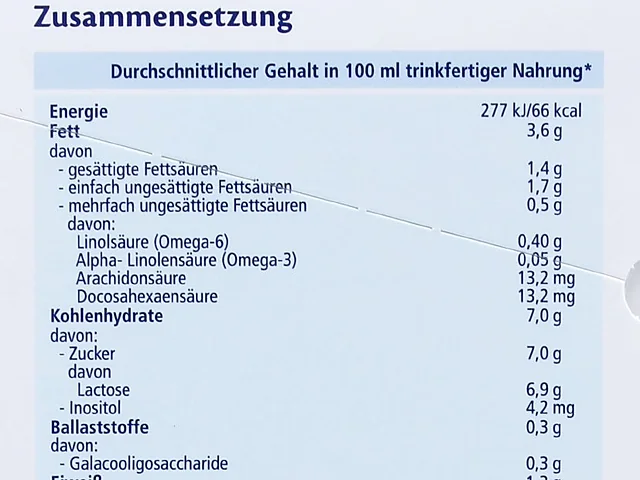
Nutrition per 100 ml, prepared
| Nutrient | Per 100 ml | Per 100 kcal | EU min to max |
|---|---|---|---|
| Energy, fat, carbohydrate and protein | |||
| Energy | 66 kcal | 100 kcal | 60 to 70 kcal per 100 ml |
| Fat | 3.6 g | 5.5 g | 4.4 to 6.0 g |
| of which saturates | 1.4 g | 2.1 g | |
| of which monounsaturates | 1.7 g | 2.6 g | |
| of which polyunsaturates | 0.5 g | 0.76 g | |
| Linoleic acid | 0.40 g | 0.61 g | |
| Alpha-linolenic acid | 0.05 g | 0.076 g | |
| ARA | 13.2 mg | 20 mg | |
| DHA | 13.2 mg | 20 mg | 20 to 50 mg |
| Carbohydrate | 7.0 g | 10.6 g | 9 to 14 g |
| of which sugars | 7.0 g | 11 g | |
| of which lactose | 6.9 g | 10.5 g | min 4.5 g |
| Fibre | 0.3 g | 0.45 g | |
| GOS | 0.3 g | 0.45 g | max 0.8 g per 100 ml |
| Protein | 1.3 g | 2.0 g | 1.86 to 2.8 g |
| L-carnitine | 1.8 mg | 2.7 mg | |
| Minerals | |||
| Sodium | 20 mg | 30 mg | |
| Potassium | 83 mg | 126 mg | |
| Chloride | 51 mg | 77 mg | |
| Calcium | 51 mg | 77 mg | 50 to 140 mg |
| Phosphorus | 27 mg | 41 mg | |
| Magnesium | 4.5 mg | 6.8 mg | |
| Iron | 0.50 mg | 0.76 mg | 0.3 to 1.3 mg |
| Zinc | 0.50 mg | 0.76 mg | |
| Copper | 0.053 mg | 0.08 mg | |
| Manganese | 0.0050 mg | 0.0076 mg | |
| Fluoride | < 0.005 mg | < 0.0076 mg | |
| Selenium | 3.8 µg | 5.8 µg | |
| Iodine | 15 µg | 23 µg | |
| Vitamins | |||
| Vitamin A | 54 µg | 82 µg | |
| Vitamin D | 1.5 µg | 2.3 µg | 2 to 3 µg |
| Vitamin E | 0.70 mg | 1.1 mg | |
| Vitamin K | 5.1 µg | 7.7 µg | |
| Vitamin C | 8.9 mg | 13 mg | |
| Vitamin B1 | 0.050 mg | 0.076 mg | |
| Vitamin B2 | 0.14 mg | 0.21 mg | |
| Niacin | 0.34 mg | 0.52 mg | |
| Vitamin B6 | 0.029 mg | 0.044 mg | |
| Folic acid | 10.0 µg | 15 µg | |
| Vitamin B12 | 0.10 µg | 0.15 µg | |
| Biotin | 1.5 µg | 2.3 µg | |
| Pantothenic acid | 0.34 mg | 0.52 mg | |
| Other nutrients | |||
| Choline | 25 mg | 38 mg | |
| Inositol | 4.2 mg | 6.4 mg | |
Values from HiPP's label for Germany, checked 18 September 2026. The last column is the range for infant formula in Regulation (EU) 2016/127, Annex I, per 100 kcal unless it says per 100 ml. The label prints values per 100 ml only, so the per 100 kcal column is calculated from them.
Every value is the one HiPP prints for 100 ml of made-up feed, which is 12.9 g of powder in 90 ml of water. The EU range for protein in the last column is the one for formula made from protein hydrolysates.24
How do you prepare it?
Boil fresh drinking water and let it cool to 40 to 50 °C, pour it into the bottle, then add one level scoop (4.3 g) for every 30 ml. Shake it hard, cool it to about body temperature and check it; HiPP says to make each bottle fresh, feed it straight away and never reuse what is left.2
| Water | Scoops | Powder | Feed size | Water temp. |
|---|---|---|---|---|
| 30 ml · 1 fl oz | 1 | 4.3 g | 33 ml · 1.1 fl oz | 40 to 50 °C · 104 to 122 °F |
| 90 ml · 3 fl oz | 3 | 12.9 g | 100 ml · 3.4 fl oz | 40 to 50 °C · 104 to 122 °F |
| 120 ml · 4 fl oz | 4 | 17.2 g | 133 ml · 4.5 fl oz | 40 to 50 °C · 104 to 122 °F |
| 150 ml · 5 fl oz | 5 | 21.5 g | 167 ml · 5.6 fl oz | 40 to 50 °C · 104 to 122 °F |
| 180 ml · 6 fl oz | 6 | 25.8 g | 200 ml · 6.8 fl oz | 40 to 50 °C · 104 to 122 °F |
| 210 ml · 7 fl oz | 7 | 30.1 g | 233 ml · 7.9 fl oz | 40 to 50 °C · 104 to 122 °F |
One scoop is 4.3 g, level, not packed. The feed size column is the volume in the bottle after the powder dissolves.
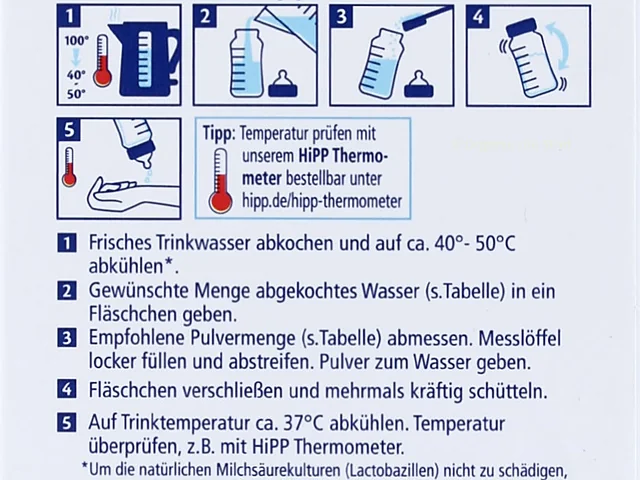
- Frisches Trinkwasser abkochen und auf ca. 40 - 50 °C abkühlen*.
- Boil fresh drinking water and let it cool to about 40 to 50 °C.
- Gewünschte Menge abgekochtes Wasser (s. Tabelle) in ein Fläschchen geben.
- Pour the amount of boiled water you need (see the table) into a bottle.
- Empfohlene Pulvermenge (s. Tabelle) abmessen. Messlöffel locker füllen und abstreifen. Pulver zum Wasser geben.
- Measure the powder the table gives. Fill the scoop loosely and level it off. Add the powder to the water.
- Fläschchen verschließen und mehrmals kräftig schütteln.
- Close the bottle and shake it hard several times.
- Auf Trinktemperatur (ca. 37 °C) abkühlen. Temperatur überprüfen.
- Let it cool to drinking temperature, about 37 °C, and check it.
How much should a baby drink?
| Age | Feeds a day | Water per feed | Scoops | Made-up bottle | Water a day |
|---|---|---|---|---|---|
| Weeks 1 to 2 | 7 to 8 | 60 ml | 2 | 70 ml | 420 to 480 ml |
| Weeks 3 to 4 | 5 to 7 | 90 ml | 3 | 100 ml | 450 to 630 ml |
| Weeks 5 to 8 | 5 to 6 | 120 ml | 4 | 135 ml | 600 to 720 ml |
| Months 3 to 4 | 5 | 150 ml | 5 | 170 ml | 750 ml |
| Month 5 | 4 to 5 | 180 ml | 6 | 200 ml | 720 to 900 ml |
| From month 6 | 4 | 210 ml | 7 | 235 ml | 840 ml |
HiPP's own chart from the pack; water a day is feeds times water per feed. Babies vary, and a hungry or sleepy baby is a better guide than the table.
The box gives the water, the scoops and the made-up bottle for each age from the first week, and calls the amounts guidelines: a baby does not have to finish the bottle.2
Who is it for, and who is it not for?
The box says it can be the only food from birth or be given alongside breast milk, after breastfeeding or another hydrolysed infant formula, and that it must not be used if a baby has, or is suspected of having, a cow's milk protein allergy.2
The NHS says a baby diagnosed with a cow's milk allergy is prescribed a hypoallergenic formula with fully broken-down protein by a GP.6
The same stage in other markets
| Market | Product | Size | Starch | Ships to the United States | Sold by Organic Life Start |
|---|---|---|---|---|---|
| Germany | HiPP PRE HA Combiotik (this page) | 600 g box | No | Yes | Yes, US and CA |
| Germany | HiPP HA 1 Combiotik | 600 g box | No | Yes | Yes, US and CA |
| Netherlands | HiPP HA 1 Combiotik | 800 g tin | No | Yes | Yes, US and CA |
What buyers say
965 reviews of this product, gathered from the sellers' own review pages, all of them counted in the rating. The newest are below as their buyers wrote them, each showing where it was written and linking to it; a review is one buyer's experience, not evidence. The rating is this product's alone, never pooled with other products or with a seller's store rating, and milkatlas edits none of them.
- 5 ★98 %
- 4 ★2 %
- 3 ★0 %
- 2 ★0 %
- 1 ★0 %
- Organic Life Start5.0 · 667
- Organic Formula Shop4.9 · 192
- Organic's Best5.0 · 60
- Formuland5.0 · 46
★★★★★ Anon Verified buyer Rewarded with a discount on Formuland
Tried all formula for my baby who has silent reflux. This was the only one he wouldn’t get extra fussy over.
★★★★★ Moises A. Verified buyer on Organic Life Start
Amelie was especially sensitive to formula, so we looked for a hypoallergenic one that would be gentler on her. We have found HiPP HA Hypoallergenic Stage Pre to be a reassuring choice and she seems much more comfortable and content during her feeds.
★★★★★ Alexis R. Verified buyer on Organic Life Start
We were nervous trying another formula after a few bad experiences, but this one surprised us. Our son adjusted within a couple of days and seems more settled now.
★★★★★ Delilah M. Verified buyer on Organic Life Start
Hipp HA Stage Pre is gentle on the most sensitive tummy!
Questions parents ask
What is the difference between HiPP HA PRE and PRE?
The protein and the organic mark. HA PRE is made with hydrolysed whey protein and is not organic; PRE uses intact cow's milk protein and is organic. Per 100 ml the panels agree on most rows and differ on seven, protein at 1.3 g against 1.28 g and potassium at 83 mg against 76 mg among them, and both take a 4.3 g scoop to 30 ml of water.
Can HiPP HA PRE be used for a cow's milk protein allergy?
No. The box says it must not be used if a baby has, or is suspected of having, a cow's milk protein allergy. A diagnosed baby needs a formula chosen by the pediatrician; the NHS says that is a hypoallergenic formula with fully broken-down protein.
Does HiPP HA PRE prevent allergies?
The evidence does not show that it does. ESPGHAN found in 2024 that there is not enough evidence to recommend a partly or extensively hydrolysed formula for preventing it, and the box itself makes no such claim.
What is the difference between HA PRE and HA 1?
Very little: the ingredient lists match word for word. HA 1 has a little more energy, iron and calcium per 100 ml and a slightly heavier scoop.
Can HA PRE be given alongside breastfeeding?
Yes. The box says it can be the only food from birth or be given alongside breast milk, and that like breast milk it can be given on demand, as often and as much as a baby wants.
Is HiPP HA PRE organic?
No. There is no Bio in its name, no EU organic logo and no organic control code on the box, unlike HiPP's German PRE Bio Combiotik.
Is HiPP HA PRE approved by the FDA?
No. The FDA does not approve infant formulas, and this box is made for the German market. No HiPP formula is on the FDA's list of formulas marketed in the United States, and the box has no US nutrition facts panel.
How long does an opened box last?
HiPP says to close the bag well, keep it dry at room temperature, and use it within 3 weeks of opening.
Why does the box say 40 to 50 °C?
So as not to damage the lactic cultures, the box says. The CDC advises water of around 70 °C for babies under two months, born early or with a weakened immune system, to kill germs in the powder; ask your pediatrician which to follow.
Sources
- HiPP Germany product page for HiPP PRE HA Combiotik the product, its age, and the link to its pack artwork fetched 18 September 2026
- HiPP pack artwork for HiPP PRE HA Combiotik 600 g, version 4 (April 2025) legal name, age, article number 2123-03, composition per 100 ml, ingredients and allergens, scoop, standard dilution, preparation and water temperature, feeding chart, storage after opening, use statements and warnings, Hergestellt in Deutschland (made in Germany), the barcode on the bottom flap; the full nutrition panel as printed, every row fetched 25 September 2026
- The partner retailer's listing for HiPP German HA PRE the pack photo, and the photographs of its ingredients, nutrition and preparation panels (the panels read on 25 September 2026) fetched 18 September 2026
- Regulation (EU) 2016/127 compositional requirements for infant formula (Annex I) and follow-on formula (Annex II) fetched 18 September 2026
- CDC, Infant formula preparation and storage water around 70 °C for babies younger than two months, born early or with a weakened immune system fetched 18 September 2026
- NHS, Types of formula first infant formula through the first year; no benefit in switching to follow-on formula at six months; never under six months; no evidence that babies settle better on formula with more casein; goat, comfort, anti-reflux, hypoallergenic and growing-up milks fetched 18 September 2026
- Greer F.R. et al., 2019, Pediatrics 143(4):e20190281 American Academy of Pediatrics clinical report: a lack of evidence that partially or extensively hydrolysed formula prevents atopic disease. The AAP has since retired the report; its page carries no retirement date, and states that AAP clinical reports expire five years after publication unless reaffirmed, revised or retired fetched 23 September 2026
- EFSA Panel on Nutrition, 2022, EFSA Journal 20(3):7141 HiPP's whey protein hydrolysate: a nutritionally safe and suitable protein source for infant and follow-on formula, with at least 1.9 g of protein per 100 kcal; growth equivalent to formula from intact cow's milk protein over three months fetched 18 September 2026
- HiPP for health professionals, HiPP HA Combiotic HiPP describes HA Combiotic as an extensively hydrolysed formula with GOS and L. fermentum, and makes claims for the immune system and allergenicity fetched 18 September 2026
- HiPP pack artwork for HiPP HA 1 Combiotik 600 g, version 5 (April 2025) legal name, age, article number 2142-03, composition per 100 ml, ingredients and allergens, scoop, standard dilution, preparation and water temperature, feeding chart, storage after opening, use statements and warnings, Hergestellt in Deutschland (made in Germany) fetched 18 September 2026
- HiPP pack artwork for HiPP PRE Bio Combiotik 600 g, version 7 (May 2025) the standard German PRE: whole cow's milk protein, organic, for comparison fetched 18 September 2026
- Vandenplas Y. et al., 2024, Journal of Pediatric Gastroenterology and Nutrition 78(2):386-413 ESPGHAN position paper on cow's milk allergy. Statement 66: for infants with a documented family history of allergic disease who cannot be exclusively breastfed, insufficient evidence to recommend the routine use of partially or extensively hydrolysed formula for preventing it. Statement 54: partially hydrolysed formulas are not recommended in its treatment fetched 23 September 2026
- Osborn D.A., Sinn J.K. and Jones L.J., 2018, Cochrane Database of Systematic Reviews 10:CD003664 16 studies; no evidence to support prolonged feeding with a hydrolysed formula rather than a cow's milk formula to prevent allergic disease in infants who cannot be exclusively breastfed, all allergic disease in infants at a typical risk ratio of 0.88 (95% CI 0.76 to 1.01, 2852 participants across 8 studies), the evidence graded very low for every outcome fetched 23 September 2026
Corrections (0)
None since this page was published. How we correct mistakes