How to switch HiPP formula stages

The answer
HiPP's instruction is to change bottle by bottle rather than all at once: one bottle of the new formula on the first day, two on the second, and so on until the change is done. Never put two different powders in one bottle. Use the scoop from the new pack and the dilution it prints, because both change between packs. Allow a few days, and up to two weeks for a sensitive stomach.
Key takeaways
- Bottle by bottle, on HiPP's own schedule: one bottle of the new formula on the first day, two on the second.
- Never combine two powders in one bottle. HiPP says so twice on the same page.
- Use the new pack's scoop. Every infant stage takes one scoop per 30 ml, but the scoop weighs 4.3 g, 4.4 g or 4.5 g depending on the pack.
- The toddler milk changes the ratio itself, to one 5.7 g scoop per 45 ml.
- The NHS says there is no evidence that switching formula does any good or harm.
How do you change from one HiPP formula to another?
Bottle by bottle, and HiPP publishes the schedule rather than leaving you to invent one. One bottle of the new formula on the first day, two on the second, and onwards until the change is done.1
The reason HiPP gives is the stomach rather than the taste: changing gradually lets a baby get used to the new food in steps. It assumes you still have powder left in the old pack, which is worth planning for before you run it empty.1
Can you mix the old and the new powder in one bottle?
No, and HiPP is unusually plain about it. The instruction appears twice on the same page, once as a heading and once inside the method: the powders of two different formulas should not be combined in one bottle.1
That is the point of the bottle-by-bottle schedule. The mixing happens across the day, not inside the bottle, so every bottle your baby drinks is one formula made at its own printed dilution.1
Which scoop do you use?
The new pack's, and HiPP says so directly: follow the preparation recommendation on the new pack and use the scoop enclosed with it, because the stated amounts of powder and water are what the label's nutrition describes.15
Our own records show why that is not pedantry. Across the German infant stages the water per scoop never changes, at one level scoop per 30 ml, but the scoop itself gets heavier: 4.3 g on PRE, 4.4 g on stage 1 and 4.5 g on stage 2.25
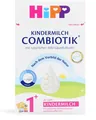
The toddler milk is the one that changes the arithmetic as well. It asks for a 5.7 g scoop per 45 ml of water, so an old habit of one scoop per 30 ml makes the wrong bottle.4
How long should the change take?
As long as your baby takes, which HiPP describes as a range rather than a schedule. Some babies hardly notice the change and drink as before. Others need a few days. Sometimes it takes up to two weeks for the stomach to settle into the new formula.1
Acceptance is a separate clock from digestion. HiPP notes that the new formula is a new taste, and sometimes a new consistency, so a baby may refuse the first attempts and need several before taking it.1
What should you expect while it happens?
For most babies, HiPP says, nothing much. For a particularly sensitive stomach it names three things: more spitting up, wind, or a different stool consistency, over the days the change takes.1
One of those has an explanation printed on the box. Changing to HiPP PRE from another formula can lead to softer stools, and HiPP attributes that to the galacto-oligosaccharides in the recipe.2
When should you stop and ask a doctor?
The NHS gives the trigger, and it is about your baby rather than about the calendar: if you think a particular formula disagrees with your baby, talk to a midwife or health visitor, who can help you decide whether to try a different type.3
That is a different situation from a baby who is objecting to a new taste, which HiPP's page treats as ordinary and answers with patience. A baby who seems unwell is not a changeover problem to be waited out.31
Products mentioned


Questions parents ask
How do you switch HiPP formula stages?
Bottle by bottle. HiPP's advice page gives the schedule: one bottle of the new formula on the first day, two on the second, and so on, which it says is gentler on a small stomach than changing everything at once.
Can you mix old and new HiPP powder in the same bottle?
No. HiPP states it twice on one page, first as a heading and then again in the method: do not put the powders of two different formulas into one bottle. Changing bottle by bottle is the alternative it gives, and that works through the day rather than inside the bottle.
How many days should switching take?
As many as your baby needs. HiPP says some babies hardly notice, others need a few days, and sometimes it takes up to two weeks.
Do I use the old scoop or the new one?
The new one, always. HiPP tells you to follow the preparation recommendation on the new pack and to use the scoop enclosed with it, because the stated amounts of powder and water are what the nutrition on the label describes. Our records show why it matters: the scoops weigh 4.3 g, 4.4 g and 4.5 g across the German stages.
Does the water ratio change between HiPP stages?
Not between the infant stages, which all take one level scoop per 30 ml. The toddler milk is the exception and asks for one 5.7 g scoop per 45 ml, so that changeover alters the arithmetic as well as the powder.
What should I expect while my baby changes over?
HiPP says a particularly sensitive stomach may react with more spitting up, wind or a different stool consistency, and that for most babies the change goes fine. It also notes that the new formula is a new taste, so a baby may refuse it at first and may need several attempts.
Why are my baby's stools softer on HiPP?
HiPP prints an answer on the PRE box itself: changing to it from another formula can lead to softer stools because of the galacto-oligosaccharides it contains. That is the manufacturer explaining its own recipe, not a finding from a trial.
What if my baby refuses the new formula?
HiPP's advice is to give it time and keep offering, because it can take a baby several days to accept a new milk.
When should I stop and ask a doctor?
The NHS gives the trigger: if you think a particular formula disagrees with your baby, talk to a midwife or health visitor, who can help you decide whether to try a different type. That is the answer to a baby who seems unwell rather than a baby who is fussing at a new taste.
Is there any evidence that switching helps?
The NHS puts it flatly: there is no evidence that switching to a different formula does any good or harm. It adds that a first infant formula can be given throughout the first year.
Do I have to move up a stage at all?
Not according to HiPP, which calls the move possible but not obligatory. Whether to move is a separate question from how, and this page is the how.
Sources
- HiPP Germany, advice page on changing over milk formula (Milchnahrung umstellen), dated 29 October 2025 the changeover should happen bottle by bottle, to accustom the stomach gradually: one bottle of the new formula on the first day, two on the second, and so on; the powders of two different formulas should not be combined in one bottle; follow the preparation recommendation on the new pack and use the scoop enclosed with it, because the stated amounts of powder and water matter for nutrient supply and digestibility; some babies hardly notice, others need a few days, and sometimes it takes up to two weeks; a sensitive stomach may react with more spitting up, wind or a different stool consistency; a new formula is a new taste and may need several attempts; moving from PRE to stage 1, or later to 2 or 3, is possible but not obligatory, and PRE may be given for the whole bottle-feeding period fetched 22 September 2026
- HiPP pack artwork for HiPP PRE Bio Combiotik 600 g, version 7 (May 2025) printed on the box: when changing over from another milk formula to this one, the galacto-oligosaccharides it contains can lead to softer stools; also the scoop weight, the water per scoop and the standard dilution fetched 22 September 2026
- NHS, Types of formula milk there is no evidence that switching to a different formula does any good or harm; unless a midwife, health visitor or GP suggests otherwise, first infant formula is the only formula a baby needs and can be drunk throughout the first year; if you think a particular brand disagrees with your baby, talk to a midwife or health visitor, who can help you decide whether to try a different type; page last reviewed 6 April 2023 fetched 22 September 2026
- HiPP pack artwork for HiPP Kindermilch Combiotik 1+ 600 g the toddler milk's own dilution, given as a portion of 17.0 g of powder to 135 ml of water, which is a different scoop and a different water per scoop from the infant stages fetched 22 September 2026
- HiPP Netherlands, label of HiPP 1 Bio Combiotik (NL2472-03) one level scoop of 4.3 g to 30 ml of water, and the instruction to use only the scoop that is in that tin fetched 22 September 2026
Corrections (0)
None since this page was published. How we correct mistakes