HiPP feeding chart by age

The answer
HiPP's first milks print the same chart: seven to eight bottles of 70 ml in the first fortnight, falling to four bottles of 235 ml from the sixth month. That chart is identical on 9 different German packs, so it describes HiPP's house guidance rather than one recipe. The British tins print a longer chart that runs to twelve months, and the toddler milks replace the chart with a daily total.
Key takeaways
- The German first-milk chart is the same on 9 packs: PRE, Stage 1, Comfort, Anti-Reflux, goat PRE, HA 1, HA PRE, PUR PRE and PUR 1.
- The British chart has eight rows and runs to twelve months, where the German one stops at six.
- Dutch tins print the water and the scoops; German boxes also print the made-up bottle.
- 8 packs replace the chart with a daily total, from 300 ml a day to 600 ml.
- HiPP UK prints the honest caveat on its own chart: it is a guide, and a baby should be fed on demand.
What does HiPP's feeding chart say?
| Age | Feeds a day | Water per feed | Scoops | Made-up bottle | Water a day |
|---|---|---|---|---|---|
| Weeks 1 to 2 | 7 to 8 | 60 ml | 2 | 70 ml | 420 to 480 ml |
| Weeks 3 to 4 | 5 to 7 | 90 ml | 3 | 100 ml | 450 to 630 ml |
| Weeks 5 to 8 | 5 to 6 | 120 ml | 4 | 135 ml | 600 to 720 ml |
| Months 3 to 4 | 5 | 150 ml | 5 | 170 ml | 750 ml |
| Month 5 | 4 to 5 | 180 ml | 6 | 200 ml | 720 to 900 ml |
| From month 6 | 4 | 210 ml | 7 | 235 ml | 840 ml |
HiPP's own chart from the pack; water a day is feeds times water per feed. Babies vary, and a hungry or sleepy baby is a better guide than the table.
Six age bands, from the first fortnight to the sixth month, with the water, the scoops and the bottle they make. HiPP prints the numbers as guide values that can vary, and the first band as the doctor advises.1
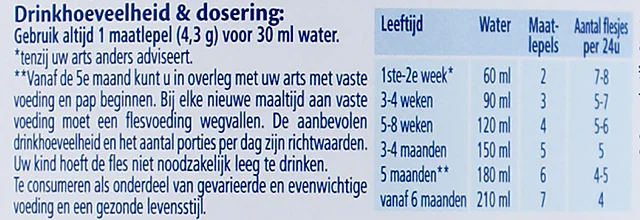
The Dutch tin carries the same bands and prints them differently: water and scoops, without the made-up total the German box gives.2
Why is the chart the same on so many packs?
Because it is HiPP's house chart rather than a per-recipe prescription. The same six rows appear on the German PRE, Stage 1, Comfort, Anti-Reflux, goat PRE, HA 1, HA PRE, PUR PRE and PUR 1.1
That is worth knowing when you are choosing between those packs: the chart will not tell you them apart, because it does not try to.1
Why do the German and British charts differ?
| Age | Feeds a day | Water per feed | Scoops | Water a day |
|---|---|---|---|---|
| Weeks 0 to 2 | 7 to 8 | 60 ml | 2 | 420 to 480 ml |
| Weeks 3 to 4 | 5 to 7 | 90 ml | 3 | 450 to 630 ml |
| Weeks 5 to 8 | 5 to 6 | 120 ml | 4 | 600 to 720 ml |
| Months 2 to 4 | 5 | 150 ml | 5 | 750 ml |
| Month 5 | 4 to 5 | 180 ml | 6 | 720 to 900 ml |
| Month 6 | 4 | 210 ml | 7 | 840 ml |
| Months 7 to 9 | 4 | 150 ml | 5 | 600 ml |
| Months 10 to 12 | 3 | 120 ml | 4 | 360 ml |
HiPP's own chart from the pack; water a day is feeds times water per feed. Babies vary, and a hungry or sleepy baby is a better guide than the table.
The British guide runs to twelve months where the German one stops at six, and it pairs every age with a typical weight as a cross-check. It also falls after six months, as solid food takes over.3
HiPP UK prints the caveat the German boxes leave out: the table is a guide only, and a baby should be fed on demand.3
Which HiPP packs give a daily amount instead?
Eight of them, the toddler and follow-on packs. The German Kindermilch asks for about 300 ml a day, and HiPP UK's Follow On Milk for 500 to 600 ml, taken as a drink, on cereal or in food.45
That is the shape the advice takes once milk is one part of a mixed diet rather than all of it: a day's total, not a bottle by bottle chart.45
HiPP German Stage 2 and the other follow-on powders do print a chart of their own, headed Trinkmenge und Dosierung on the German boxes. This site has not transcribed those yet, so this page shows the charts it holds and does not pretend to hold the rest.1
What does the ready-to-feed chart look like?
How much of this should you actually follow?
Treat it as a sanity check. HiPP marks its own numbers as guide values, HiPP UK adds that a baby should be fed on demand, and the CDC says how much and how often depends on the baby.137
If you would rather start from weight than from age, the feeding calculator on this site does that arithmetic and names the rule it follows, which is more honest than a chart that cannot know your baby.7
Products mentioned
Questions parents ask
How much HiPP formula should a baby drink?
By HiPP's own chart, 7 to 8 bottles of 70 ml in the first two weeks, rising to 200 ml from the fifth month and settling at four bottles of 235 ml from the sixth. HiPP calls those guide values, and the CDC's position is that every baby differs.
Is the chart the same for every HiPP formula?
For the first milks, almost entirely. The same six rows appear on 9 different German packs, including Comfort, Anti-Reflux and both HA boxes, which tells you the chart is HiPP's general guidance rather than something measured for each recipe.
Why does the British chart go further than the German one?
HiPP writes its charts per market rather than per formula. The British tins carry eight rows out to twelve months and pair every age with a typical weight as a cross-check; the German boxes stop at the sixth month, by which point HiPP assumes solid food is doing some of the work. Neither label explains the difference, and the milks behind them are close to identical.
Should I go by age or by weight?
HiPP's charts go by age, and the British ones add a weight beside each age as a check. If you would rather work from weight, the feeding calculator on this site does that arithmetic and says which rule it is following.
What if my baby does not finish the bottle?
Expected, and HiPP's German packs say so outright: a baby need not finish the bottle. Throw away what is left rather than saving it.
Why does my HiPP box give a daily amount instead of a chart?
Because it is a toddler or follow-on pack, and by that age milk is part of a mixed diet rather than the whole of it. The German Kindermilch asks for about 300 ml a day and the British Follow On Milk for 500 to 600 ml, as a drink, on cereal or in food.
How many scoops is each bottle on the chart?
The charts print the scoops beside the water, at one level scoop per 30 ml. The scoop page has the weights, which differ by pack.
Does the ready-to-feed chart work the same way?
It gives the bottle instead of the water, because there is nothing to add. The liquid PRE runs the same six age bands as the powder; the liquid Stage 2 prints one row, 170 to 200 ml, and a note that babies need about five feeds a day.
Is the chart a rule?
No, and none of the sources behind this page pretends otherwise. HiPP prints its numbers as guide values that can vary, HiPP UK adds on the same table that a baby should be fed on demand, and the CDC says how much depends on the baby. A chart is a sanity check, not a target.
When should I worry that my baby is drinking too little?
When the pattern changes rather than when a single bottle is refused, and when weight gain or nappies change with it. That is a conversation with your doctor or health visitor, which is what both HiPP and the CDC say too.
Sources
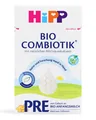
- HiPP pack artwork for HiPP PRE Bio Combiotik 600 g, version 7 (May 2025) the German feeding chart: six age bands from the first fortnight to the sixth month, with the water, the scoops and the made-up bottle, marked as guide values that can vary fetched 18 September 2026
- HiPP Netherlands, label of HiPP 1 Bio Combiotik (NL2472-03) the Dutch chart: the same six age bands, printed as water and scoops without a made-up total fetched 18 September 2026
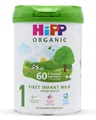
- HiPP UK, product page for HiPP Organic First Infant Milk the British feeding guide: eight rows from the first fortnight to twelve months, each age beside a typical weight, and the line that the table is a guide only and a baby should be fed on demand fetched 18 September 2026
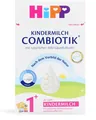
- HiPP pack artwork for HiPP Kindermilch Combiotik 1+ 600 g the toddler milk prints a daily amount rather than a chart by age fetched 18 September 2026
- HiPP UK, product page for HiPP Organic Follow On Milk about 500 to 600 ml a day from six months, as a drink, on cereal or in food, rather than a chart by age fetched 18 September 2026
- HiPP pack artwork for HiPP PRE Bio Combiotik trinkfertig 200 ml (2227-05), version V1 05/26 the ready-to-feed chart: the same age bands, printed as the bottle itself with no water column and no scoops fetched 25 September 2026
- CDC, How much and how often to feed infant formula every baby is different, how much and how often depends on the baby's needs, watch for hunger cues, and talk to a doctor or nurse about growth or intake; page dated 21 April 2026 fetched 22 September 2026
- NHS, Types of formula first infant formula is the only formula a baby needs, and can stay the milk through the first year fetched 21 September 2026
Corrections (0)
None since this page was published. How we correct mistakes