Who HiPP is not for

The answer
HiPP's own labels exclude some babies by name. 9 of the 47 packs this site records say they must not be used where a cow's milk protein allergy exists or is suspected, and the goat tins carry a warning of their own. Beyond the labels: no HiPP formula is lactose free by the EU definition, none is made for a premature baby, and none is registered for sale in the United States. Each of those is a reason to ask someone rather than to buy.
Key takeaways
- 9 packs name a cow's milk protein allergy and rule themselves out; the ordinary formulas say nothing, because nobody expects them to be allergy formulas.
- No HiPP formula is lactose free. The lowest on record is Comfort at 2.7 g per 100 ml, and the EU threshold for the words lactose free is 10 mg per 100 kcal.
- HiPP makes no preterm formula in any market this site tracks.
- None of it is registered for sale in the United States: no HiPP formula is on the FDA's list of formulas marketed there.
- The NHS says children aged one to five do not need formula milks at all, toddler milks included.
Which packs exclude someone by name?
9 of the 47 this site records. Every HA powder, both HA ready-to-feed bottles, the German Comfort and the German Anti-Reflux carry the same line: not to be used if a baby has, or is suspected of having, a cow's milk protein allergy.12
The goat packs word it differently. The Dutch tins rule the allergy out; the German box says its proteins are similar to cow's milk proteins, declares traces of cow's milk, and says that with an existing or suspected allergy it should be used only after talking to the paediatrician.3
The ordinary cow's milk formulas say nothing at all about allergy, and the reason is worth noticing: the packs that warn loudest are the ones people mistake for allergy formulas. Nobody buys a plain first milk expecting it to be safe for an allergic baby. People do buy HA expecting exactly that.
A baby with a diagnosed cow's milk protein allergy
No HiPP formula. Every one of them starts from cow's or goat's milk, and the NHS says a baby diagnosed with cow's milk allergy is prescribed a formula with fully hydrolysed proteins.4
Hydrolysed is not a synonym for safe. ESPGHAN does not recommend partially hydrolysed formulas in the treatment of cow's milk allergy at all, and puts a cow's-milk-derived extensively hydrolysed formula first for a diagnostic elimination diet.6
Goat is not a way around it either. The NHS says goats' milk formulas are not suitable for infants with cow's milk allergy, because the proteins they contain are very similar.4
A baby who cannot have lactose
No HiPP formula is lactose free. The lowest on record is Comfort, at 2.7 g per 100 ml, which its own box calls lactose-reduced.2
The words have a legal threshold behind them. EU law lets a formula be called lactose free only where lactose is no greater than 10 mg per 100 kcal, and requires a non-soya product using those words to carry the statement that it is not suitable for infants with galactosaemia.5 Comfort is roughly four hundred times that threshold.
So for galactosaemia the question does not arise: that baby needs a formula a metabolic team chooses. For a suspected lactose intolerance, which is rare in infants, the question belongs with a doctor before any tin is bought.
A baby born early, or one whose formula a doctor chose
HiPP makes no preterm formula in any market this site tracks. A premature baby's feeding is set by the neonatal team, using breast milk, fortifiers and preterm formulas, and the American Academy of Pediatrics describes that as the team's decision rather than a shelf's.8
The same applies further down the line. If a doctor put your baby on a particular formula, that choice is theirs to change.
Anyone who needs a formula registered where they live
HiPP makes these formulas for European markets, and no HiPP formula is on the FDA's list of formulas marketed in the United States.10
Resellers do ship European formula to American addresses and this site lists the ones it tracks, but that is a different thing from a formula a pediatrician can prescribe or a programme will pay for.
What it is not for, even though people buy it for that
Preventing allergy. ESPGHAN found in 2024 that there is not enough evidence to recommend a partially or extensively hydrolysed formula for preventing cow's milk allergy, even in infants with a documented family history, and a Cochrane review of sixteen studies found none in 2018, grading what there is very low for every outcome.67
Feeding a toddler. The NHS says children aged one to five do not need formula milks at all, growing-up and toddler milks included, and that whole cow's milk can be the main drink from one year. The American Academy of Pediatrics says most toddlers do not need a toddler formula either.49
Products mentioned
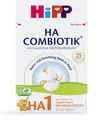 HiPP German HA 1
Sold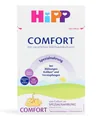 HiPP German Comfort
Sold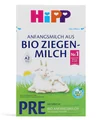 HiPP German Goat PRE
Where to buy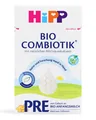 HiPP German PRE
Sold
Questions parents ask
Which HiPP formulas say who they are not for?
9 of them. All 5 HA powders, both HA ready-to-feed bottles, the German Comfort and the German Anti-Reflux say they must not be used where a cow's milk protein allergy exists or is suspected. The Dutch goat tins rule it out too, and the German goat box says to use it only after talking to the paediatrician.
Can a baby with a cow's milk allergy have any HiPP formula?
No. Every HiPP formula starts from cow's or goat's milk, and the NHS says a diagnosed baby is prescribed a formula with fully hydrolysed proteins.
Is HiPP HA safe for an allergy because it is hydrolysed?
No, and its own pack says so. Hydrolysed means the protein has been broken into smaller pieces, not that the allergen is gone. ESPGHAN does not recommend partially hydrolysed formulas in treating cow's milk allergy at all, and puts an extensively hydrolysed formula first for a diagnostic elimination diet. The HA guide sets out what HiPP does and does not say about the degree.
Is any HiPP formula lactose free?
None of them. The lowest on record is Comfort at 2.7 g per 100 ml, which its own box calls lactose-reduced rather than lactose free.
What about galactosaemia?
No HiPP formula is suitable. EU law lets a formula be called lactose free only below 10 mg of lactose per 100 kcal, and requires such a product to carry a warning that it is not suitable for infants with galactosaemia. No HiPP product comes close to that threshold, so the question does not arise: a baby with galactosaemia needs a formula a metabolic team chooses.
Does HiPP make a formula for a premature baby?
Not in any market this site tracks. A premature baby's feeding is set by the neonatal team, and the American Academy of Pediatrics says the same.
Can I use HiPP in the United States?
Not as a registered product. HiPP makes these formulas for European markets, and no HiPP formula is on the FDA's list of formulas marketed in the United States. Resellers do ship it, and this site lists the ones it tracks, but that is not the same as a formula a pediatrician can prescribe.
Is any HiPP formula dairy free?
No. Every HiPP formula this site records is made from cow's or goat's milk, the HA range included, whose milk protein is broken down but is still milk protein, so none suits a family avoiding dairy.
Is HiPP suitable for a vegan family?
No. Every HiPP formula is made from cow's or goat's milk, and several add fish oil, though the British ready-to-feed bottles use algal oil instead.
Should a toddler be on HiPP?
Usually not, and this is the one exclusion that comes from the health services rather than the pack. The NHS says children aged one to five do not need formula milks, toddler and growing-up milks included, and that whole cow's milk can be the main drink from one year. The American Academy of Pediatrics says most toddlers do not need toddler formula either.
Will HiPP HA stop my baby developing an allergy?
The evidence does not show it. ESPGHAN found in 2024 too little to recommend a hydrolysed formula for prevention, and a Cochrane review found none in 2018.
Sources
- HiPP pack artwork for HiPP HA 1 Combiotik 600 g, version 5 (April 2025) the line every HA pack carries: must not be used if a baby has, or is suspected of having, a cow's milk protein allergy fetched 23 September 2026
- HiPP pack artwork for HiPP Comfort Spezialnahrung 600 g, version 6 (April 2025) the same allergy line on a food for special medical purposes, and the lactose-reduced statement with lactose at 2.7 g per 100 ml fetched 23 September 2026
- HiPP pack artwork for HiPP Pre Anfangsmilch aus BIO Ziegenmilch 400 g, version 7 (June 2026) the goat box: its proteins are similar to cow's milk proteins, it declares traces of cow's milk, and with an existing or suspected allergy it is to be used only after talking to the paediatrician fetched 6 October 2026
- NHS, Types of formula a baby with cow's milk allergy is prescribed a formula with fully hydrolysed proteins; goats' milk formulas are not suitable, as the proteins are very similar; partially hydrolysed comfort formula is not suitable either fetched 23 September 2026
- Commission Delegated Regulation (EU) 2016/127 Article 9(2): the words lactose free may be used only where lactose is no greater than 2.5 mg per 100 kJ, which is 10 mg per 100 kcal, and a non-soya product using them must carry the statement not suitable for infants with galactosaemia fetched 23 September 2026
- Vandenplas Y. et al., 2024, Journal of Pediatric Gastroenterology and Nutrition 78(2):386-413 ESPGHAN position paper on cow's milk allergy. Statement 22: an extensively hydrolysed cow's milk formula first for a diagnostic elimination diet. Statement 54: partially hydrolysed formulas not recommended in treatment. Statement 66: insufficient evidence for prevention fetched 23 September 2026
- Osborn D.A., Sinn J.K. and Jones L.J., 2018, Cochrane Database of Systematic Reviews 10:CD003664 16 studies; no evidence to support prolonged feeding with a hydrolysed formula rather than a cow's milk formula, graded very low for every outcome fetched 23 September 2026
- American Academy of Pediatrics, Your premature baby's nutrition needs a premature baby's feeding plan is set by the neonatal team and the pediatrician, using fortifiers and preterm formulas fetched 23 September 2026
- American Academy of Pediatrics, Most toddlers don't need toddler formula toddler formulas are unnecessary for most children, and whole cow's milk is the usual drink from twelve months; published 20 October 2023 fetched 23 September 2026
- FDA, Infant Formulas Marketed in the U.S. the two tables of infant formulas on the American market, which name no HiPP product; a maker must register and notify the FDA at least 90 days before marketing a formula there fetched 25 September 2026
Corrections (0)
None since this page was published. How we correct mistakes