HiPP Comfort vs HA

We earn a commission when you buy through links on this page, including from our partner retailer, which sells and ships the order. How this site is funded →
The answer
HiPP Comfort and HiPP HA share a protein and differ on sugar. Both are made with hydrolysed whey, both add the same prebiotic and culture, and neither is organic. Comfort cuts the lactose to 2.7 g per 100 ml and adds maltodextrin and starch; HA keeps all 7.0 g of its lactose and adds no starch at all. Comfort is a food for special medical purposes, HA is ordinary infant formula, and both packs rule out a cow's milk protein allergy.
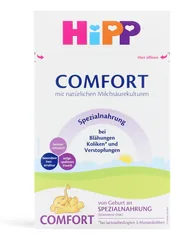 HiPP German Comfort2313 · 600 g boxA food for special medical purposes: less lactose, plus maltodextrin and starch.
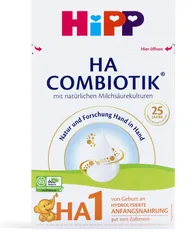 HiPP German HA 12142-03 · 600 g boxOrdinary infant formula: all its lactose, no starch, and no symptom on the box.
Key takeaways
- Both use hydrolysed whey protein, and both boxes describe it as split rather than giving a degree.
- Comfort has 2.7 g of lactose per 100 ml against HA 1's 7.0 g, and 1.5 g of starch where HA has none.
- Past the carbohydrate they are close: of 44 shared rows, most of the rest sit within a few per cent.
- Comfort is made to the food for special medical purposes rules; HA is made to the infant formula rules.
- Neither is for a diagnosed cow's milk protein allergy, and both packs say so in the same words.
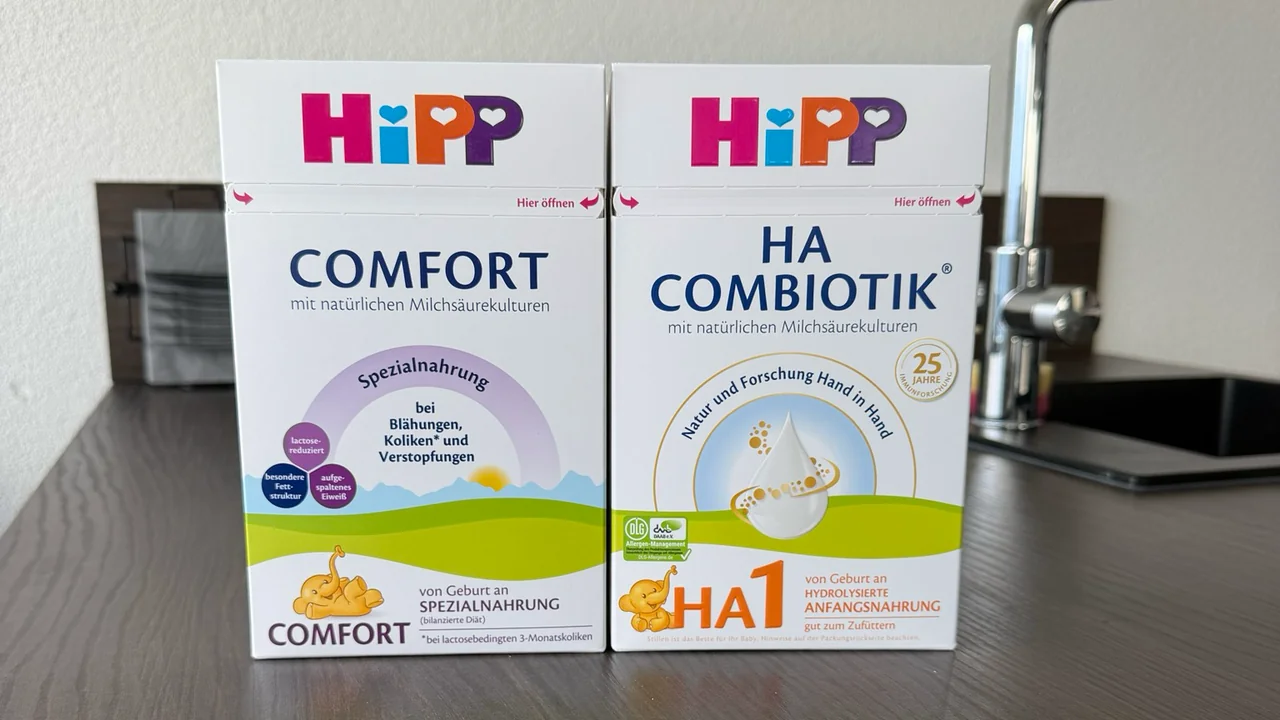
How do HiPP Comfort and HiPP HA compare?
| HiPP German Comfort | HiPP German HA 1 | |
|---|---|---|
| Age | From birth | From birth |
| Size | 600 g box | 600 g box |
| Article code | 2313 | 2142-03 |
| Base | Cow's milk whey protein, hydrolysed | Cow's milk whey protein, hydrolysed |
| Protein | 1.25 g | 1.3 g |
| Carbohydrate | 7.0 g · Lactose, maltodextrin and starch | 7.1 g · Lactose only |
| Starch | Yes | No |
| Fat | 3.6 g | 3.6 g |
| DHA | 13.2 mg | 13.4 mg |
| GOS | 0.3 g | 0.3 g |
| Combiotik | GOS + L. fermentum | GOS + L. fermentum |
| Scoop | 4.3 g per 30 ml | 4.4 g per 30 ml |
| Price at Organic Life Start, United States | $40.79 · $6.80 per 100 g | $43.39 · $7.23 per 100 g |
Nutrition from each product's panel, fetched 15 October 2026. Prices seen 15 October 2026.
Is the protein the same?
Both are hydrolysed whey, and both boxes describe it the same way rather than measuring it. The Comfort box calls its protein split and the milk lactose-reduced; the HA box calls its protein strongly split.12 Neither gives a peptide size, and neither claims a category.
That shared protein is why the two get confused, and it is also why the comparison matters: the same starting material is being sold for two different problems.
What actually separates them?
The sugar. Comfort has 2.7 g of lactose per 100 ml where HA 1 has 7.0 g, and Comfort adds 1.5 g of starch and maltodextrin to make up the energy. HA adds no starch and lists lactose as its only carbohydrate.12
Past that the two are close. Of the 44 rows both panels print, most of the rest sit within a few per cent, including the fat, the protein, the iron and the calcium; both carry the same prebiotic and the same lactic culture, and neither is organic.12
Is either one for a cow's milk allergy?
No, and the two packs say so in the same words: not to be used if a baby has, or is suspected of having, a cow's milk protein allergy.12
The NHS says the same of the category. Comfort formula contains cow's milk proteins partly broken down, it writes, and partially hydrolysed formula is not suitable for a baby with a cow's milk allergy; a baby with a diagnosis is prescribed a formula with fully hydrolysed proteins.3
ESPGHAN goes further and says what is used instead. A cow's-milk-derived extensively hydrolysed formula is its first choice for a diagnostic elimination diet, and it does not recommend partially hydrolysed formulas in the treatment of cow's milk allergy at all.6
So which is for what?
Comfort is the one sold for a symptom. HiPP says it is for the dietary management of wind, colic linked to lactose and constipation, to be used after talking to a paediatrician and only as long as the symptoms need.7 The NHS says comfort formulas are supposed to make digestion easier and help prevent colic and constipation, but that there is no evidence for this.3
HA is sold for nothing in particular, because it may not be. It carries no symptom on the box and no claim, and the evidence on hydrolysed formula and allergy prevention is the subject of its own guide.5
Questions parents ask
What is the difference between HiPP Comfort and HiPP HA?
The carbohydrate, mainly. Both are made with hydrolysed whey protein, but Comfort cuts the lactose to 2.7 g per 100 ml and adds maltodextrin and starch, where HA keeps all 7.0 g of its lactose and adds no starch.
Is either one for a cow's milk allergy?
No, and both packs say so in the same words: not to be used if a baby has, or is suspected of having, a cow's milk protein allergy. Hydrolysed is not the same as allergy-safe, and a diagnosis is a question for the doctor who made it.
Which one would a doctor reach for?
Neither, for an allergy. ESPGHAN puts a cow's-milk-derived extensively hydrolysed formula first for a diagnostic elimination diet, and does not recommend partially hydrolysed formulas in treatment at all.
Is HA better for colic?
HiPP does not sell it for colic, and an EU infant formula may not claim anything of the kind. Comfort is the one HiPP sells for digestive symptoms, and the NHS says there is no evidence comfort formulas prevent colic or constipation.
Why is Comfort a special medical food and HA is not?
Because of what each is sold for. A food for special medical purposes is made under its own regulation, for the dietary management of a condition and under medical supervision, and may say so. HA carries no condition on the box, so it is sold as an ordinary infant formula, and EU law then forbids it from claiming anything at all, which is why its box is so quiet.
Do they taste different?
Probably, and in opposite directions: splitting protein changes the taste, and Comfort has less than half the milk sugar. Nobody has published a test of either.
Is either organic?
No, neither of them, in any market. That sets both apart from the HiPP Bio Combiotik milks on the same shelf.
Can a baby have both, or move between them?
That is a question for whoever suggested the one the baby is on, because Comfort is only meant to be used under medical supervision. HiPP's own advice on changing between its milks is to replace one feed a day and never mix two powders in the same bottle.
Which is cheaper?
They are within a few per cent of each other per 100 g at our partner retailer, and the table above gives both. Neither price difference is a reason to choose.
Are the UK versions the same?
The UK Comfort tin is the German box's milk on every row both print. HiPP UK sells no HA at all, so this comparison only exists in the German and Dutch ranges, where HiPP sells both.
Sources
- HiPP pack artwork for HiPP Comfort Spezialnahrung 600 g, version 6 (April 2025) the hydrolysed whey protein described as split, the lactose-reduced statement, the carbohydrate as lactose, maltodextrin and starch, the composition per 100 ml, and the cow's milk protein allergy line fetched 23 September 2026
- HiPP pack artwork for HiPP HA 1 Combiotik 600 g, version 5 (April 2025) the hydrolysed whey protein described as strongly split with no degree given, lactose as the only carbohydrate, the composition per 100 ml, and the same allergy line fetched 23 September 2026
- NHS, Types of formula comfort formula is partially hydrolysed, is supposed to help with colic and constipation, and there is no evidence for this; it is not suitable for a cow's milk allergy; hypoallergenic formula is used only under medical supervision and a diagnosed baby is prescribed fully hydrolysed protein fetched 23 September 2026
- Commission Delegated Regulation (EU) 2016/128 food for special medical purposes: for the dietary management of a condition, used under medical supervision, and for infants made to the infant formula rules except where the intended use requires otherwise fetched 23 September 2026
- Commission Delegated Regulation (EU) 2016/127 infant formula and Annex I; Article 8, that nutrition and health claims shall not be made on infant formula fetched 23 September 2026
- Vandenplas Y. et al., 2024, Journal of Pediatric Gastroenterology and Nutrition 78(2):386-413 ESPGHAN position paper on cow's milk allergy. Statement 22: a cow's-milk-derived extensively hydrolysed formula is the first choice for a diagnostic elimination diet. Statement 54: partially hydrolysed formulas are not recommended in its treatment fetched 23 September 2026
- HiPP Germany product page for HiPP Comfort Spezialnahrung what HiPP sells Comfort for, and its instruction to use it after talking to a paediatrician and only as long as the symptoms need fetched 23 September 2026
- HiPP Germany, Was muss ich beim Umstellen von Milchnahrungen beachten? HiPP's advice on changing between its milks: one feed at a time, and never two powders in the same bottle fetched 23 September 2026