HiPP UK Growing Up Milk ready to feed HiPP Organic Growing Up Milk Ready to Feed, 200 ml bottle

We earn a commission when you buy through links on this page, including from our partner retailer, which sells and ships the order. How this site is funded →
The answer
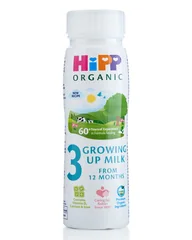
Catalogue entry. No seller we track ships it to the markets we cover.
HiPP UK Growing Up Milk ready to feed is HiPP's organic toddler milk, already mixed and sealed in a 200 ml bottle, labelled from twelve months and sold by the case of six. Water is its first ingredient, it has no galacto-oligosaccharides at all, and it is the thinnest of the range, with the least energy and fat per 100 ml. HiPP asks for about 350 ml a day.
Key takeaways
- Organic toddler milk, ready to drink in a 200 ml bottle, labelled from twelve months as an alternative to cows' milk.
- No galacto-oligosaccharides and no culture: the only bottle in the range with neither.
- The least energy and fat per 100 ml of the four, and the most protein.
- An opened bottle can be resealed and kept for 72 hours, three times as long as the younger bottles.
- The European Food Safety Authority found young-child formula has no unique role in a balanced diet.
Availability
Catalogue entry, not soldThis product is listed for reference. Neither milkatlas nor any seller we track ships it to the markets we cover. It is documented here because it appears in the HiPP range and parents ask about it.
Tell me if that changes
What is in HiPP UK Growing Up Milk ready to feed?
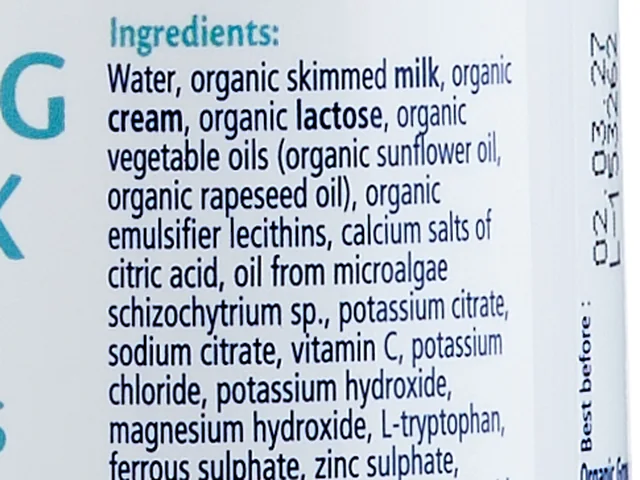
Water comes first, then organic skimmed milk, organic cream, organic lactose, organic sunflower and rapeseed oils and a lecithin emulsifier.1
There are no galacto-oligosaccharides in it and no lactic culture, which makes it the only bottle in this range with neither. Its DHA comes from algal oil.1
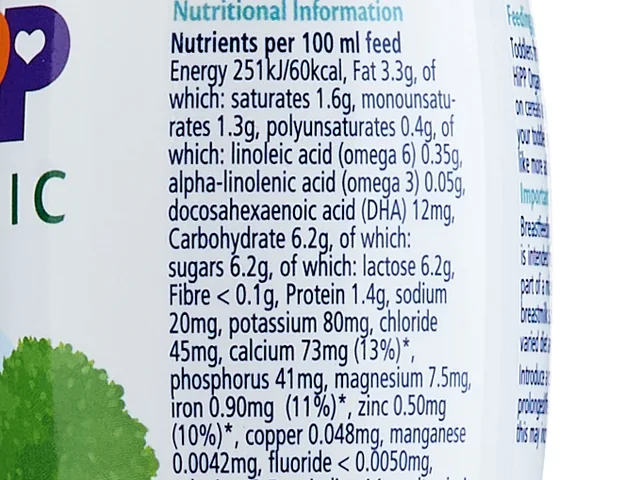
Nutrition per 100 ml, prepared
| Nutrient | Per 100 ml | Per 100 kcal | EU min to max |
|---|---|---|---|
| Energy, fat, carbohydrate and protein | |||
| Energy | 60 kcal | 100 kcal | 60 to 70 kcal per 100 ml |
| Fat | 3.3 g | 5.5 g | 4.4 to 6.0 g |
| of which saturates | 1.6 g | 2.7 g | |
| of which monounsaturates | 1.3 g | 2.2 g | |
| of which polyunsaturates | 0.4 g | 0.67 g | |
| Linoleic acid | 0.35 g | 0.58 g | |
| Alpha-linolenic acid | 0.05 g | 0.083 g | |
| DHA | 12 mg | 20 mg | 20 to 50 mg |
| Carbohydrate | 6.2 g | 10.3 g | 9 to 14 g |
| of which sugars | 6.2 g | 10 g | |
| of which lactose | 6.2 g | 10.3 g | min 4.5 g |
| Fibre | < 0.1 g | < 0.17 g | |
| Protein | 1.4 g | 2.3 g | 1.8 to 2.5 g |
| Minerals | |||
| Sodium | 20 mg | 33 mg | |
| Potassium | 80 mg | 133 mg | |
| Chloride | 45 mg | 75 mg | |
| Calcium | 73 mg | 122 mg | 50 to 140 mg |
| Phosphorus | 41 mg | 68 mg | |
| Magnesium | 7.5 mg | 12 mg | |
| Iron | 0.9 mg | 1.5 mg | 0.6 to 2 mg |
| Zinc | 0.5 mg | 0.83 mg | |
| Copper | 0.048 mg | 0.08 mg | |
| Manganese | 0.0042 mg | 0.007 mg | |
| Fluoride | < 0.0050 mg | < 0.0083 mg | |
| Selenium | 3.5 µg | 5.8 µg | |
| Iodine | 14 µg | 23 µg | |
| Vitamins | |||
| Vitamin A | 49 µg | 82 µg | |
| Vitamin D | 1.6 µg | 2.7 µg | 2 to 3 µg |
| Vitamin E | 0.8 mg | 1.3 mg | |
| Vitamin K | 0.8 µg | 1.3 µg | |
| Vitamin C | 9 mg | 15 mg | |
| Vitamin B1 | 0.045 mg | 0.075 mg | |
| Vitamin B2 | 0.18 mg | 0.3 mg | |
| Niacin | 0.3 mg | 0.5 mg | |
| Vitamin B6 | 0.046 mg | 0.077 mg | |
| Folic acid | 11.3 µg | 19 µg | |
| Vitamin B12 | 0.17 µg | 0.28 µg | |
| Biotin | 2.5 µg | 4.2 µg | |
| Pantothenic acid | 0.31 mg | 0.52 mg | |
Values from HiPP's product page for the United Kingdom, checked 3 October 2026. The last column is the range for follow-on formula in Regulation (EU) 2016/127, Annex II, per 100 kcal unless it says per 100 ml. HiPP gives values per 100 ml only, so the per 100 kcal column is calculated from them.
Every value is for 100 ml as poured. This is the thinnest milk of the four bottles: least energy, least fat, least sugar, and the most protein.1
HiPP UK's product page gives the fluoride row as a greater-than, where every other HiPP panel we have read gives a less-than. The label on the bottle prints < 0.0050 mg, a less-than like the rest, so the table follows the label.18
How do you prepare it?
Wash your hands and the beaker, check the cap and seal, shake the bottle and pour. Use what you pour within two hours, and reseal the rest and keep it in the fridge for up to 72 hours.1
HiPP UK's general FAQ, on its first milk page, gives growing-up milk two days instead. This bottle's own instructions and its own FAQ both say three days, and the label on the bottle in your hand is the one to go by.17
Nothing is added: the bottle is already at drinking strength. Pour out what you need and give it at room temperature, or warm it and check it first. Keep an opened bottle in the fridge for no longer than 72 hours.
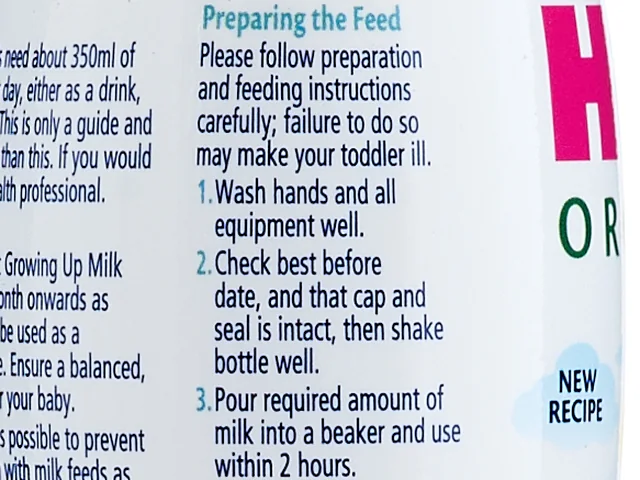
- Check best before date, and that cap and seal is intact, then shake bottle well.
- Sediment before shaking is normal; HiPP prints that on every bottle in the range.
- Pour required amount of milk into a beaker and use within 2 hours.
- A beaker, not a bottle: HiPP assumes a toddler is off the bottle by now.
- Milk can be given at room temperature or warmed if desired. If warmed check temperature before feeding.
- Cold is fine. Warmed, check it first, and never in a microwave.
- Unused milk left in this bottle can be resealed and stored in the fridge for up to 72 hours.
- Three days, where the younger bottles in the range allow one.
How much should a baby drink?
No chart by age: HiPP asks for about 350 ml a day, as a drink, on cereal or added to food, and says a toddler may need more or less.1
Who is it for, and who is it not for?
For toddlers from twelve months, alongside a varied diet, as an alternative to cows' milk. HiPP calls the choice one for parents to make on their toddler's needs and preferences.1
It is made from cow's milk and is not lactose-free, so it is not for a toddler with a diagnosed cow's milk protein allergy.14
Questions parents ask
What age is HiPP Growing Up Milk ready to feed for?
From twelve months. HiPP offers it as an alternative to cows' milk alongside a varied diet, and asks for about 350 ml a day.
Does a toddler need it?
Not according to the European Food Safety Authority, which found in 2013 that young-child formula has no unique role and does not bring additional value to a balanced diet. Whole cows' milk is the usual drink from twelve months. A toddler milk is a convenience and a fortification, not a requirement.
How is it different from the follow-on bottle?
Water is its first ingredient rather than whey product, it has no galacto-oligosaccharides at all, and it carries less energy, less fat and less sugar per 100 ml, with more protein and calcium.
Why does it keep for longer once opened?
HiPP allows 72 hours in the fridge here, against twenty-four hours on the younger bottles in the range, and does not say why.
Can I give it in a beaker?
Yes, and HiPP assumes it: the label says to pour it into a beaker and use it within two hours, and to move a child onto a cup early, to limit how long milk sits on the teeth.
Is it organic?
Yes. The milk, cream, lactose and vegetable oils all carry the organic mark in the ingredient list, and the label carries the organic logos beside them.
Does it have DHA?
Yes, from the microalga Schizochytrium rather than from fish oil, which is why this bottle has no fish allergen to declare. There is less of it per 100 ml than in the first and follow-on bottles.
Is it the same as the Growing Up Milk powder?
No. The powder tin is its own recipe with its own values, and its label prints a legal name this bottle does not: organic follow on milk from the twelfth month onwards. Compare the two nutrition tables rather than assuming the bottle is the tin made up with water, because on every pair we have checked in this range the liquid and the powder differ somewhere.
Where is it made?
Austria, as the label says. So is the follow-on bottle; the two first milk bottles in the same range are made in Germany, which is worth knowing if country of origin matters to you.
Can it replace cows' milk entirely?
HiPP offers it as an alternative to cows' milk, not as a replacement for a varied diet. From twelve months a toddler's drink is usually whole cows' milk, and the fortified milks exist alongside it rather than instead of it. Ask your health visitor if you are unsure.
Sources
- HiPP UK, product page for HiPP Organic Growing Up Milk Ready to Feed article number GB2222-02, from 12 months, ingredients with water first and no galacto-oligosaccharides, the full nutrition table per 100 ml, preparation in a beaker, an opened bottle resealed in the fridge for up to 72 hours, Product of Austria, about 350 ml a day, and its FAQ says the same fetched 25 September 2026
- HiPP UK, product page for HiPP Organic Growing Up Milk the powder of the same name, whose tin prints the legal name: organic follow on milk from the 12th month onwards fetched 23 September 2026
- Regulation (EU) 2016/127 compositional requirements for infant formula (Annex I) and follow-on formula (Annex II), retained in UK law fetched 18 September 2026
- NHS, Types of formula formula comes as a dry powder or a ready-to-feed liquid; ready-to-feed tends to be more expensive and, once opened, needs to be used more quickly; no benefit in switching to a follow-on formula at six months fetched 21 September 2026
- CDC, Infant formula preparation and storage the extra preparation steps for a baby under two months, born early or with a weakened immune system are written for powdered formula; ready-to-feed formula where water cannot be made safe by boiling fetched 21 September 2026
- European Food Safety Authority, press release on young-child formula young-child formula has no unique role and does not bring additional value to a balanced diet; 25 October 2013 fetched 18 September 2026
- HiPP UK, product page for HiPP Organic First Infant Milk Ready to Feed 200ml its general FAQ: an opened bottle keeps up to 24 hours in the fridge for first infant milk, or 48 hours for follow on or growing up milk fetched 25 September 2026
- The partner retailer's photographs of the Growing Up Milk bottle the pack photo, and its ingredients, nutrition and preparation panels, read on 3 October 2026; the source of the fluoride row, which HiPP UK's product page gives as a greater-than fetched 3 October 2026
Corrections (2)
- The preparation note had told you to warm the feed to about 40 °C. HiPP UK says it may be given at room temperature or warmed, as the panel on this page shows, and the note now says so. (before publication)
- The nutrition table had copied HiPP UK's product page, which gives fluoride as more than 0.0050 mg per 100 ml, and a note called the row odd, since every other HiPP panel gives a less-than. The label on the bottle, photographed on 2 October 2026, prints less than 0.0050 mg. The table now follows the label, and the note says so. (before publication)