Which HiPP formula is right for your baby

The answer
HiPP sells eight ranges across four markets, and 16 of its powders are labelled from birth. Four questions narrow them: how old your baby is, whether a health professional is involved, which milk you want, and which market's label you are buying. The third is the only one that changes what is in the tin. The stage number, the country on the box and the choice between PRE and 1 all matter less than they look, and this page says why.
Key takeaways
- 16 HiPP powders are labelled from birth. The age question narrows them least, because most of the range starts there.
- The milk is the real choice: cow's milk, goat's milk or hydrolysed whey. It is also the only one that changes the ingredient list.
- If you want organic, the HA range is out: it is the one powder range HiPP does not make organic.
- The Comfort and Anti-Reflux tins are foods for special medical purposes and belong to whoever suggested them, not to this page.
- The market on the box changes the label, the pack and the price per 100 g, and for the first stage it does not change the milk.
First question: how old is your baby?
It narrows less than you would think. 16 of HiPP's powders are labelled from birth, across four different ranges, so a newborn does not reduce the choice to one.123
What the age does decide is the legal category. A baby under six months needs an infant formula, which is every PRE and every 1. A baby over six months may have a follow-on formula, every 2 and every 3, but does not have to: a first infant formula can stay the main drink to one year.45
The stage finder does this part interactively, by age and by the market you can buy from. What the numbers mean is its own page.
Second question: is a health professional involved?
If one has named a formula, that is the answer and this page is not. If one has not, two of HiPP's ranges are still not yours to choose.
The Comfort and Anti-Reflux tins are foods for special medical purposes under Regulation (EU) 2016/128, sold for the dietary management of a named condition, and both say to use them under medical supervision.6 They are on open shelves, which is why people buy them unprompted, and that is the wrong way round.
There are also babies no HiPP formula is for, which has its own page: a diagnosed cow's milk protein allergy, galactosaemia, a premature baby, and anyone needing a formula registered in the United States.
Third question: which milk?
This is the real choice, and the only one that changes the ingredient list.
Combiotik is organic cow's milk with galacto-oligosaccharides and the lactic culture Limosilactobacillus fermentum. It is the main range and the widest: PRE, 1, 2, two different Stage 2 boxes in Germany, and 3.1
PUR is organic cow's milk with neither the prebiotic nor the culture, for parents who want fewer additions. Germany only.1
Goat is organic goat's milk with the prebiotic and no culture. It is an alternative rather than an upgrade: the trial EFSA reviewed found babies grew the same, and it is not a way around a cow's milk allergy.4
HA is hydrolysed whey protein, with the prebiotic and the culture, and it is the one powder range HiPP does not make organic. That surprises people, and it is worth knowing before the rest of the decision: if organic is what you came for, HA is out.1
UK organic is the British first and follow-on milk: organic cow's milk with the prebiotic and no culture.3
Fourth question: which market's label?
Least important of the four, for the first stage at least. The German PRE, the Dutch Stage 1 and the UK First Infant Milk agree on all 44 rows of the panel, and all three are made in Germany.
What the market changes is the label, the pack size, the price per 100 g, and one ingredient that never reaches a panel: the British tin lists no lactic culture, and its instructions ask for hotter water in consequence.
What matters less than it looks
Three things, in order of how much anxiety they cause.
The stage number. It sorts HiPP's products inside two legal categories and the only line with weight is at six months. A higher number is a different category, not a better milk.5
PRE against 1. In the German range the difference is a little starch; everything else matches. Outside Germany the question does not arise, because no other market sells both.
The country on the box. See above: for the first stage it is the same milk.
What matters more than any of them is whether a baby is feeding and gaining. If one is, the tin is working, whatever is printed on it. If one is not, no tin is the answer and a health visitor is.4
Products mentioned
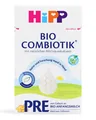 HiPP German PRE
Sold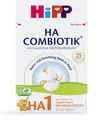 HiPP German HA 1
Sold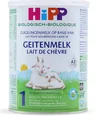 HiPP Dutch Goat Stage 1
Sold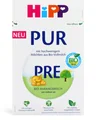 HiPP German PUR PRE
Where to buy
Questions parents ask
Which HiPP formula is best for a newborn?
Any of the 16 labelled from birth can be a newborn's only food. Among the organic cow's milk ones we lean to a formula with lactose as its only carbohydrate, which means the German PRE, the Dutch Stage 1 or the UK First Infant Milk. They are the same milk.
What is the difference between the HiPP ranges?
The milk and what is added to it. Combiotik is organic cow's milk with a prebiotic and a culture, PUR is organic cow's milk with neither, goat is organic goat's milk, and HA is hydrolysed whey and is not organic.
Is HiPP HA better than ordinary HiPP?
No, and it is not sold as better. HA is made with hydrolysed protein for parents worried about sensitivity, it is the one powder range HiPP does not make organic, and the evidence that hydrolysing the protein stops an allergy developing is not there. Its own packs rule out a baby who already has a cow's milk protein allergy, which is the opposite of what many buyers assume.
Does the country on the box matter?
For the first stage, not to the milk. The German PRE, the Dutch Stage 1 and the UK First Infant Milk agree on all 44 rows of the panel.
Which HiPP formula has no starch?
Most of them. Every PRE, the Dutch and British first milks, the whole HA range, the whole goat range, the whole PUR range and the Anti-Reflux tin have lactose as their only carbohydrate. The German Stage 1 adds a little starch, the German Stage 2 and 3 add more, and Comfort adds starch and maltodextrin while cutting the lactose. If you want lactose only, you have plenty of choice.
Do I need the stage finder or this page?
Both do different jobs. The finder narrows by age and market and gives you packs; this page explains what separates them.
Which is the cheapest way to buy HiPP?
Compare per 100 g rather than per pack, because HiPP sells 400 g, 500 g, 600 g and 800 g packs and the biggest is not always the cheapest per gram. Every product page and comparison table on this site prices both ways.
What if my baby seems unsettled on the one I picked?
Talk to a midwife or health visitor before buying another tin. The NHS says there is no evidence that switching formula does any good or harm.
When would I buy Comfort or Anti-Reflux?
When a health professional names one. Both are foods for special medical purposes, sold for the dietary management of a named condition, and both packs say to use them under medical supervision. Comfort is the one HiPP sells for wind, lactose-linked colic and constipation; Anti-Reflux is thickened, for reflux and regurgitation.
Is HiPP formula good for babies?
Every HiPP infant formula sold in the EU must meet the composition Regulation (EU) 2016/127 sets, whichever country's pack it is, so it meets the same rules as any other infant formula sold there. Whether it suits your baby only feeding shows, and the NHS notes there is no evidence that switching formula does any good or harm.
Is organic worth paying for?
That is a question about farming rather than nutrition, and this site does not pretend the panel answers it. What the panel does show is that the HA range is not organic.
Sources
- HiPP Germany, Milchnahrung the German ranges and their names: PRE and 1 from birth, the Combiotik, PUR, HA, goat and special medical lines fetched 23 September 2026
- HiPP Netherlands, melk producten the Dutch ranges: Combiotik, HA and goat, each in 800 g or 400 g tins fetched 23 September 2026
- HiPP UK, formula milks the British range: First Infant, Follow On and Growing Up Milk, the ready-to-feed bottles, and the Comfort and Anti-Reflux tins fetched 23 September 2026
- NHS, Types of formula first infant formula is the only formula a baby needs in the first year; there's no evidence that switching to a different formula does any good or harm; comfort and anti-reflux formulas are for use on advice fetched 23 September 2026
- Commission Delegated Regulation (EU) 2016/127 the two categories, infant formula and follow-on formula, and the composition each must meet, which is the same across the union whichever market a pack is printed for fetched 23 September 2026
- Commission Delegated Regulation (EU) 2016/128 food for special medical purposes: the category the Comfort and Anti-Reflux tins belong to, for the dietary management of a condition under medical supervision fetched 23 September 2026
Corrections (0)
None since this page was published. How we correct mistakes