HiPP German vs UK ready to feed

The answer
HiPP's German PRE ready-to-feed bottle and HiPP UK's First Infant Milk ready to feed were the same milk until HiPP changed the German recipe in 2026. The new German print, article 2227-05, declares more magnesium and adds taurine; the British bottle, GB2227-04, still lists the earlier recipe. Every other row both labels print matches. Both now allow the feed at room temperature, and the British feeding guide still runs twice as far.
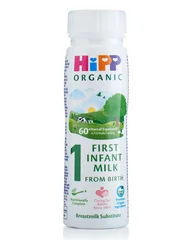 HiPP UK First Infant Milk ready to feedGB2227-04 · 200 ml bottleEnglish label, the earlier recipe, room temperature or warmed, charts a baby to twelve months.
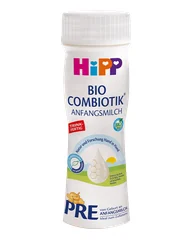 HiPP German PRE ready to feed2227-05 · 200 ml bottleGerman label, the 2026 recipe with taurine, room temperature or a warm water bath, charts a baby to six months.
Key takeaways
- HiPP's 2026 German print, 2227-05, raises magnesium and adds taurine; the British bottle still lists the earlier recipe.
- Every other row both labels print matches, so a German bottle from the earlier print is the same milk as the British one.
- Both labels now allow the feed at room temperature; the German one says to warm it, if at all, in a water bath to about 37 °C.
- The British feeding guide runs to twelve months with a weight beside each age; the German one stops at six.
- Which you can buy depends on where you are: the importers this site tracks ship the German bottles, and none ships the British ones.
How do the two bottles compare?
| HiPP UK First Infant Milk ready to feed | HiPP German PRE ready to feed | |
|---|---|---|
| Age | From birth | From birth |
| Size | 200 ml bottle | 200 ml bottle |
| Article code | GB2227-04 | 2227-05 |
| Base | Cow's milk: whey product, skimmed milk and cream | Cow's milk: whey product, skimmed milk and cream |
| Protein | 1.3 g | 1.3 g |
| Carbohydrate | 7.0 g · Lactose only | 7.0 g · Lactose only |
| Starch | No | No |
| Fat | 3.6 g | 3.6 g |
| DHA | 13.2 mg | 13.2 mg |
| GOS | 0.3 g | 0.3 g |
| Combiotik | GOS only | GOS only |
| Scoop | None: ready to drink | None: ready to drink |
| Price at Organic Life Start, United States | Not sold by Organic Life Start | Not sold by Organic Life Start |
Nutrition from each product's panel, fetched 25 September 2026.
The article numbers tell the story before the table does. Britain's is still GB2227-04, while Germany's has moved on to 2227-05, the print HiPP marks as an improved recipe.12
On the labels' full panels, magnesium is the row that moved: 6.0 mg per 100 ml in the German bottle against 4.5 mg in the British one. The German label also adds taurine, 3.3 mg, which the British label does not list at all.12
What do the two labels tell you to do differently?
Less than they did. HiPP UK says the milk may be given at room temperature or warmed, as you prefer. The German reprint now says much the same: room temperature, or warmed in a water bath to about 37 °C. The earlier German print asked you to warm it and gave no cold option.12
Hygiene is written out more fully in Britain: sterilise the feeding bottle and teat first, and throw away a poured feed within two hours. The German sleeve says to feed at once and discard what is left, without the hours.12
Both say the same thing about the microwave, in the same words: do not, because hot spots can scald.12
Why do the feeding guides differ?
The British guide runs to twelve months, gives a typical weight beside each age, and falls after six months as solid food takes over. The German chart stops at six months and gives no weights.12
Where they overlap they agree: 70 ml a feed in the first fortnight, 200 ml at five months, with the same number of feeds a day.12
Do the other bottles match?
The follow-on bottles do. HiPP UK's Follow On Milk and the German liquid Stage 2 carry the same values, though the British label breaks the fibre down into galacto-oligosaccharides where the German one prints fibre alone.34
After that the ranges part company. Britain has a 470 ml first milk and a growing-up milk that Germany does not sell as liquids, and Germany has an HA PRE bottle that Britain does not.13
Which can you actually buy?
Questions parents ask
Are the German and British ready-to-feed bottles the same?
Not any more. The German PRE bottle's 2026 print declares 6.0 mg of magnesium per 100 ml against the British bottle's 4.5 mg, lists 3.3 mg of taurine the British label does not, and adds a whey powder product to the ingredients. Every other row both labels print is the same.
What else differs between them?
The paperwork. Britain's feeding guide runs to twelve months and pairs each age with a weight; Germany's stops at six months and gives no weights. Britain also tells you to sterilise first and to use a poured feed within two hours.
Which one should I buy?
Whichever your country sells. Both are infant formula made to the same EU composition rules, and we found no evidence that either recipe does better for a baby. Being able to read the instructions on the pack in your hand matters more than the magnesium row.
Does the British follow-on bottle match the German Stage 2?
On the values, yes: energy, protein, fat, carbohydrate, lactose, DHA, iron, vitamin D and calcium all match. The two labels print different rows, though. HiPP UK breaks the fibre down into galacto-oligosaccharides, where the German label gives the fibre figure and stops, so the British page answers a question the German pack leaves open.
Where is each one made?
Both first milk bottles say Germany on the label. The British follow-on and growing-up bottles say Austria, so the British range is split between two plants.
Can I buy the British bottles in the United States?
Not from any seller this site tracks. The importers who ship HiPP across the Atlantic carry the German bottles, and the British ones stay in British shops and on HiPP UK's own site, which delivers within the United Kingdom. The German bottle is the one to buy there, and a case may still hold the earlier print.
Why did HiPP change the German bottle?
The label calls it an improved recipe and marks taurine as new, and says nothing more. We will not guess at a reason.
Is one label stricter than the other?
On hygiene, Britain: it opens by telling you to sterilise the bottle and teat, and puts a two-hour limit on a poured feed. On warming, Germany is more exact, naming a water bath and a temperature where Britain says only to check the milk before you feed it.
Do the two have the same allergens?
Yes: milk, and nothing else. Neither lists fish oil, because both take their DHA from the microalga Schizochytrium and their arachidonic acid from Mortierella alpina oil. The powders of the same names do list fish oil, and declare fish as well as milk.
How do I tell the German prints apart?
By the article number on the sleeve: 2227-05 is the 2026 recipe, and the print before it ends in 04. The new sleeve also says verbesserte Rezeptur, improved recipe, on the front.
Sources
- HiPP UK, product page for HiPP Organic First Infant Milk Ready to Feed 200ml article number GB2227-04, the ingredient list, nutrition per 100 ml with magnesium and no taurine, room temperature or warmed, sterilise all equipment, the two-hour rule, the feeding guide by age and weight to twelve months, Product of Germany fetched 25 September 2026
- HiPP pack artwork for HiPP PRE Bio Combiotik trinkfertig 200 ml (2227-05), version V1 05/26 article 2227-05, marked verbesserte Rezeptur: magnesium and taurine per 100 ml, a whey powder product and taurine, marked new, in the ingredients, room temperature or a water bath to about 37 °C, no microwave, the feeding chart to six months, Hergestellt in Deutschland fetched 25 September 2026
- HiPP UK, product page for HiPP Organic Follow On Milk Ready to Feed article GB2223-01, the galacto-oligosaccharide figure as all of the fibre, Product of Austria fetched 21 September 2026
- HiPP pack artwork for HiPP 2 Bio Combiotik trinkfertig 200 ml (2225-01), version V1 08/24 the German liquid Stage 2: the same values, a fibre figure with no galacto-oligosaccharide breakdown fetched 21 September 2026
- NHS, Types of formula ready-to-feed tends to be more expensive and, once opened, needs to be used more quickly fetched 21 September 2026
Corrections (1)
- The page had said the German PRE bottle and HiPP UK's First Infant Milk bottle are the same milk, with every value the same, and that only the British label allows a room-temperature feed. HiPP changed the German bottle in 2026: its new print, article 2227-05, declares 6.0 mg of magnesium per 100 ml against the British bottle's 4.5 mg, adds taurine at 3.3 mg and a whey powder product, and allows the feed at room temperature or warmed in a water bath to about 37 °C. The page now says so. A German bottle from the earlier print, 2227-04, is still the same milk as the British one.