HiPP formula foam, clumps and smell

The answer
Foam, a faint fishy smell and small clumps all have explanations printed on the pack. HiPP's powders declare fish oil, its labels ask you to shake the bottle hard, and they ask for water at 40 to 50 °C, which is cooler than powder dissolves easily in. What you can see and smell is also not what recalls are about: the four official HiPP alerts on record were two allergen labelling faults, an iron level and criminal tampering. Check the batch rather than the bottle.
Key takeaways
- Every HiPP powder this site records declares fish oil. The ready-to-feed bottles take their DHA from a microalga instead and declare no fish.
- The oil is there by law: Regulation (EU) 2016/127 made adding DHA mandatory.
- HiPP's own instructions produce the foam and the clumps, asking for a hard shake and for water at 40 to 50 °C.
- HiPP publishes no note about foam, clumps or smell, so nobody is confirming or denying it for its own product.
- No alert on record concerned appearance or smell. Your nose is not the test; the official batch list is.
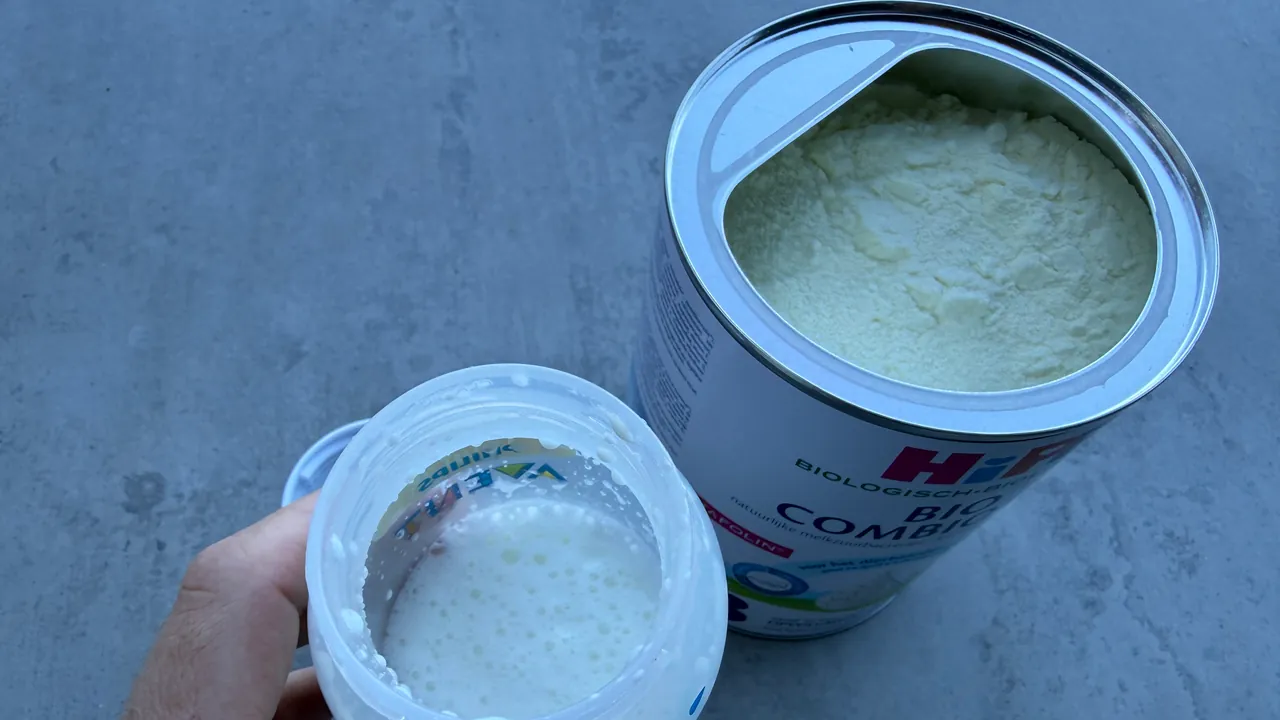
Why does HiPP powder smell of fish?
Because there is fish oil in it, and the ingredient list says so. On the German PRE box it sits between the galacto-oligosaccharides and the potassium chloride, beside a second oil most parents have never heard of, from the fungus Mortierella alpina.1
The oil is not a flourish. Regulation (EU) 2016/127 made adding DHA to infant formula mandatory, where it had been optional before, so every formula sold in the European Union has to get DHA from somewhere.4
HiPP gets it from two different somewheres, and that is why two HiPP products can smell unlike each other. The powders declare fish oil. The ready-to-feed bottles name oil from the microalga Schizochytrium and declare no fish at all.12
Why does it foam so much?
Why are there clumps, and do they matter?
Mostly because of the temperature HiPP asks for. The label wants the water cooled to 40 to 50 °C before the powder goes in, and it prints its reason: do not pour boiling water over the powder, so as not to damage the natural lactic acid bacteria.31
That is a trade HiPP has made on your behalf. Cooler water protects a live culture and dissolves powder less readily, and you are holding the result. The British packs take the other side of the same trade, putting the powder into water within 30 minutes of the boil.83
They do matter, for a duller reason than spoilage. Powder still clumped in the bottle is powder your baby did not drink, and the dilution printed on the pack assumes it went into the milk.1
What does a pack that has gone wrong look like?
Like a damaged pack, rather than like odd milk. The ready-to-feed sleeve asks you to satisfy yourself before use that the packaging has remained intact, and says the bottle is packed under a protective atmosphere, which is the seal you are being asked to check.2
The powder box carries the warning that EU law requires it to carry: improper preparation and storage of the prepared feed can harm health, for instance through the growth of unwanted germs. That sentence is about what you do with the pack, not about what the powder looked like when you opened it.1
So the things worth acting on are a tin that has been wet, punctured or dented at the seam, a bottle whose seal is not intact, and a pack kept somewhere hot or damp for longer than the 3 weeks the label allows after opening.12
When should you stop and check the batch?
Whenever you have a reason that is not the smell. Here is why: of the four official HiPP alerts this site records, not one could have been detected by looking at the milk.56
Fish oil left off a label in December 2019, which named three batches. Celery not emphasised on a jar label in April 2026. Criminal tampering with jars in Austria in April 2026, after which HiPP withdrew its whole jar range at one retailer as a precaution.5677
Two of those were allergen labelling, one was a composition figure and one was a crime. All four were invisible in the bottle, and two of them were the opposite of a smell: an ingredient that was present and unlisted.56
Products mentioned
 HiPP German PRE
Sold HiPP German PRE ready to feed
Where to buy
Questions parents ask
Why does HiPP formula smell fishy?
Because it contains fish oil, which the ingredient list on every HiPP powder this site records declares. It is in there to supply DHA, and the ready-to-feed bottles smell different because they use oil from a microalga instead.
Does the fishy smell mean the tin has gone off?
The smell is an ingredient, not a verdict. HiPP publishes nothing about how its powder should smell, so we cannot offer you a description to compare yours against, and no official alert on record has concerned smell. If you doubt a pack, the batch list for your market is the thing that answers it.
Why does HiPP foam so much when I shake it?
The label asks you to shake the closed bottle hard, and a hard shake beats air into milk. HiPP prints no note about the foam that follows.
Why will HiPP powder not dissolve properly?
Largely because of the temperature its own label asks for. HiPP wants the water at 40 to 50 °C and says why, to avoid damaging its lactic cultures, and that is cooler water than powder dissolves easily in. The British packs put the powder into water within 30 minutes of the boil, which is far hotter.
Do clumps mean my baby is getting the wrong amount?
Powder left clumped in the bottle is powder your baby did not drink, and the dilution the pack prints assumes it dissolved. That is the practical reason to keep shaking rather than to stop worrying about it.
Why does the ready-to-feed bottle smell different from the powder?
Different ingredients. The bottle's list names oil from the microalga Schizochytrium and no fish at all, and it also carries an added emulsifier, where the powder has fish oil and a fungal oil from Mortierella alpina. Both carry about the same DHA, which is the point of either oil.
Does HiPP say anything about foam, clumps or smell?
Not that we can find, on any pack or page. The labels give the instructions that cause all three and stop there.
My new tin looks a slightly different colour. Is that a problem?
We cannot tell you a shade is normal, because HiPP does not describe an expected colour and we have found no published account of how much its powder varies between batches. What we can tell you is that no HiPP alert on record concerned the look of the powder, and that the batch list is the only thing that settles it.
What have HiPP's actual recalls been about?
Four on record, none visible in the bottle. Fish oil left off a label in 2019, celery not emphasised on a jar in 2026, an iron level below the American minimum on formula an importer took into the United States in 2021, and tampering with jars in Austria in 2026.
When should I stop using a pack?
When the pack itself is wrong rather than when the milk looks odd: a tin that has been wet, punctured or dented at its seam, a bottle whose seal is not intact, or a batch that appears on the official list for your market.
Should I switch formula because of the smell?
Switching between HiPP powders will not change it, because they all declare fish oil. Only the ready-to-feed bottles leave it out. A switch your pediatrician asked for is a different question.
Sources
- HiPP pack artwork for HiPP PRE Bio Combiotik 600 g, version 7 (May 2025) the ingredient list, which names fish oil and Mortierella alpina oil among the vegetable oils, lactose and galacto-oligosaccharides; boil fresh water and cool it to 40 to 50 °C; do not prepare the feed with water that is too hot; the warning that improper preparation and storage can harm health through the growth of unwanted germs fetched 22 September 2026
- HiPP pack artwork for HiPP PRE Bio Combiotik trinkfertig 200 ml (2227-05), version V1 05/26 the ingredient list, which names oil from the microalga Schizochytrium sp. and lecithins as an emulsifier, and no fish oil; packed under a protective atmosphere; satisfy yourself before use that the packaging has remained intact fetched 25 September 2026
- HiPP Netherlands, label of HiPP 1 Bio Combiotik (NL2472-03) the five preparation steps: the cooled water into the bottle first, the scoop filled loosely and levelled off, the bottle closed and shaken hard, and the footnote advising against pouring boiling water over the powder so as not to damage the natural lactic acid bacteria fetched 22 September 2026
- Regulation (EU) 2016/127, recital 20 the mandatory addition of docosahexaenoic acid to infant formula and follow-on formula is a new requirement introduced by this Regulation, where it had been allowed on a voluntary basis under Directive 2006/141/EC fetched 22 September 2026
- FSA, food alert FSA-AA-105-2019 HiPP Organic Combiotic First Infant Milk starter packs recalled in December 2019 because fish oil was not declared on the label; batches L-099191, L-162192 and L-186191 fetched 21 September 2026
- FSA, food alert FSA-AA-23-2026 a HiPP Organic vegetable lasagne jar recalled in April 2026 because celery was not emphasised on the label; batch B49311 fetched 21 September 2026
- AGES, product warning for a HiPP vegetable jar, 190 g criminal tampering in April 2026, after which HiPP recalled its whole jar range at one Austrian retailer as a precaution; the warning was lifted in May 2026 fetched 18 September 2026
- HiPP UK, product page for HiPP Organic First Infant Milk the British preparation instructions: boil fresh water and leave it to cool for no more than 30 minutes before making the feed fetched 18 September 2026
Corrections (0)
None since this page was published. How we correct mistakes